Pageviews past week

The cold world of skimo & alpine climbing

The cold world of skimo & alpine climbing
Showing posts with label climbers. Show all posts

Wednesday, April 20, 2011

Huntington....

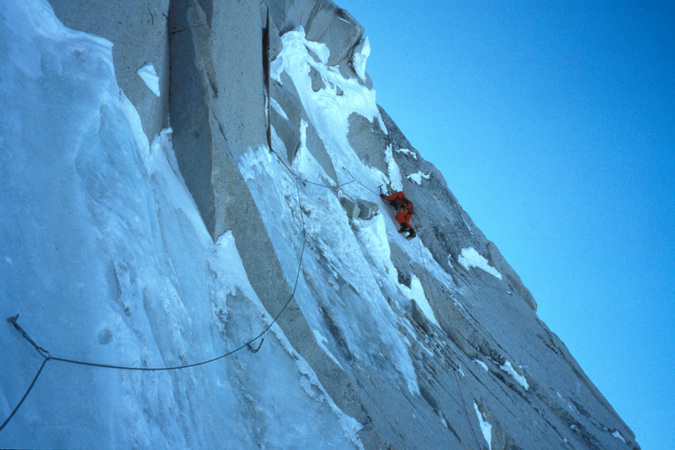
Mt Huntington's, North face on the left, French Ridge aka NW Ridge center and the West face with the Harvard Route on the rib and just out of sight on the far right side, the Phantom Wall.  Phantom Wall was first climbed by Jay Smith and Paul Teare on their third attempt in 1991.  It has not had a second ascent despite a number of strong attempts.

More here:
http://www.alpinist.com/doc/ALP14/climbing-notes-tackle
http://www.climbing.com/news/hotflashes/huntingtonapp/


Mark Westman kindly allowed me to post his hi-def picture of the right side of  the West face of Huntington.  The Harvard Route takes the left hand spur in this picture.  Phantom Wall is directly above the climbers.    "Jared Vilhauer and Tim Dittmann making an attempt on the Phantom Wall last Saturday".  Make sure you dbl click both photos for full effect.  Thanks Mark!

"

Tuesday, April 19, 2011

News from Shisha Pangma on Ueli Steck...

18/04/2011 - by Planetmountain


"Ueli Steck top speed solo on Shisha Pangma

On 17/04/2011 Swissman Ueli Steck ascended Shisha Pangma (8027m), Tibet in record time.

After a month acclimatising in the Khumbu region, Ueli Steck has kicked off his Himalayan season with a bang: in a mere 10.5 hours the Swissman climbed

Shisha Pangma, at 8027m the 14th highest mountain in the world.

Making the most of the weather window Steck set off from ABC at 5800m at 22:30 on Saturday at 22:30, and climbed the SW Face in 10. 5 hours. 20 hours after departure he was already back in Base Camp. The blitz climb was carried out alone, after his partner Don Bowie's wise forfeit since he did not feel perfectly acclimatised.

Details here:
http://www.uelisteck.ch/en/news/news/230-erfolg-am-shisha-pangma-detailbericht.html

Shisha Pangma is Steck's third 8000er, after Gasherbrum II in July 2009 and Makalu in September that same year. The alpinists have now time to celebrate: they're already focused on the next objective, Cho Oyu (8201m). Naturally to be climbed in Ueli Steck style, i.e. in record time."


Notes from::
http://www.planetmountain.com/english/News/shownews1.lasso?keyid=38082


More on the peak and a previous solo of the Soulth Face by American, Chris Warner, on his 16:40 hour  summit climb.  See Chris' comments (comment section) which made me aware of his climb in 2001.   And the link to his trip report on Shared Summits.

http://www.sharedsummits.com/index.php/Shishapangma-2001.html

http://www.8000ers.com/cms/shisha-pangma-general-info-198.html


Ueli Steck's Project Himalaya from Mountain Hardwear on Vimeo.

Thursday, April 7, 2011

Fast and light...but SHEEEEET!

My buddy Jack Roberts and I were chatting while having a nice warm cup of coffee Chamonix.  I mentioned something about Colin Haley and his times frames climbing a le Droites-le Courtes combo.  Jack mentioned something about Colin being fast in the mtns (El Cap and Hal Dome in a day or the Cassin in a day seemed to register) and according to Jack those weren't "normal" (more likely he meant not normal for old guys)  time frames.

One definition of fast and light:   Colin Haley simu soloing at this point and about to start simu climbing.


photo courtey of Colin Haley, http://colinhaley.blogspot.com/.

Jack aint exactly normal himself (just look at his feet and is past resume in the mtns and you'll understand that statement) so comments like that stand out in a conversation.

Anyway I digress.

These is so much "bull shit" to fast and light.    You aint going to go fast if you aren't going light.  More to the point and more important to me personally is you aren't going to be going fast if you are too cold.  But no way in hell will you go fast if you are too hot.   

"Say what?  What are you talking about now Dane?  Light?  Fast?  Cold?  Hot?"

Here is my thought on it.  To go fast you have to go light.  To stay warm you have to keep moving.  If the climbing is too hard for your skill set or too slow because of your comfort level the idea of fast and light hits the ZERO fun button pretty quickly.

To climb fast and light both climbers obviously have to climb quickly.  In the mtns, rock, ice and mixed...the second needs to be half the time of the leader.  That takes some effort generally and you have to want it.  Better yet simu clim or simu solo. Which is why I pay so much attention to my umbilicals.

To climb fast you can't over dress, but neither can you afford to get really chilled.  Add too many clothes and you can't climb in them or over heat instantly when you do start climbing.

Cold will numb the body given enough time, but worse yet it will numb the mind if you allow it to.

And I have allowed it.

Pushing the conditions (climbing in lots of new snow) made several of our recent climbs really slow.  Really slow.  Seldom have I been so uncomfortable in the mountains, slow.  To stay warm at the belays in the shade at 12K feet in -20 temps took some effort.  It only takes one of those trips to encourage you to take enough clothes the next time.  Having your core get chilled and shivering on belays and then not being able to generate enough heat to warm up on lead or while following can be mentally and physically disabling.

For an old fat guy I pride myself on the speed at which I can climb technical ground and the lwt weight clothing systems I choose to do so in.  But to climb fast and dress light I have to be able to closely monitor and control my body core temperature.  Which means I have to be able to climb quickly and spend little time on the belays.

Terrain, conditions and the team's skills will define the speed at which you climb.  The idea is to hit the perfect balance between those three and your gear selection.  

Here is a good comparison:

I am wearing a Atom SV plus an  Atom Lt and likely two lwt hoodies under that combo, with NWA salopettes and two pair of longs under them.  It took that to stay warm at the belays.  The SV would come off mid pitch if we belayed and was in the pack when we climbed together.  Even with just an Atom LT on as an outer garment climbing together I was too warm.  But if I had stopped for any length of time I would have chilled my core.

Better answer?  We should have simu climbed the entire route together (which would have required a stronger and/or more skilled team)  and I should have had a lighter outer shell available (my poor gear choice).


For this one  I am using a Gortex hybrid shell jacket, a lwt Merino wool sweater and a pair of Gamma LT pants with no longs.   If I had stopped or had to belay....no question I would have chilled my core in a very short amount of time.  Better answer?  One pair of longs would have made this a much more comfortable (mentally) combination.  Physically, for this climb, this day it was a perfect combo for soloing.  But it was also very obvious to me I didn't want to stop for long either. 


I'm still learning.  And the best lessons are still painful.  But every lesson makes the game easier in the long run.

Monday, April 4, 2011

When the numbers just don't add up.....

I had a few interesting conversations over the last two months on alpine, rock and ice conditions and ratings.

One comment was, "I'm not worried about the ice, how much harder than Canadian WI5 can it be."

Another, "The Eiger!  It is only 5.7 right?"

"The route...it is easy to find....watched 3 videos of it last night."

"Must have had better conditions."

All these from friends of mine.  My thoughts at the time went something like this.....

WI5...is generally easy compared to 300m of rock hard 55 degree alpine ice under 2 or 3 feet of snow stuck on the end of the day ....at 12K feet.

The Difficult Crack seemed like 5.11r in boots, crampons, a big pack and a coating of verglass at first light.

This after being shattered on a trade route in -20C temps, 20cm of new snow and a stiff wind.   We had no clue where the route was suppose to go.   And I was hard pressed to believe it actually did/would  go where we went.....

"Welcome to Chamonix, it is always, all about conditions...."

Alpinism...it is always a good laugh and generally gets the last laugh as well  :-)


Some of that "easy" 50 degree alpine ice.


Alpinism?

If you aren't aware of the fact, the blog format  details very accurate data on use and visitors.  So I see where the traffic comes from by country and URL both.


Photo courtesy of Ally Swinton, his Nomic with a C/T hammer, solo on the North Face of the Midi 

The majority of the use is from the US and Canada followed closely by the UK and then virtually every alpine country in the world follows.

The US numbers would seem to be a given.  I post enough on Canadian and the UK climbing web sites that it isn't a surprise there.  The rest of the traffic is.

I hope those that already know this will pardon me restating the obvious for us in NA.

Last year a couple of friends asked me how to better learn "alpinism".   What ever that means to you.  For many here in the NW that might mean climbing Ptarmiganm ridge as the ultimate goal or the North face on Mt Temple in the Rockies.  For others the Cassin on Denali.  Big jump between the three.

And any one of them worthy goals.

When I look back at 40 years of alpine climbing the one place that defines the sport and generally the climbers I admire it is Chamonix.  Climbs like the MacIntyre-Colton on the Grand Jorasses define alpinism to me.

There are a couple dozen climbers I suspect in Chamonix-Courmayeur area (or who climb there on a regular basis) that we have never heard of, that have done more hard alpine climbing than anyone from the US, past or present.

Bold statement, I know.

But then, do you know the guy who not only broke Ueli Steck's speed record on the Ginat this winter and  carried skis up and over while doing it?  Yes. alpine climbing is all about conditions.  And the Ginat had steps up it earlier in the in the winter.   But still...anyone know this guy or his time?

Chamonix is a big and complex area, has an amazing amount of climbing, (more than any one person will ever do in a life time)  and super easy access (but not as easy as it first appears).  Generally you will be climbing above 11,000 feet if you want to climb on the bigger faces.  And best of all the rock is stellar in comparison to Canadian limestone and the weather stunning in clarity if rather harsh (Alaska harsh) in the storm cycles when they do arrive.  Nothing like it for terrain in North America outside Alaska.


Bottom line here?  If you want to learn what the state of alpine climbing is in the world today...or get better at your own alpine climbing in the shortest amount of time involved, you simply must climb (and you must ski)  in Chamonix. 

Lots of places to rock climb in the world.  Yosemite one of the best.  Just as many of us have learned a lot in Yosemite it isn't the end all to rock climbing.  Close may :)   It might well be the one destination you must make it to if you rock climb.  Chamonix is the one place you must visit if you alpine climb.

Take a look at Colin Haley's blog during March and April over the last few years to put the climbing access and skiing into perspective.

http://colinhaley.blogspot.com/2010/04/back-in-chamonix.html

I have a few months worth of writing and opinions to catch up on.  Most of that is based on this year's Cham experience.  Some of it a surprise even to me.

Sunday, February 13, 2011

DEEP THOUGHTS WITH COLIN HALEY

By: Steve House

http://www.sportiva.com/live/page.php?id=48&at=24
 
More here:
 
http://colinhaley.blogspot.com/2010/11/exocet-solo.html

Solo on the Cassin?

I asked my friend Cosmin Andron to share some of his experience on the Cassin last spring.
Solos are always a journey.  This one no less so.


"It’s been snowing for days and I am going bonkers at the Ski Hill (NE Fork) camp (cca 2400 m alt.). Tent bound since the 13th of June I start doubting I’d be able to get on the “Cassin” on this trip and I’m getting sure my acclimatization is wearing out by the hour now… I’ve listened my music, I’ve read my books, I’ve weighted my options all the while the snow was incessantly falling…


Then it’s 20th morning and the sun is shining and the skies are clear. Mark, back at KIA, mentioned something about a break in the weather for the weekend and I guess this must be it. I am weighting my options: go light – no tent, no sleeping bag just the stove, my Sirius down jacket and compressor pants and some bars and gels. Or plan for a three days ascent and go heavy: tent, sleeping bag, food, haul line in case I need to pull my bag, some cams and screws in case I need an anchor… It’s all about weight and weighting my options.

I’ve never done the route and weather proved to change swiftly. I may have lost my acclimatisation while doing book-worm work in my tent for the last seven days. Caution takes over the judgment steering and I opt for the heavy option; and heavy it is. "


More of the story here:

http://www.cosmin-andron.com/2010/07/cassin-ridge-solo/


Cosmin picks up the story here with the gear list he used and what he might suggest or use himself now listed in the 2nd column..


Cosmin sez:

Before I left for the Cassin Ridge I was worried that I spent too much time (7 days) at low elevation (NE Fork) and that the weather window won’t last longer than that day. I knew the route was long and all I had was a printed topo. I had to make a choice if to go light or go prepared to stick it out. From the info I had (through the grapevine) was that a Russian team did the route while I was in 14000 ft Camp and they spent 4 days on it. I prepared for 3, but I thought luxurious 3 so I can extend to 5 or 6 if needed.


Not knowing what was the condition of the route I took enough gear to protect some pitches if necessary.

I am usually cold so I erred on the side of warmth rather than lightweight.

With such a gear load and bivy equipment my priority was not to move very fast but safe, which meant that I spent a whole day listening music on Cassin ledge, waiting for the night and firm snow conditions. Second day I wasted half of it wandering lost within the first rock band.

In 2010 I started climbing at 4am on 21 June. By 8am same day I was finishing setting up my tent on Cassin ledge and took some photos. I spent the whole day (very warm day) on the ledge listening to music. On 22 June at 12:45am I set off. I am at the hanging glacier early morning. I wasted 2 to 3 hours fixing my broken old Jetboil. I spent 1 hour eating and hiding from the sun. Lunchtime I entered the first rock bad, had a rest near M shape d rocks and spent the next 4 or so hours climbing up and down looking for the route. I joined a pair of Canadians that came up and found the bivy spot with them early that evening. On 23 June I left the bivy spot around 2:30pm (allowing the Canadian team three hours advance). By 9pm on 23 Jun I reached the bivy spot above the 3rd rock band (5350m) and the Canadian pair who were just cooking dinner. They left early morning on 24 June, for the summit. I packed up at 4pm and left for the summit at about 4:30pm. I was on the summit at exactly 11pm.


All in all the bag was quite heavy for what I am accustomed to and I haven’t used quite everything. The pro I used was:

- an ice –screw belay 50 up from the ‘shrund on the Japanese couloir so I can haul my backpack over it. (I fell into the ‘shrund while trying to climb it with my backpack on when the snow collapsed)

- the rope to haul the backpack in the Japanese couloir, and twice while climbing off-route in the first rock band

- the rope to abseil four/five times within the rock bad (used natural anchors)

- camalot # .5 and 60cm dynema sling


I had dual points on my Cyborgs and combined with the heavy backpack and hard ice or crumbly ice I had to kick twice/thrice to stick it. When I climbed without the backpack on, it went smooth. Besides climbing lighter, next time I’d stick to monopoints….

Having a third tool (first time ever) was a good choice. On the last abseil within the first rock band I clipped my Cobras on my ice-clippers and because of the tangle I unclipped the umbilical. I flicked the rope over my right hip, the Cobra snagged and unclipped and tumbled down the pitch and stopped on a shelf. Just then the Canadian pair was coming up so they brought it up, but it was comforting knowing I had another tool in my backpack.

Below I made two lists. In the first one is what I had in June 2010. In the second list is what I would carry now if I were to do it again. I believe that with a partner, with an tweak in gear, in similar conditions and
climbing competently we could do it with two bivis and leading on a single 8.1 Iceline (not recommended by the manufacturer). Trying it alone again, with the benefit of current knowledge of the route and with a lighter pack I believe I could do it without a bivy. In neither scenario I am planning on super fast ascents.


gear in June 2010                       if I were to do it again                      

Equipment                                         Equipment                                              

BD Speed 40L (with lid)                 BD Speed 30L (no lid)                       

BD Cobra (pair)                              BD Cobra (pair)                                


Grivel leash                                     BD Spinner leash                                  

Grivel Matrix Light hammer            Grivel Quantum Light hammer -

BD Cyborg crampons                        BD Cyborg crampons                        

Grivel helmet                                      BD Half dome helmet

BD Camalots ( .5, .75,1, 2, )              BD Camalots (.5) BD

BD Express screws (4)                        BD Express screws (1)

Titanium pegs (4)                                   Titanium pegs (2)

BD nuts (5) - -

BD Neutrino (16)                                BD Neutrino (6)

BD Dyneema 60cm (8)                       BD Dyneema 60cm (3)

BD Dyneema 12cm (2)                       BD Dyneema 12cm

CT Oval locking biners (3)                   CT Oval locking biners (1)

BD Oval wiregate biner                        BD Oval wiregate biner

Kong Duck (2)                                     Kong Duck (1)

BD ATC guide                                     BD ATC guide

Arc’teryx M280 Harness                          Arc’teryx M280 Harness

Beal Iceline 8.1mm (1X50m)                   Beal IceTwin 7.7mm (1X50m)

Mammut 5mm X 5m-                             Mammut 5mm (1X2m )


Bivy gear                                                  Bivy gear

BD Firstlight tent                                    
Valandre Odin Sleeping bag                 

Foam matteress                                                             

Jetboil and small canister )                      Jetboil and small canister


Food Food

Adventure Food – B-fast (3)                

Adventure Food – Meal (3)                 

Adventure Food – Dessert (4)             

Powerbars (6)                                           Energy bars (5)

Sweets (100g)                                          Sweets (50g)

Isostar powder (100g)                               Energy drink powder (50g)


Clothing                                                   Clothing

Arc’teryx Rho LT top                               Arc’teryx Rho AR top

HH bottom                                               Arc’teryx Phase AR bottom

Arc’teryx Gamma Salopette                       Arc’teryx Gamma Salopette                    

Arc’teryx Accelero Pullover

Arc’teryx Gamma MX Hoody                     Arc’teryx Gamma MX Hoody


Arc’teryx Dually Belay Parka                        Arc’teryx Atom LT Hoody

Valandre Syrius Down Jacket                        Valandre Syrius Down Jacket

MH Compressor pant                                  Arc’teryx Alpha SL pant


Smartwool Hiking Liner x 2                            Smartwool Hiking Liner

Smartwool Mt Extra HW x 2                          Smartwool Mt Extra

BD Guide (old) gloves x 2                              BD Punisher gloves

BD Absolute (old) mitt                                  BD Absolute mitts

Valandre down mitt                                  

Valandre down botties                             

Arc’teryx embroid cap                                  Arc’teryx embroid cap

No-name fleece balaclava                               Arc’teryx Rho LT Balaclava

La Sportiva Spantik                                        La Sportiva Spantik

BD gaiters                                                      BD gaiters


Accessories                                                   Accessories

Salice googles                                                     googles

Iridium satphone                                               Spot device

Cassio Pro-Trek watch                                   Cassio Pro-Trek watch

Keymaze GPS watch

iPod Shuffle music player                               iPod Shuffle music player

BD Mt walking poles (pair)                         

MSR snowshoes                                              W Rib access to route

Nalgene bottle                                                   Nalgene bottle

Camera                                                             Camera

Thursday, February 10, 2011

You don't know Jack!

The NW face of M.t Kennedy, "A pair of Jacks"  Jack Roberts and Jack Tackle 1996

OK, Pete Takeda has been telling me he was going to write that line, "you don't know Jack!" for half a decade now about Jack.   I'm still waiting but no story?    So I finally stole the line..  (my apologies Pete but I'll make it up to you and your blaster some how;-)

 "So You don't know Jack!"

As in Jack Roberts. and "The Timeless Face" on Mt. Huntington or the epic new route on the SW face of Denali.

1978 North Face of Huntington, Jack Roberts and Simon McCartney, summit reached on July 6, 1978.

"Timeless Face VI 5.9 WI5, McCartney-Roberts). Simon McCartney and Jack Roberts climbed and hid from objective dangers and avalanches for five epic days to gain the summit.   Taking  five more to get down  and reach their base camp.   Pounds lighter for the experience.  It remains unrepeated as of 2010.  And apparently no known suitors in tow.  Alpinist 20 has a good write up on the history of Huntington,

Jack collected a few good second ascents early on in Yosemite including the Shield, Cosmos, Tis-sa-ack, The Zodiac and many FAs in the High Sierras.

But ice and alpine has been his real forte over the years. In Canada the second free ascent and third overall of Polar Circus, first winter ascents of Robson's North Face and Kitchener's Grand Central Couloir. In Alaska he has made four FAs in the Kichatna Spires, Huntington's NW Face, the SW face of Denali and on the NW face of Mt. Kennedy to the NW Ridge.  And a fist full of good routes in  the Alps as well.

So Jack has been around some and likely does know something of big walls, alpine and ice cliimbing.

From the La Sportiva web site.
"Do you have a claim to fame?"

"Jack sez: The reputation of the shape and condition of my toes and feet have made me infamous. Even Reinhold Messner wanted to see them! Also, I'm the only male Sportiva athlete to appear in a dress in any ad.

"What really scares you about climbing?"

It's very easy to mistake the sensation of feeling omnipresence for omnipotence and get severely hurt trying to understand the difference.

"Do you wish you had sexier feet?"

No one has sexier feet than I have. Didn't we have this discussion earlier?"

I've seen Jack's feet..and understand why Messner would ask.  Trust me..you don't want to ask.

  The Timeless Face- Huntington

The Roberts/McCartney line is pretty much a plumb line from the right hand summit knob to the rock buttress below the lowest hanger just right of center.


Jack's recently drawn topo of the line.  Be sure to dbl clik this one.


Some speculation on this climb in the community over the last 30 years.  It hasn't been repeated.  Few have tried.  From what I know,  most of the speculation came from one source. Simon McCarthney virtually disappeared after the new route on Denali and final rescue, which hasn't helped.  Does any one know Simon's where abouts today?   A party that summitted shortly after Roberts and McCartney wrote of being surprised at seeing their foot prints coming up the North Face.   More recently a set of stuck and chopped ropes suspected to be from Roberts and McCartney were found melted out, near the Nose, on the Harvard route, long buried under the snow and ice there.   I have no reason to doubt the ascent.


Jack is always in it.  Guiding full time, writing on occasion and still climbing hard.  March of 2011, underneath le Droites, N. Face, Chamonix.


What does Jack think are 10 winter climbing tips that are worth writing down?

TECH TIPS WINTER


10 WAYS TO SPEED UP YOUR ALPINE CLIMBING

When you are climbing in the mountains you want to be able to move swiftly and efficiently if you want to increase your margin of safety and increase your chances of success. Moving quickly though also usually increases your enjoyment as you feel yourself becoming more adept and sucked into what you are doing at the moment you are doing it. Moving fast doesn't necessarily mean climbing harder. It isn't about getting stronger or becoming more supple. Speed climbing is all about becoming a more cerebral climber and therefore the skills necessary can be learned by anyone. I have listed ten tips that I feel are important and that will help anyone become faster.


RHYTHM

Moving fast in the mountains isn't so much about sprinting from the tent like an Olympic champion but more like being a ultra-marathoner where you find your rhythm and learn how to stick to it. You have to learn and to teach your body the art of maintaining a cadence and pace that suits your body best and that allows you to always move forward hour after hour. This cannot be learned if you are always at your limit both technically and physically. You can however, learn your own personal cadence by practicing on long routes that are a grade or two below your limit and by building upon that. If your limit on single pitch traditional rock routes is 5.10, then try longer routes of up to 5.8. Concentrate on moving with intent. Placing protection. Setting up belay anchors etc. All these factors practiced on longer , less difficult routes will increase your speed and without realizing it you will find yourself being much faster and having more energy.


Move up a grade when you feel like it and practice the same things.

BE EFFICIENT

Do you really know just how long it takes you and your partner to lead and second a pitch? How long does it take for you to sort out the rack and begin the next lead? You and your partner must have a system worked out that takes the minimum of time to complete. Whether it be racking the gear as you follow, setting up the belay, stacking the rope at the belay incorporating speed and still staying safe is critical. As you climb and when you reach the belay NEVER let up on your pace. Set-up the anchors. Stack the rope, keep the rope tight for the second and pass off the gear rack swiftly and immediately. Use the Reverso or an auto-block plate for belaying, thereby allowing you to eat or drink whilst still belaying the second up. While the second is following the pitch he is racking the gear in a prearranged manner so that there is no time wasted when passing the rack between partners. The goal is to move upward at all times. Taking ten minutes at each belay for six pitches is 60 minutes time which can mean getting down in the light or by headlamp.

KEEP IT SIMPLE STUPID

The only way to avoid wasting time is to eliminate the complexity of your systems. A simple way to begin this is to reduce the number of ropes you climb with. Do you really need double ropes or will a single 60 or 70m rope work. This is usually long enough to link pitches together (eliminating the belay sort-out time) and one rope is easier to stack and handle than two. If you need an additional rope for rappelling consider taking a lightweight 7mm) tagline and carry this in your pack or tied onto your back.


The rack can be simplified by reducing the number of cams and nuts to one set each. Cams go in and out faster plus the are easier to locate. Of course deciding how big the rack will be depends on the difficult nature of the climbing but in general most climbers require less protection than they place on their rack. Take more 60cm slings and fewer quickdraws. In this way you encounter less rope drag which is a must when linking pitches together. Rack onto a should sling rather than your harness gearloops. In this way the rack can be switched over from partner to partner with minimum time wasted. Use two pieces of bombproof gear for the belay anchor rather than three and tie off the pieces with your rope instead of using slings. A cord-de-lette works well but does take practice in order to not waste precious time. Have a repertoire of belay techniques you can incorporate depending on the severity of the pitch. Know how to do a shoulder and hip belay. Belay through the belay anchor using just a overlapping close hitch.

KEEP IT LIGHT

Every thing you wear or carry is weight. Even the lightest equipment adds up and will slow you down, tire you out and will contribute to not getting up your desired route unless you give paramount importance to how much each piece of gear and clothing weighs. Can you substitute your heavy oversized carabiners for smaller wire-gates that weight a few grams less. Do you really need 22cm length screws when 17cm length ones work just as well. Can you get away with a smaller and lighter belay device. Do you ALWAYS drink two or three quarts of liquid or generally do you stay dehydrated and drink less? One quart weights two pounds which is quite a lot of extra weight to carry if you don't use it. Drink it or lose it!! Do you really need that extra pair of gloves or cap?


A good way to force a light pack onto yourself is to carry only a small pack and NOT overstuff it. The old adage of "whatever size pack you have you will fill" is very true. Carry a smaller pack and you will have less weight. Think about what weight you can take away not what you can add. In today's climbing culture we have a gimmick for just about any level of comfort or purpose. Thoreau's adage of "Simplify, simplify, above all simplify" is most important here. Don't carry a piece of gear if it only has one use to it. Bubble wrap insulates, is padding and its weight is practically non-existent. Climbing clothing is fashionable clothing. Critique what you wear. Is an item going to be used as equipment or to make you look sexier in the photos? Do you really need a fork and spoon for a bivouac meal or can you do without.

KNOW YOUR PARTNER

Having a partner who is able to move at least as fast or faster than you is critical. If you are always waiting for your partner to catch up it quickly becomes tiring and demoralizing. Understanding how your partnership climbs together, communicates, moves, not only speeds things up but also makes your climb much safer and more fun. Having a clearly defined way to communicate that you both understand helps reduce misunderstanding and increase safety.

MOVE TOGETHER

The single best way to maximize the entire team moving upwards is to move together on moderate terrain. Nobody said that this technique is 100% safe yet when practiced enough by two or three partners who know each other's movements well, this technique (simul-climbing) can be safer than being belaying on ground which may be dangerously exposed to objective dangers. However, this is a technique which must be practiced ahead of time so it is learned and understood well.


Always make sure that when simul-climbing you have one or two points of protection between you. As long as the rope remains relatively taught between each climber everyone is protected. Both climbers should go at a steady pace and treat this technique as if one were soloing. This is especially important when the leader is climbing over the crux and the second is on moderate ground. Another safe option to try is using a Wild Country Ropeman or a Petzl Tiblock to improve safety when climbing.


The leader would place a Ropeman upside down on a very solid anchor and place the rope through it. Placed this way the rope would run easily through it when the leader is climbing. In this manner should the second fall then the Ropeman cam would jam against the rope and stop the fall while not putting any pressure on the leader. A Petzl Tiblock can be used in the same way but is less trustworthy. The Tiblock has teeth which can shear the sheath of a rope. A Ropeman does not have any teeth and therefore will not damage the rope.


It is important to note that when setting up the Ropeman at the anchor it be able to stop and upward AND downward fall, that it be matched to the locking gate carabiner that it is clipped into and that it locks correctly when screwed. This technique seems to work best when using a thin rope. Anywhere from an 8mm to 9.2 works best. Anything bigger and there is too much rope drag. Be sure and play around with this system on something easy so that you understand completely how it works and how to avoid any dangers that might arise.

LEAVE EARLY

Pretty much the earlier you leave for your intended ascent the better are your chances of success or survival. I've had to turn back from many summits early because I ran out of time, ran out of light, didn't get there ahead of the party in front of me etc. all these failures could have been avoided if I'd gotten out of the sack just one hour earlier. Alpine climbing is an adventure and adventures always have unexpected twists and turns. You will be better prepared for the unknown if you and your partner get an earlier than planned start to your day.

DRESS SERIOUSLY

If you want to move fast then dress lightly so that you don't become too warm and comfortable. Dressing seriously means that you wear a baselayer underneath a windproof top (pants and bottoms) and you use movement as a means to keep warm. Should you slow down enough whereby you get chilled and start to get very cold then ADD an insulating layer on top of what you are already wearing. If you really want to see how light you can go purchase a micro wind/water-resistant nylon shell from Go Lite or Patagonia along with a thin silk balaclava, liner gloves, Petzl Tika headlamp, a few GU packets into a chalk bag and wrap your lightweight insulating jacket around your waist for speed.

DRINK AND EAT

Sometimes nothing is more debilitating than becoming thirsty and experiencing low blood sugar. Hitting the wall or bonking is no fun and is easy to do because the all-absorbing attention we give to our movement over rock and ice sometimes distracts us from how dehydrated and hungry we have become. I make a rule to keep some power gel or GU handy in my outside pockets so that I can easily and quickly take a bit of 100-200 calories when I need it without slowing myself down. Done regularly a person should be able to go for hours if they snack along the way in order to keep their glucose level up. Becoming dehydrated is just as tiring as not having enough food. For this reason it is worth looking into having a pack which will hold a water bladder with a tube you can suck on. In this manner you will be able to have continuous little gulps of moisture to keep you motivated and feeling fresh. These days most bladders seem to be pretty leak-proof and the only kink to work out is how to keep them from freezing. I still haven't worked that one out yet so I usually just climb in a state of dehydration which isn't good.

TRAIN AND TRAIN SOME MORE

Lastly there is no substitute for being physically and mentally trained for your project. Climb easy rock in poor weather in mountain boots. Climb regardless of weather conditions or how hungover you may be from the excesses of the evening before.

Train, train and train some more.

© 2003-2010 Jack Roberts. All rights reserved. Site / bluetrope.


CLIMBING magazine....BITD.  The story of the first winter ascent of the GCC Direct, Mt. Kitchener,  Jack Roberts and Tobin Sorenson.  It was cold enough the colors froze to shades of gray..


Friday, February 4, 2011

And from our Friends in Finland!

From the top of Europe a great blog and an approprieate picture for the current and reaccuring topic of crampons.

Thanks Toby!

Gotta watch that crampon fit.  Nepal Evos and Black Diamond Cyborgs should be good to go though.  That one might well be operator error.  Sorry Toni...as I was cheering for you!    But I know the head of Black Diamond's hard goods program uses the same set up and hasn't lost a crampon yet.

More here:

http://lightfromthenorth.blogspot.com/2011/01/january-ice-climbing-and-hiking.html


Black Diamond field testing the same boot/crampon combo on Utah ice last winter.


Wednesday, February 2, 2011

Joe Tasker and Dick Renshaw English Alpinists?

Much of the ideas you read here from my own climbing came early on as I and my partners were testing our own limits as young men.  The climbs I aspired to then are still the climbs I aspire to do now. Ice and mixed climbs generally not higher than 6000m.  More typically less, at around 4500m.   That covers most of the alpine faces in Alaska, the Canadian Rockies and the Alps.

Some how I am not surprised that the same discussions in gear choices we had in the '70s are the same discussions we are having today.   Frozen feet and frost bite in single boots have brought us the warmest double boots ever made.  But may be not the best double boots ever made.   High tech clothing, insulation and fabrics are exceptional now .  But the designs and products you can buy off the shelf may not be the best designs for climbing.   Designs intentionally must do multi tasking as ski, snowboarding  and climbing clothing.   "Climbing designs" being the last in line generally as the smallest consumer group.
Long gone are the days when most serious climbers owned a sewing machine and actually knew how to use it!

Tasker and Renshaw did a number of first British and first British winter ascents in the Alps from the mid '70s  on.  Including a winter ascent of the Eiger in 1975.  There were others that were just as impressive at the time as the Eiger.  Both went on to succeed on bigger climbs.  The climbs are the same.  Our gear has gotten better.  I would be hard pressed to say we as climbers have gotten better.  Certainly our imaginations have grown as have our capabilities.

A lot has changed in alpine climbing over the last 35 years.  Including the weather.  It is generally warmer.    But much of the basic challenge has stayed the same as well,  which is why winter alpine climbing still interests me..   

This article is from the August/September 1975 issue of MOUNTAIN LIFE.   


Jonathon Griffith photo @ http://www.alpineexposures.com/

One Man's Gear
 by Joe Tasker (1948-1982)


"Are you taking your long-johns?"

The author of the "Wall in Winter", an account of his seven-day epic on the Eigerwand with Dick Renshaw, featured in MOUNTAIN LIFE 20, will need no introduction to readers. Here Joe Tasker presents his own personal likes and dislikes in Alpine equipment.

Even after years of practice I still find that before an Alpine route the same questions about clothing and equipment get asked: 'Are you taking your "long-johns"?'

'No, I've got my overtrousers. They'll do just as well. How many jerseys have you got?'

'Just one spare.'

And so it goes on, the ceaseless evaluation of weight against eventuality; the number of krabs and pegs estimated in accordance with the difficulty of the climb and then whittled down to a manageable load. Each time it all needs rethinking and there is no guarantee that one has chosen the right combination and amount of clothing and equipment until one is back safely off the mountain. But some things can be seen to be more useful and better suited to Alpine climbing than items of clothing and equipment currently in use. One of the most awkward pieces of clothing that many people wear are those much praised thick, woollen breeches [I think Americans call them knickers]. They are meant to be warm even when wet, but in practice they tend to be too warm and uncomfortable when it is hot, and when it is cold the snow sticks to the wool, melts from the body warmth and freezes into an icy armour-plating, stiff to walk or move in and storing up moisture to melt later in the warmer surroundings of a hut or bivouac. Much more sensible - but much more expensive and not readily available - is a salopette. This is a chest-high trouser with sewn-in braces; for climbing the leg of the salopette ends low down on the calf and for skiing it is ankle-length. The design is excellent; the height of the 'waist' virtually eliminates the cold spots which can develop there from jersey and shirt getting separated from breeches. The length of the leg cuts out the cold spot below the knee where gaiters and breeches often part. On top of that the material dries readily if it does get damp and consequently does not freeze solid. The material is a stretch fabric, not completely waterproof but, more importantly, snow does not adhere to it. Skiers have been used to much more sensible material for dealing with snow for years but I wouldn't recommend rushing out and buying a climbing salopette derived from the ski salopette, even if you can find any on sale. They were retailing last year in Chamonix at £27 per pair!

As with so many articles of clothing the salopette can be readily made from materials obtainable in many big stores or by mail order. It only requires a bit of patience and a few hours with a sewing machine.

It is difficult, however, to compromise on footwear. Even for summer climbing in the Alps double boots seem to be the best thing. This may simply be a reflection of the sort of climbs that Dick Renshaw and myself have been doing over the last few years, but we have done some hard rock routes in 'doubles' too - such as the Walker Spur and the Bonatti/Gobbi route on the Eckpfeiler. At first it wasn't through choice that we climbed such routes in doubles but because they were the only boots we had. Although such routes were quite trying in doubles the boots came into their own on mixed climbs. We rarely experienced cold feet on stances and once survived a whole night on the Dent Blanche North Face standing up on a step cut in the ice, unable even to take our crampons off, never mind slacken our boots (as the books advise). Although we had to wiggle our toes to make sure they were still there we never had the slightest trace of frost-bite afterwards.
Except for the Galibier Hivernales, most double boots seem similar in their warmth-retaining properties and clumsiness; my own are Harlin Leroux, which don't seem to be made anymore. There isn't a lot one can say about krabs, nuts, slings and pegs, except that we British climbers seem to take far too many. Perhaps this is due to the habit of taking meticulous care to protect pitches on a British climb - a precaution which is out of place in the Alps, where protection is usually more straightforward and must be more rapidly arranged. Some of the 'super-strong' krabs on the market today seem to be too fat for ease of manipulation in awkwardly-placed pegs or where one wants to slip a piece of line or tape through the eye of the peg. I do not really think that there is any one set of equipment that is the answer; it depends on what you grow accustomed to. Of the various models of curved pick axes available Dick and I have been using Chouinard axes and hammers. At the time we got them there were few others available. In summer the combination of axe and hammer curved picking' seemed to work well, though Dick was justifiably apprehensive of his axe after the tip broke off on a winter climb in Scotland - an eventuality one dare not contemplate on a big ice route like the North Face of the Droites. When the ice is very hard, though, as it can be in winter, the Chouinard hammer is very unsatisfactory - the shaft being too short. This causes poor purchase in the ice due to the limited arc of swing and also damages the knuckles, even through Dachstein mitts. In very hard ice we were often making a Terrordactyl-type insertion movement, and that sort of axe/hammer might be more efficient on certain ground - but against that would have to be weighed its disadvantages on more general ground.

On the question of crampons I am undecided. I climbed a lot in a pair of Salewa adjustables which someone described as 'bent tin' and another lad, whose gear hadn't arrived in Chamonix, declined my offer to loan them to him until I said that they had taken me that year - amongst other climbs - up the North Face of the Eiger, Dent Blanche and Eckpfeiler. I didn't see them again for another six months and was consequently forced to buy another pair. I chose the Chouinards but didn't find myself on really difficult ground in them until a year later. Meanwhile Dick had used his on various hard climbs and was visibly startled one day on the camp-site when doing the ritual sharpening of the points to find fracture lines across both crampons; they subsequently came apart in his hands. A couple of weeks beforehand he had been on the North Face of the Col de Peuterey. They fractures must have occurred then.

It constantly surprises me to think of how much crampons do put up with and that the front points don't just buckle up.

As far as performance goes the 'bent tin' Salewa crampons seemed perfectly satisfactory, but I did feel that Dick had the advantage over me on the North Face of the Eckpfeiler, when we were climbing very steep ice for about 1500 feet and he was wearing the Chouinards. They do give very good support for front-pointing but after one or two unnerving moments on difficult mixed ground I've never really felt at home in Chouinard crampons where there is rock around. The more flexible crampon seems to mould itself to the contours of the rock and hold better.

The sharpening of crampon points is overdone in the Alps. When you think of how much rough ground you often cover before meeting the real difficulties of a climb it is quite clear that all the effort put into sharpening them - and quite a bit of steel - is lost. I felt the points of my crampons at the foot of the Eckpfeiler; they had been razor-sharp to start with but were more blunt than they had ever been - and that was just with the descent from the Trident bivouac hut, and Col Moore! I don't think the same holds true for axe and hammer.

The drive-in/screw-out ice screw is the most useful ice peg around. The oddly-shaped Salewa-type, however, tends to hold too well in very hard ice. It can take far too long to extract and precious time is wasted hacking it free from the ice or riskingmaking it unusable by warping or even snapping it while it is still tight. A much more manageable drive-in/screw-out is the Simond-type,which has a round, slightly tapering shaft with a fine thread. It seems to hold well and is extracted with a minimum of effort. However, in some ice the Salewa does hold better.

Finally a word about food. Sometimes our food seems to weigh a bit heavy but at least we know that what we have got is nourishing. Over several seasons we have evolved a bivouac menu that has nothing to do with dehydrated foods and soups - which seem to be the standby for many teams. Quite apart from any considerations as to whether there is actually any food value in the dehdrated stuff, it takes too much heating and cooking.

For soup we take bouillon cubes - a continental equivalent of Oxo - in various flavours. This is a meat extract, very tasty, and replaces a lot of the salt lost in the day's exertions. It only needs to be put into hot water and it's ready.Into that you can put polenta, a ground corn, easily obtainable abroad and far more nutritious than powdered potato (Hiebeler survived several days in winter living solely on heated-up polenta. You can also buy fairly cheaply big, fatty lumps of meat to cut up into the bouillon. This makes the 'soup' into a tasty concoction of real value.

These comments are not meant to be definitive but might suggest new possibilities and improvements. The End!


More here on Taker and Renshaw:

http://reference.findtarget.com/search/Joe%20Tasker/

http://en.wikipedia.org/wiki/Joe_Tasker

http://cc.bingj.com/cache.aspx?q=dick+renshaw&d=5037361146364964&mkt=en-US&setlang=en-US&w=54fd9b70,895d08b0

I'd like to thank IAN PARSONS for tracking down this article for me and making the effort to email it from England to the far side of the USA.  The effort is much appreciated!

Wednesday, January 26, 2011

Will's at it again :)

Will Gadd is always up to some generally crazy shit.  "Spray On", on spray ice is no different.  Wild stuff even if he does like them funky fruit boots :)


More here if you missed it on the blog list I follow:

http://gravsports.blogspot.com/2011/01/spray-ice-quick-report.html

Slovenian ice?

Bjørn-Eivind Ã…rtun  is one of the strongest guys out there playing the game.  And a great guy as well.
I saw this blog post and thought it worth passing on.  Fun pictures as well.

"Norrøna ambassador Bjørn-Eivind Ã…rtun got invited by the Alpine Club in UK to an ice climbing gathering in Slovenia this month", here a report and some photos from B-E: 

http://www.norrona.com/en/main/blog/

Monday, January 24, 2011

STH the SLC METRO ICE

Every time I am lucky enough to visit SLC I get a terrible urge and want to move there. If you wonder why...it is always sunny when visit and you can ice climb, ski and ride your road bike all in the same day if you were really ambitious. (well every time I've been here anyway ;)  And there are a few locals that actually such things.


A bunch have asked I document some of the ice climbing here. I'm stuck in the airport with time to kill so here ya go. This is Stairway to Heaven in easy conditions and light for the grade right now on the first 5 pitches.(thankfully!)

Here is a quick look at what the locals do before going to or after work...the bastards!  Make sure to dbl click to get some perspective.  And this is just the "junk" ice around the city.  Cool thing about OR?  There are plenty of rope guns running  around you can put to work ;)


10 min approach with the highway below and up to 10 pitches later in the winter.

Yep, they are the chit..BD's new, "Stinger" monopoint.
More coming on them shortly.

Sunday, January 16, 2011

Scotland and the "kids".......

The line topo of "To Those That Wait"


Big numbers being bounced around  @ IX/9

And  "It turned out to be much easier than "To Those Who Wait", but none the less "The Secret" was an awesome line ".

The Secret was X/10 last I checked.


http://www.climbing.com/news/hotflashes/thesecretbennevis/


Will Sim:
"Greg gave the pitch the somewhat conservative grade of IX 9.....Its almost certainly the hardest onsight on the Ben to date. Its called "To Those Who Wait" "


Will on pitch one...waiting for the money to come.


Saw this on Will's blog a bit ago when he got home from Patagonia.  But missed the gist of if until today.

Will Sim, Greg Boswell and Steve Lynch.  Three we'll hear more from I suspect.

Obviously some very good climbing being done by all three.

Fun read as we sit out the local monsoon and 55F temps in mid Jan. and

More here:
http://steve-lynch.blogspot.com/2011/01/stob-coire-nan-lochan-8th-jan.html

here:
http://gregboswell.blogspot.com/2011/01/compare-and-contrast.html

and here:

http://willsim.blogspot.com/2011/01/scottish-fix.html

Wednesday, January 12, 2011

Barry Blanchard discussing moderate ice?

This is fun from Barry Blanchard;

"The first time I went there was to follow my good friend and ice guru, Kevin “Wally” Doyle up the route. February, 1980, Wally lead the crux with his usual panache. I teetered up tenuously talking to the Lord about every pick placement. “Please, God, let this hold.” I had a 55 cm Serac Sabre in my left hand and a 25 cm Molinar Hammer in my right. Molinar was too short and I flailed to get him in. My knuckles took a bloody beating and my forearm wilted with exhaustion. God wasn’t listening, or he got bored with me. "

and certainly what will become an all time classic:

“Do you know that you have a bald spot.” What! I was losing my hair! … at 23! I instinctively felt my crown, but she said “No, not there, ” and she guided my hand just above, and right, of the nape of my neck “here.” I felt skin as smooth, and bald, as a baby’s bottom. She held up a mirror, hairless pink scalp the size of two silver dollars.

“Oh god. Am I going bald?”

"No, not necessarily. It happens to men sometimes. Have you been really scared lately?”


More here :-)

Barry Blanchard's 10 Favourite Fat Ice Moderates - Gripped Magazine

Tuesday, January 11, 2011

Ouray 2011!

Take a look at this....which is pretty cool.


Ouray Spills and Thrills 2011 from Rock & Ice on Vimeo.


And then put this effort into perspective.  Congrads to everyone involved and a BIG tip of the hat to Josh's effort after coming back for the injuries.  It is the injun not the arrow, but I couldn't help but notice BD's BIG green machine in there as well ;)


Josh Wharton Wins at Ouray Ice Competition from Rock & Ice on Vimeo.

Saturday, January 8, 2011

Light is always right


It doesn't matter if you are sport climbing at your local crag or in the greater ranges, light is always right if you want to push the limits of what you are capable of.

Every trip out reinforces that mantra to me.   It doesn't matter if the object under discussion is a super light weight forged wire gate carabiner, your climbing pack, the helmet or clothes you choose.  All of them add up to significant weight as a whole.  How you decide to climb, be it unroped, scantily protected or lacing it up matters as well.  Are your skills up to the task and your chosen style?

How fast you climb will define what you bring for food and water.  How you dress will define that equation as well.  Too warm and you'll need more water and your body won't work as efficiently.  Too warm and you'll climb slower. 

Going light means speed in the mtns.    And speed in the mtns is all in the details which include staying aware and alert top to bottom.  Are the ropes organized?  Did you bring enough gear but not too much gear?   Will the climb push you or will you push on the climb?

The picture is a scan from the 1984 Wild Things catalog.  It is worth a dbl click to read or reread. 


In April of 2010 I published a "weight list"  here on the blog.  I didn't do it for anyone but myself.   I update it it as needed and refer to it myself all the time.  If you don't write it down and keep track of the info you'll never know what you carry or how much it weights.  And what it weights matters if you what to push yourself.  It is a habit worth developing.

My list:
http://coldthistle.blogspot.com/2010/04/weights.html

If you are reading this blog then likely you are aware of the amazing climbs getting done in the alpine.  If you aspire to those sorts of climbs it also pays to look at the gear and systems the major players are using.

There are few Willo Walzenbach's going off on their bicycles and using wool over coats to climb the big north faces these days.

There is how ever a ton of technology available to us today.  All of the most recent hard climbs have depended on that same technology to some extent.  Saying  that takes nothing away from the climbers involved.    It has always been that way.   Modern gear and the resulting technology has just allowed us to push the envelope farther.   Just as it has previous.   Take a look at your "favorite flavor".   I've mentioned or posted pictures of mine on the blog any number of times or just check the other links.   The same guys that are generally pushing hard and going extremely light.  

You don't have to climb at a professional level or in distant mountains to take advantage of what I am suggesting here.   And to get good at it you need to do it in small doses, locally first.

Gear doesn't climb mountains, men do.    

Alpine climbing (or any climbing) is a thinking man's game.

Smart climbers think about what gear they use, what it weights, the tactics they will try to use on the climb and why.  If you aren't doing all of that, you are missing well over half the game.