Icefield's Parkway - Polar Circus
"Polar Circus is a popular and classic ice climb located in the Canadian Rockies off the Icefields Parkway. Climbers from throughout the world come to Canada to test their skills (and empty their bladders, sometimes unintentionally) on this incredible, 700 meter tiered frozen waterfall. Originally rated Grade VI, the first ascent of this route required eight days, fixed ropes, and substantial aid on the steepest sections. In what was to become a typical situation on this beautiful wall, the climb was crowded even during the first ascent, with two parties competing for the prize. The second ascent party, narrowly missing being the first to bag this great line, eliminated all but five meters of aid from the route. With the evolution of modern tools and techniques, "Circus" has since been downgraded to Grade V, WI5, and is typically climbed by competent teams in a long day from the Icefields Parkway."
With a 5 minute approach from the road this is one of the WI2+ pitches that start up the Cirrus Mtn Gully aka the Canadian water ice classic...."Polar Circus". Below: looking up the first of the those early easy pitches in early Jan. conditions. The perfect warm up for the climbing to come. 1st step on the approach.
A bit more of easy climbing (appro. 200m) leads you to the first steep section of water ice. 2nd step on the approach below. And then yet some more rambling to get to the base of the first steep pitch on the route.
Below is going up the gully and turning right to start the first steep pitch. Chain and bolt rap anchors on the right at the top of the pitch.
Below, looking down from the start of that pitch.

Polar Circus '80, in easy ice conditions...the first steep bit that blocks access to the upper gully. Depending on conditions any where from WI3+ to WI 4.

The same pitch in Feb 2010 and a bit steeper and more sustained.

Same pitch early Jan 2011 and much steeper than it first appears.
Late in the season, with safe avi conditions and on warm, soft ice, Polar Circus can be an easy (WI4+/ 5-), and super classic one day ice climb. With an short approach and quick descent it is one to go back to again and again.
The first snow section below:
Below is the last section of ice (WI2/3) before the snow gully and short ice steps below the Pencil.
On top of that pitch, again 1980 with bivy gear (the 80/81 winter season turned Polar Circus from an over night climb to a one day route). This is at the beginning of the long snow gully below the Pencil.

And the Pencil's snow gully below:
Below, turning the Pencil (which is obvious, directly above) on it's right hand side.
This is looking down the snow gully section just after turning the easy ice at the base of the Pencil which is on the right of this picture and just out of sight. Climber's right, then left and up hill of this picture is the avi prone slope.

Turning the Pencil just below and gaining the avi slope. Short bits of up to WI4 and a lot of easy ice steps and easy snow terrain are below this. Spectacular position! The avi slope goes up and out to the right and then back left, up and then left again into the upper bowl above. That final level traverse back into the basin and the upper tiers can be really scary because of the sun exposure and snow conditions.
John Lauchlan in this picture and below the area where he was likely swept away in an avalanche while trying to make the first solo ascent in the early winter of 1982.

Ray Jotterand photo 1979
The unformed Pencil's bottom stub.

Partially formed Pencil in early Jan.
Looking up from the first right hand section of snow traverse above the Pencil. At the trees in the picture the track jogs back left, up and left again into the huge upper bowl.
Below is the upper left hand traverse which can be a little spooky if the snow conditions are bad.
In the picture below we are belaying the entire traverse..which is a new one for me. Likely we shouldn't have been there at all in those snow conditons. We made do.
Get there early while the traverse is still in the shade!
The last four pitches of the climb (or 3 rope stretching pitches with a 60 or 70m rope and some imagination) and for a strong party these might be the only pitches you rope up on in good conditions. In early Jan of '75 the first ascent party climbed 14 roped pitches of ice and taken 8 days up and down. Water fall climbing was still new and nothing this long or this cold had been done before. Charlie Porter, the Burgess Twins and Bugs McKeith were some of the most accomplished climbers of their generation at the time. The second ascent lead by Canadian, Laurie Skreslet, literally following in the 1st ascent teams foot steps, done in two days and all but the last short bit of it free.
Huge admiration for both team's imagination, tenacity and skills. Ice climbing changed faster than anyone ever thought possible between 1975 and 1980.
The upper bowl from lower on the route.

The upper bowl when you turn the corner on the snow traverse. Good look at the first fun pitch on the first tier of the 3 upper tiers. The upper tiers are made up of this pitch (70M+), the Ribbon pitch and the final head wall of ice (2 pitches).

Below, the bivy cave used by all the early ascents up to 1980.
Below, the Ribbon pitch.

Difficulty on this pitch depends on the amount of ice some what but more importantly what time you get there, the temps and how wet the ice is. This pitch can easily be running with water and nothing but rotten ice.

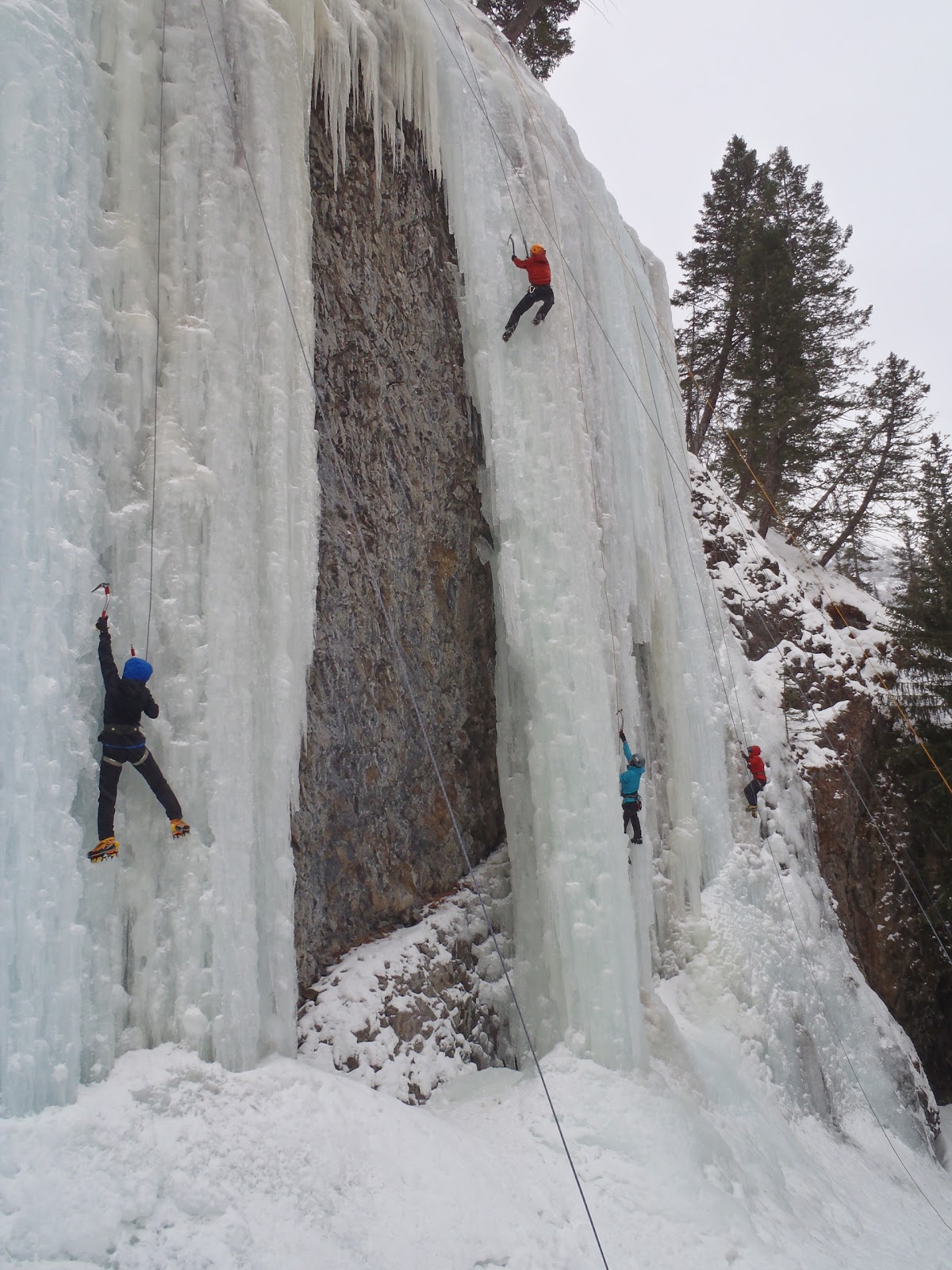
You are looking at entire last set of tiers in this picture. The three climbers at the right side of the ice are at the base of the Ribbon pitch in fat, late Feb '10 conditions.


Parts of the the last long pitch (or two short pitches) are shown here on the last tier. Fixed anchors on the right with a decent belay platform and rap chains. Climber here is on the last bit of steep ice and generally the crux of the route.

The final short pitch to finish the climb..steeper than it looks and generally sun rotted ice by the time you get on it. Perfect finish to a great climb! Picture is taken for the chained belay anchor and rap point.

For shortened view of the last tier. Chains on the rock are climber's right with a good ledge, one small step above the climber in the picture. The belay becomes pretty obvious when you are there. More so than in this picture.

Looking back down the final pitch just below the last set of rap chains. Incredible piece of ice!

The always terrifing, free hanging rap off the Pencil on the way down. And not always the easiest rap station to find in the dark if it has been snowing. My suggestion is when in doubt "follow the water course" into the gully. You want the third one on the far right. From the upper tier you walk to the first station (fixed pins and tat) that are on the left wall (looking down) where it narrows and steepens. The second set are fixed pins and tat again, this time on the right hand side of the gully when facing down hill. The wrong gullies start out much steeper than the correct rap line. If it seems too weird and scary go north a gully...or two. You want teh tird gull on the north side of the bench.

A wonderful climb to be done over and over again just for the fun of it!
Polar Circus topo courtesy of Joe Palma copyright 2007
Some chain achors were replaced and new ones installed in the spring/fall of 2010
Dbl click to enlarge the topo and check out the rap line, depending on conditions and daylight if might be a little confusing first time up the route.
Another topo here worth looking at as well:
Gear Notes:
These days all but the last rap anchor are bolts, fixed chains or pins and tat. You will rap straight over the Pencil so be careful there of you or your rope knocking anything down. 70m ropes are really much easier but 60m ropes will work as well. Take some tat for V threads but make sure someone hasn't beat you to it already. V threads get burried quicky on the upper pitches where you might need them so come prepared.
Be really careful on the avi slop above the Pencil...it has been fatal. It has three sections, a right hand traverse, a left hand traverse and short up hill and a final long left hand traverse which is a good sized slope show in the pictures above. A slides here will dump debris into the canyon below the Pencil.
Avi danger in particular on this route can be very high. Even small slides coming out of the upper bowl while on the last 3 tiers will be serious.
Worth a look at the photos here:
http://www.pc.gc.ca/eng/pn-np/ab/banff/visit/visit7a12/visit7a12c-3/Polar%20Circus.aspx
and no the photos are not photo shopped.....
A dozen screws should be plenty for anyone capable of finishing the climb. In good conditions plan on anywhere from 5 to 3 roped pitches depending on the length of your rope and a lot of easy ice either soloed or climbed together.
A early start will get you off before the south facing avi slopes heat up. Or better yet do it on a snowy, cloudy and cold day. You can avoid the avi danger and soft, rotten ice on the crux pitch if you do without the sun. Don't forget 3 or 4 long screws just for that rotten ice late in the day.
8 or 9 hrs round trip, car to car, these days is a reasonable time with good ice and snow conditions. 5 or 6 hrs of climbing. A hook fest on hammered out ice will make it quicker. A lot of snow to break trail through or really cold, new ice can make it a "slightly" longer day. There is a reason the climb is rated a V for over all grade and time.
Approach Notes:
On a good day 10 minutes up a boot packed trail from the road. Cowboy-up and start on the first easy ice available instead of walking up the snow slope to the left and beginning of the first WI4 pitch.

 Posts
Posts