Pageviews past week

The cold world of skimo & alpine climbing

The cold world of skimo & alpine climbing

Tuesday, June 7, 2011

The TLT 5 Dynafit series Part I of 2

The Dynafit TLT 5 Series as a all mountain cold weather boot?

The Intro and the players:
Ok, I am the first to admit this is one of the most fun blogs I have researched and written to date. Huge fun for me because it gave me a reason to get back into some skiing and to look at how I climb and why in the process.   The TLT did take some effort to "use my imagination" as to where it might be used best.

So it is a bit long winded before the goods are delivered. Or I can simply cut to the chase... if you ski and climb you'll want some of these!

If you haven't paid attention the ski industry has changed a lot in just a couple of years.  Fat skis, tech bindings (which are the various clones of the original Dynafit) and super light weight ski boots that you can also easily tour in, skin in and more importantly to me climb in.

All of the major European boot manufactures seem to have a super light AT boot out now.  Quick look at the top four here shows some differing ideas in technology and kenetics.


In no special order and I have likely missed someone, Scarpa, La Sportiva, Dynafit and may be most importantly Pierre Gignoux, who seems to be driving the others to catch up with his technology. Pierre Gignoux's first boot in 2006 weighed in at 650g!


"At the time it weighed 650g per boot and was nearly half the weight of the Scarpa F1 (1200g).
The 2008 XP 500 were down to 520 g per boot without liner in size 27.5.
This year, the new XP 444 shell weighs a cool 444 grams in 27.5"

Note the Gignoux boot weights are without the liners...not the best data but then I don't have a pair of $2000+ Gignoux boots to weigh for you, sorry ;)

Dynafit claims the new DyNA will come in at 700g with the liner!  Dynafit TLT 5 liners weight in at 160 to 180g.   So call it a 550g shell to be on the safe side. That should be good enough for my use ;)

Some perspective here?   The newest DyNA will be 1# 8oz (24oz) per boot.  The trango S Evo is 1# 13oz (29oz)  per boot!   That is a warm thermo formable plastic dbl boot you can ski and climb technical ground with that is lighter than a pair of Trango Evo S!    A Spantik with a similar Palau liner is 2# 12oz (44oz).  That is saving 1# 4oz per boot!   3# pre pair for the DyNA.  The Spantik with a lwt liner is 5# 8oz a pair.
(I'm very excited here with what might yet be possible)


Bottom line here is there is some amazing ski boot technology available to day......but it is literally "at a price".

http://www.wildsnow.com/4256/dynafit-evo-backcountry-skiing-boot/

Like many reading this I suspect you are more interested in how the boots skis and climb and  more importantly just how much they will cost you.  The original DyNA has been out two seasons now.  The TLT5 Series just one full season.  With much of the US inventory coming in later than anyone would have preferred.  I was slow to recognise the benefits of these style of boots for both skiing and climbing.  But I also wasn't interested until the prices dropped on line at the very end of the 2010/2011 winter season.

Adding a $1000 ski boot or even a $700 ski boot to my gear room no matter how good they ski or climb is not a easy or likely decision.  On sale at 40% off...not easy but way more likely.   $1300 and up?  For a ski boot? Not likely to fly at my house.

I have been skiing in all three of the TLT boots for the last couple of months.  Crazy I know but I thought the new technology was important enough to make the effort.  Boot models and their retail prices are listed below.  Shop around.  I believe you'll find most retailers willing to match online prices.  As the Euro gained value against the US dollar this spring the price of these boots plummeted until even I felt happy with the purchase.  I wouldn't be surprised how ever to see these boots at retail again in the fall and because of the increased demand here in North America hold their  original retail prices well.  Take that as a warning if you are looking for "cheap" boots.

In the grand scheme of things the North American market is tiny compared to the demand in Europe for these boots.  I suspect that will change.

TLT 5 Performance
$1000
42.5oz./ 1200g (no tongue) Or 1290g with the tongue.


TLT 5 Mountian TF
$800
42.2oz./ 1190g (no tongue) Or 1280g with the tongue.


TLT 5 Mountain TF-X
$750
TLT 5 Mountain TFX 1360g no tongue   Or 1440g with the tongue

This an uncredited quote (quotes?)  from a 32 page Teton Gravity forum TLT 5 thread  by Jonathon S. that is worth reading all the way through.  Dynafit boot designer/engineer Federico Sbrissa  joins the conversation as well for some very informative conversation.

http://www.tetongravity.com/forums/showthread.php/200054-Dynafit-TLT-5-Boot
More links here:

http://www.wildsnow.com/2346/dynafit...boot-its-here/

http://www.wildsnow.com/2446/dynafit-gear-review/

“I took the TLT 5 Mountain TF (the one without carbon fiber and with the standard TF liner rather than a beefed up TFZzero 4 / Mega-Ride in terms of forward flex, but it’s pretty close especially considering how much lighter and better for touring it is. Not sure how much stiffer the carbon version will be in terms of forward flex, but I doubt it will be that different. Lateral stiffness was great but presumably will be even better with carbon cuff.


For comparison I also skied the Scarpa Maestrale and found it to ski better than expected, but not as well as the TLT 5. From flexing the Meastrale indoors I figured it wouldn’t be much more than an F3, but it’s definitely much more than an F3. TLT 5 seems to be the winner all around, but for significantly less $$ the Maestrale looks great too.”

“Jan, if you felt the TLT5 Mountain TF being a little soft in forward flex don’t worry, the pebax cuff of the sample you skied are not “final”. In production the thickness of the cuff’s internal wall will be increased and the pebax mix will be approx 20% stiffer. This will make the boot laterally stiffer and also a bit stiffer in forward flex.

If you have doubts about the “stiffness” difference between the TLT5 performance and the mountain I can tell you it’s amazing… not about 10% or 20% … I would say nearly the double… the combination of the stiff Grilamid downhill tongue with the carbon cuff is impressive…

So if I have to give a general suggestion I would say the final TLT5 Mountain will be the boot for every body, excellent mix of up-hill agility and downhill support, incredible lightness to performance ratio… but still a little forgiving in the most challenging mixed snow…”

"We knew going in that the DNA skied awfully well for a super lightweight. With the additions for better skiing performance on the TLT series, we expected more downhill fun. The fact that it skis better than the DNA is not surprising, what was surprising however was that for a boot that only weighs 1050gr, it can power pretty much ANY size of ski with fairly solid precision. The carbon cuff has a lot to do with that as it has extraordinary torsional stiffness. But even with this stiffness, there was absolutely no shin bang or abrupt stiffening of the flex curve. Rather the flex is smooth all the way thru, linear but with solid support throughout. When you need to really drive the ski edge and put some power down, the boot doesn’t give up on you. While it is NOT a Titan in power, it is as good or better than most typical touring boots in the 1800 gram range. We skied on Movement Goliaths, the new Dynafit Stoked, Manaslus, G3 Zen Oxides, G3 Tonics, BD Justice as well as some lightwt speed touring setups like Movement Randoms and Dynafit Seven Summits SLs. We skied these combinations on ice, powder, spring-like corn, slow speed and ripping groomers. With the bigger skis, pushing the speeds on hardpack would eventually challenge the TLT’s, but most AT boots are challenged at this level. In every combination to a lesser or greater degree the boots were very comfortable with excellent power transfer. The only area that they have a “different” feel is with the Activ-Flex. This 5 mm of flex in the forefoot, makes the boot almost feel like it has a damper installed in the feedback loop from ski edge to the soles of your feet. The Scarpa F1 series with a bellows are particularly vague in this feel and sensitivity. The TLT has a much more positive feel underfoot, but this is an area where it differs from a pure rigid sole AT setup. Some people may not like that feel and not want to make the compromise. But given the extra efficiency gained in stride, personally, we feel it is totally worth the small amount of desensitizing because the power is still there."


Federico Sbrissa:
"A tech boot like the TLT5 needs a little more attention from the skiers, it's definitely not a super user friendly product and it was not meant to be... most of the parts used are coming from the DyNA that was a ski running race boot so every part was tuned to save weight and targeted to skiers which are used to paying a lot of attention to their gear..."

As  reference the lightest AT boot in the Black Diamond line is the Prime.  The Prime in a 28.5 mono weighs in @  1720g.  But no where near the flexability of the TLT 5 flex in walking mode.  They are ski boots so lets compare how they fair against the Prime.  It is. "all about the down" after all ;)

As a reference.  Not uncommon for me to ski the Prime unlocked at the hinge.   So it should be obvious I am not adverse to riding a soft boot.  BD rates the Prime at a 110 locked up.  Certainly not a super stiff boot even then. The BD Factor is rated as a 130.

Here is how I think the boots pan out from the softest flex to the stiffest boot.

Prime unlocked
mtn no tongue
Prime locked
Performance no tongue
Mtn tongue
Perf tongue 

 Another quote from the TG thread:
"For fit comparison, i've also tried on the Maestral and BD Prime. The Prime forefoot was wider and lower than either the maestral or TLT5. The Prime also had a nice heel pocket. Not as nice as the TLT5 tho. The maestral heel was quite roomy.
The TLT5p is the stiffest of the 3. Prime second and Maestral softer still. Didn't like flex progression of Maestral either, it would flex forward and abruptly become stiffer. The Prime is nicely progressive. I'm wondering how much stiffer the pebax Prime becomes in the cold and whether the TLT5p stiffens up as much...thinking the carbon cuff isn't as affected by temperature?

Hike mode the Prime was nicest *(not what I found by a long shot btw)*  until i took the tongue out of the TLT5p. Then the TLT5p won by a mile."

More on the walk mode of the TLT5 later.  But no question the TLT 5 is best walking ski boot currently available under $750 retail.

There is no question the Pebax cuffs are effected by temperature change.  Very warm spring temps are the only place I have ever wanted a tongue in the Perf for extra control.  The kind of lift day where everyone is in short sleeved shirts and shorts.

But within a few degrees of freezing the Pebax/carbon cuffs seem plenty stiff.   I didn't notice much of a change in flex once the boots were out in below freezing conditions.  All the boots seemed consistent in their flex at 0C or -20C.  Get them warm however and you'll have "slippers" to ski in.  So much for a "rug test" in the shop as to how the boot will flex while skiing.  Cuffs on the TLT5 Mtn are Pebax.  Cuffs on the Performance are a combo of Pebax and Carbon fiber.

From the Arkema Pebax web site:

"Pebax® does not stiffen in cold weather! It retains its outstanding performance even in extreme conditions (down to -40°C)! Pebax® gives a maximum comfort to demanding skiers, and guarantees the same feeling of your boots whatever the weather. It is the reason why Pebax® is the material of choice for ski boot designers and has been chosen for years by all the high-end ski boots manufacturers."

Shells on all the TLT5s are Grilamid a nylon based synthetic.
More here on Grilamid:
http://www.grilamid-tr.com/

There ia a lot of information on the Internet on how the original DyNA skiis as well as how the Mountain  and Performance versions of the TLT 5 ski.  Part of  Dyanfit's advertising fro the TLT 5 Series is "SKI MOUNTAINEERING WITH NO COMPROMISES".  I have to agree.

Little compromise in the TLT 5 Performance boot for skiing..let alone the limit of ski mountaineering.
Do a Google search if you wnat to see what others think of the TLT 5 as a ski boot. 
Here is one of the best reviews imo:
http://en.escaperoute.ca/product-reviews/Dynafit/alexw_tlt5p.aspx

I want to talk about them as a climbing boot.

"Introducing a new Dynafit boot to once again redefine the ski mountaineering market. The ideal choice for skiers who demand the best boots to challenge long distances and high altitude tours. Also the best option for tours with difficult climbing both on ice and rock, thanks to its short rockered sole and perfect crampon compatibility. The additional Downhill Booster tongue makes it extremely supportive during even the most technical and steep descents, while the racing-derived Ultra-Lock system allows for incredible cuff rotation and uphill agility with a super fast, single-motion transition from walk to ski mode. The Performance version is the top-of-the-line, with a Carbon Fiber cuff for lightness and maximum downhill support"

The Mountain TF is actually a gram of two less in weight.

"Introducing a new Dynafit boot to once again redefine the ski mountaineering market. The ideal choice for skiers who demand the best boots to challenge long distances and high altitude tours. Also the best option for tours with difficult climbing both on ice and rock, thanks to its short rockered sole and perfect crampon compatibility. The additional Downhill Booster tongue makes it extremely supportive during even the most technical and steep descents, while the racing-derived Ultra-Lock system allows for incredible cuff rotation and uphill agility with a super fast, single-motion transition from walk to ski mode. Designed for a wider range of users, the Mountain version features a Pebax cuff for a great combination of lightness and downhill performance. "

The reason I have repeated Dynafit's spiel here and left out the Mountian TF-X is I am interested in the warmest and lightest versions of the TLT 5 boots.  If you want to ski in them more than climb get the Performance version.  The carbon fiber cuff is stiff.  99 % of my ski boot use of the Performance TLT is done with out the additional tongue.  I am skiing everything from 110cm under foot, 190cm fatties to 78cm under foot 160cm mountaineering skis.  The Performance TLTs will ski.  But the upper cuff is stiff and walk enough in them or side hill long distances and it ain all that fun.

The Mountain TF on the other hand skis well.  But in nasty conditions I prefer to add the tongue.  And I generally prefer a softer boot.  But with out the tongue the slightly softer cuff and no tongue makes the Mountain TF a good compromise for walking, long side hills and climbing.   You get a bit of flex that makes long days  easier on the feet and knees.  It doesn't take much.

One of the things that the TLT 5 series have for the moment is a bit of flex that not all AT boots have.  It isn't much (5mm?) but it is enough to notice after a long day in stiff boots.  The newest DyNA version has left the flex feature out.  It is an advantage in a climbing boot imo.  Disadvantage in a ski boot, plus the added weight is the reasoning behind that change.


The Dynafit toe flex design that allows for a rigid sole boot for skiing, but flexible boot for walking.  And imo the missing link for plastic climbing boots  Simply brilliant..

The other thing that is important imo as a climbing boot is it's volume.  I have long thought most climbing takes place in an environment where a light weight dbl boot would be enough to keep cold damage at bay and be enough for the majority of climbing where you need more than a single boot but less than the most current crop of high volume double boots, like the Spantik, Baruntse or 6000.  Dynafit's use of the light and extremely well fitting Palau thermodable liner helps here.  It is a low volume foam liner that is easy to dry and exceptionally warm for it's weight and amount of insulation. 

Think the volume of the Kolfach plastic boots. Although it is actually less and a more anatomical shape.  Just 30 years newer technology and in this case the priority on skiing instead of climbing.   But the technology is good enough to be applied to technical alpine climbing as well.  For the alpine ice climbs that involve a ski approach it is a system that is hard to beat.
Colin Haley Photo


At least in the Performance version and with the tongue installed it is also a boot I would use on something like the Cunningham.  Although admittedly buckled up a bit tighter than normal  ;-)  A good skier could use  either of the TLT Mountain versions easily enough.


End Part I

Part two: How do they climb?


Sunday, June 5, 2011

Major new route on the North Face of Hunter!

http://moonflower-expedition.blogspot.com/

Congrads to Matt Helliker and Jon Bracey!


Picture of the route is courtesy of Helliker's web site.

Rapping....

I generally see people screw this up.  Or at the very last seem a bit confused on how to rig it.  I rig mine below the rap device.   I also use and carry a PP except that it is pre rigged with a dbl fisherman's.
Good comments worth reading as well.  The trick as mentioned in video is "try before you fly".

Friday, June 3, 2011

Skiing and Alpinism?

I have a buddy who found climbing late in life. He really enjoys climbing and doing moderate classics here in the Cascades. With easy access to the volcano's locally one of the side sports seemed really fun to Joe, which was, alpine touring. Joe took a buddy's advice to heart, which was, "learn to ski first or you'll hate it". Good advice I think to a beginning climber who had never skied.

So Joe has spent the last four winters not only learning how to ski but becoming and PSIA instructor while he was at it. Last week was his first day out on AT gear. The question now is will he continue?

One of my most fond memories in the mountains was cutting under the ski area boundary rope late one spring just before the area closed for the season. Skiing was just skiing back then. No AT gear.   Cross country gear was skinny stuff done in running shoes for the flats. But I do remember the amazing freedom I felt being able to go "just anywhere" on the hard pack spring corn. We only did a couple of runs that day but they are still some of the best skiing I can remember today.

That kind of spring skiing lead to a lot of hiking up hill carrying our skis and ski boots over the next decades. The original goal in our little group was to ski every month of the year. Not sure if we ever managed that. Although I have now by traveling to the southern hemisphere. But that would have been considered cheating by our old standards.

late May '73


Classic early '70s ski gear and attire!

Late spring skiing in the Pacific Northwest generally starts on Mt Hood because they had/have a summer ski program. But if you were willing to hike, Mt St. Helens (pre-crater) , Mt Rainier, Mt Baker and Shasta were all easy goals. So I was always a skier, who slowly became a climber because what I really wanted to do was ski.


I have the idea that the best alpine climbers are generally good skiers. Steep snow and weird conditions don't phase them. If you ski and climb you look at the conditions and the steepness of a slope differently. Knowing what conditions you can get stopped on if you fall and what you can't is always a good thing. Falling while snow climbing is likely a unusual situation. Falling on a pair of skis may not be.

Everything that applies to skiing applies to alpine climbing. It is gear intensive. The very best gear these days is super light and will allow you to do things much easier and much faster with less energy output.   I admit to a bit of bias here but if you want to see how someone climbs, watch how they ski.  Or if  you are forced to play with one, watch how they board  ;-)


The final gut check is are they willing to hike for turns in the spring and summer?  If so you might well have a budding Alpinist!   Make them break trail a season or two before you commit though.  More if they ride goofy foot instead of ski.  ;-)

Some sports never change. The players obviously do.
At least we don't have to carry the boots now.  Some how it is still the extra baggage that seems an issue.
late May '11
It is always steeper than it looks!


Joe likely questioning his own sanity a few hours before his first AT turns :)


Thursday, June 2, 2011

Arc'Teryx Atom SV parka?


After writing down my "best" list for 2010/2011 I realised a few days later that I hadn't written about the majority of items on that list.  So among other things I am playing catch up on that list.  I figure if it is good enough to be on that list and I actually use it, it is worth the effort of a blog.  This jacket is well worth some additional exposure.  It was my main go to belay parka in Chamonix this winter.  And I had several well thought out choices I could and did use in addition to the Atom SV.   But the most often used jacket for the cold weather we climbed in during Feb and early March the Atom SV was my outer insulation.  Twice on cold bivy's I did use the SV as a mid layer under a Brooks Range Cirro.   The Cirro I'll write more about later.

Below:  Happy to be tucked away in the in the Midi loo under a few layers.  SAG Merion wool hoody, Patagonia R1 Hoody, Atom LT, Patagonia Nano Puff pull ove, Atom SV, Merino wool hat and a Brooks Range Cirro over it all. Just enough in this case to keep me happy.  But it was "just enough".


Here is the official spiel:

"Significantly warmer and more protective than a fleece jacket, this insulated hoody is breathable enough to be used as a super warm mid-layer on frigid days and protective enough to be an outer layer while belaying or hanging out at camp. An extra thick dose of synthetic Coreloft™ insulates but packs small, and a light tricot underarm panel enhances breathability.  Warm insulated Coreloft™ jacket with an insulated hood; Ideal for use as a super-warm mid-layer in cold conditions, or as a stand-alone piece in warmer conditions"

Technical Features


•Moisture-resistant outer face fabric
•Breathable
•Insulated
•Lightweight
•Compressible and packable
•Wind resistant

Construction
•DWR finish (Durable Water Repellent) helps bead water from fabric surface
•Tricot-lined underarms to enhance breathability

Patterning
•Articulated elbows
•Gusseted underarms

Hood Configuration
•Insulated hood

Pocket Configuration
•Internal chest pocket
•Two hand pockets

Zippers & Fly Configuration
•Full front zip with wind flap

Cuff & Sleeves Configuration
•Stretch-woven cuffs

Hem Configuration
•Drop back hem
•Adjustable hem drawcord

For me it helps to place the Atom SV in the Arc'Teryx range of insulated pieces.  The SV is a real jacket compared to the sweater weight and more breathable Atom LT Hoody.   But the SV is a lighter weight and more likely used lwt belay jacket version of the Arc'Teryx  Duelly.  The Duelly is a full blow belay/bivy jacket more suitable for Spring in Alaska imo but now with the SV it is also a little dated.  Dated because the SV has many of the Duelly's best design features and a better designed hood for helmet use.  But the SV is clearly not as warm as a Duelly.
 
 
Happy to be out climbing, up high, mid winter, long after dark?...."Not!"
 
I used the Atom Lt on a regular basis as a mid layer under the Atom SV.    Between the LT and the SV I pretty much had the insulation value of a Duelly with a much more versatile clothing system.   But no question there are times I would rather have a Duelly....just hate carrying one.  The SV on the other hand is easy for weight and volume in a small pack.  No question the best mid weight synthetic insulated climbing jacket I have used to date.  Sizing and pattern is perfect for me.  It is also the perfect layering pattern to use over a Atom LT or various other layers you might chose.   I did get too warm on occasion climbing technical ground while wearing the SV...but I never felt like the jacket was limiting my movement.     High praise from me  even if I do look like the Great Pumpkin in mine ;-).


Fun from Pete Tapely's blog..

HFA?  A scruffy little route!


There is more....check it out.

http://petetapley.blogspot.com/2011/02/home-field-advantage-talk-about-milage.html

More on HFA in a past blog here as well.

http://coldthistle.blogspot.com/2010/11/home-field-advantage_04.html

Quick tour of my choice in biners....


In my "best of" list I mentioned a few biners that I think are stand outs. 

It has been a while but I haven't counted how many different styles and brands of carabiners I currently have.  It is more than six..  What I actually use is three or four styles and generally just two, maybe three on a regular basis.

I generally try to hold on to my gear so I have carabiners that go back a few years.  If you think super light and small 'biners are a "new deal" check some of these out.

The blue Latok mini biner is rated at  kN 1700 and weighs 28g.   The newest green Metolius mini is rated at kN 2200 @ 26g.

I have to agree with Colin Haley, who once described the Metolius by saying "they finally made a biner that is too small".   I have them.  I don't use either.


A biner I have used a lot is a bent gate.  One of the first imported into the US, the blue gate "New Alp" imported by Climb High from France in the late '70s is on the left.  Rated at kN 220 @ 56g.  I did most of my hard rock climbing with that biner on my rack.  The idea was a quick clip and it worked very well for that  purpose.  In the middle is a more recent bent gate by Black Diamond that I still use in some situations 19 kN @ 46g.    And on the right my current favorite the Trango Super Fly 30g and 24kN   


The runner up for my own use on the Trango is the BD Oz @ 30g as well and 20kN.  Pretty much the same size and feel.  BD is off on the numbers a bit but I use both on my rack now depending on the price they can be had at.


I use three locking biners depending on the required use.  Left to right, Trango 40g @ 24 kN, Black Diamond Gridlock 78g @ 22kN and the Mammut 78g and 24kN.


And I have a few I am still undecided on.   Trango on the left, a small Camp  @ 22g and 20kN and the new Petzl @ 30g and 20kN


And finally a carabiner that impressed me while we watched it being destroyed at the Grivel factory.
The hard anodized Grivel Yamma K2W biner, 34g and 27kN that is individually tested and serial numbered in production.  An extra 3 to 7 kN bmp in stregth is a big bump in all these lwt biners.   No quessing either as Grivel tests biners like this one to failure on a regular basis.


If nothing else I like consistency.  I find it annoying to climb with all sorts of differing sizes and styles of carabiners on my rack.  So I try not to, even if that means we use my rack a lot :-)

Wednesday, June 1, 2011

March 2010 Chamonix

More skiing!


Vertical front point crampons?

I have a gear room wall full of crampons.  Several versions of each.   Black Diamond, Petzl and Grivel are all represented.

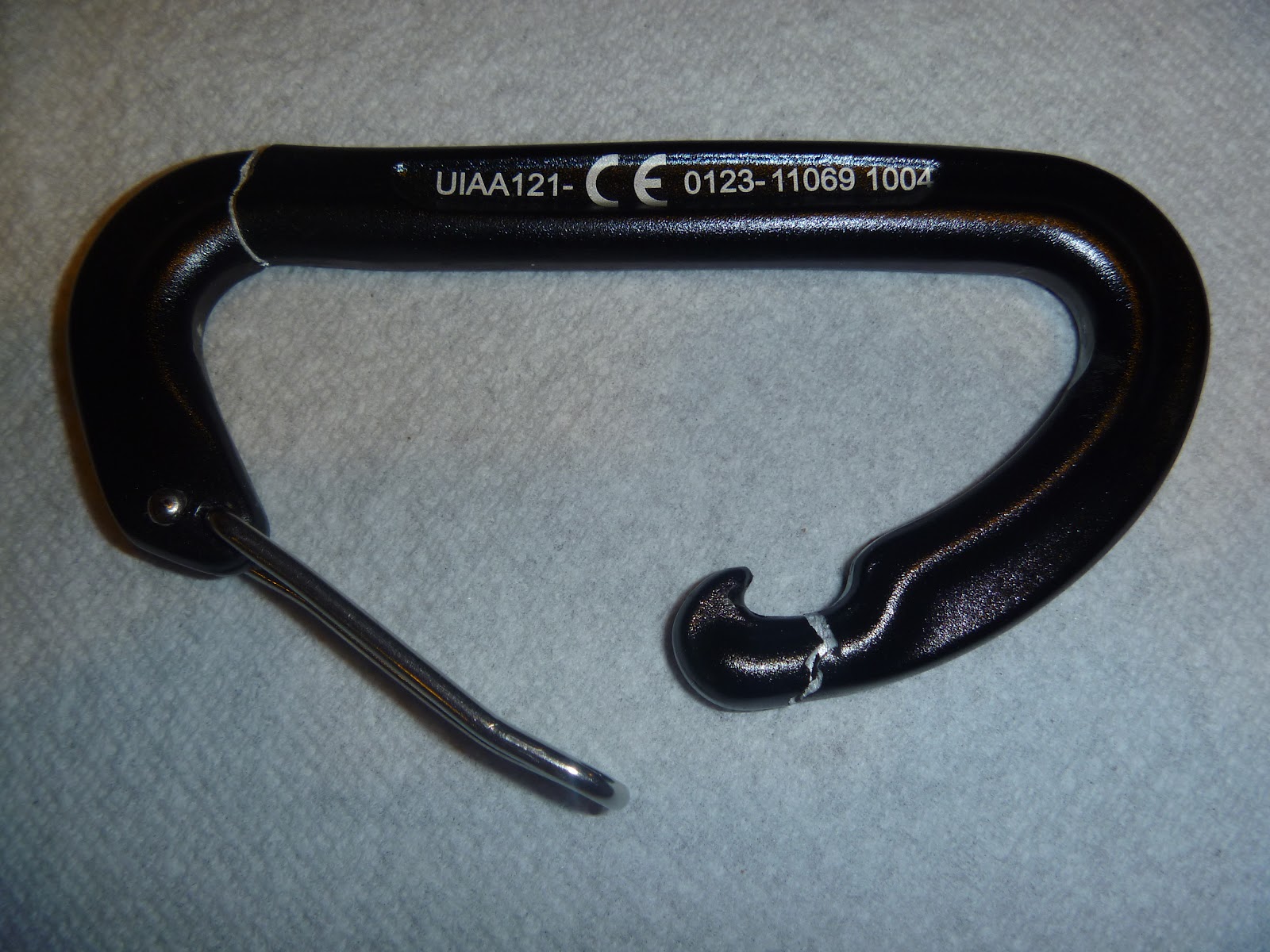
Until recently I have been a big fan of the Black Diamond horizontal crampons for most conditions.  Sabertooth to be exact.  But I have also used the Serac.  They both climb exceptionally well.   Positive blogs on both can be found here on Cold Thistle.   Big fan until they started breaking.  BD has yet to acknowledge they have a problem.  To the opposite in fact, they have publically denied any problems.   Despite continuing to quietly replace production crampons as they crack or break and are returned to BD.


Since the breakage issue was made public on a Canadian blog in Feb of 2010 when horizonatals seemed required, I have been climbing in a heavier, but still outstanding, Grivel  G12s.   Chromoly is proven technology I trust.  Easier for me to simply change brands than to be required to physically check and then have to still worry about my crampon's reliability everytime out.  I do check my gear...and like the Sabertooth a lot.  This one seems an overly obvious failure just too easy to avoid.


With an exceptionally cold winter in Western NA and a mid winter trip to the Alps I ended up using vertical front point crampons more this winter than I normally would.  Given a choice I really don't like climbing a lot of hard, cold ice.  This winter I had little choice.  So I climbed in the BD Cyborg, the new Grivel G22 and my old stand by, the Dartwin.


None of the previous mentioned vertical front point 'pons are what I would consider "amazing".  Something about each I don't like and somethings about each I do like.

My first complaint is none of them fit well on my boots, the Spantik or Ultra very well.  Surprizing the G22 is the worst of the bunch.  BD Cyborg second "best".  Both need new front bails for my boots and my standards..  Easily done.  I use Petzl bails on both the other brand crampons.  How long is it going to take these guys to figure the bail thing out?    The Dartwin has a good front bail obviously.  But the back heel lever could be better on the Petzl.  The leverage is all wrong on the keeper strap.  And  the bottom of the heel piece shape (Grivel and Petzl) will collapse the Spantik sole if tighened very much.    So the Petzl heel lever I replace with a BD heel lever, which offers more surface area and a tight crampon.  Problems solved on the Dartwin  for the most part.


Of the three the Grivel has the best front points imo.  The Cyborgs 2nd there as well.  In comparison the Dartwin is the worst performance of the three.  But not by much.   Only the Cyborg is replaceable and hard to tell the difference in performance of the G22, Dartwin and the Cyborg.   But you can if the conditions are bad enough and the ice hard enough.    A few bucks to replace the fronts on a Cyborg.  The Dartwin and G22 you buy a new front crampon.  Expensive that and unnecessary by today's engineering standards.  The Dartwin wears better than the G22 simply because of front point surface volume.

The Cyborg will climb easy ground better than the G22 or the Dartwin. Try walking on smooth 30 degree water ice as an example.   The term ice skates will get a whole new definition there.   But what you pay for that kind of performance in additional weight.  Too much extra weight imo.  Cyborg is a dated design.   But then all three are really if you look at what is possible in crampons today.   Dartwin is a little better on easy ground than the G22 imo.  All three crampons could go back to the drawing board and easily eliminate their down sides with little effort.

Big advantage to the Grivel G22 though  on the out of box fit for the TLT5 Dyanafit ski mountaineering boots.  Almost like the G22 was purposely designed to fit this boot :)   Not perfect but it is a good out of the box fit.   You'll likely see a lot of that combo on technical ground next winter.  I'll certainly be using them.


weight listed per pair:

Petzl Dartwin 1/2 bot 30.5oz / 865g
Grivel G 22 w/full bot 900g
Black Diamond Stainless Cyborg full bot 39.4oz / 1116g
 

Dartwin has eight down points working for you on moderate ground.  The Grivel 22 just six!  The Cyborg ten.  No wonder the Cyborg is more secure on moderate ground!  Not everyone's choice but when all said, the fit and performance is good enough on the Dartwin.  Which makes the Dartwin my choice in vertical front point crampons. Although it is an expensive one if you are climbing a lot of mixed when compared to the M10, G14 or the Cyborg.
 
Strip a set of Cyborgs down and you have this:
 
Black Diamond Stainless Cyborg, mono, no bot, 28.6oz / 811g


No stainless Cyborg bodies broken yet that I have heard about.  And Cyborgs get used a lot around the world.   Something to be said for a dual point that can be converted to a mono and easily replacable, CHEAP to replace, front points.  I won't be getting rid of my Cyborgs anytime soon.


BB and Grivel versions come with botts.  The Petzl version you have to buy the heel piece.  Still nothing up front on the Dartwin.


                                                     left to right:  Cyborg, Dartwin and G22

There is much more to a crampon than the front points.  I start with relaibility and how the crampons fit my boots and move on from there.  For me once trust in the design is established,  fit is the most important issue for picking the right crampon.


For those that wonder why I worry so much about crampons fit?

UIAGM Guide Dylan Taylor has a great blog post about climbing the Ginat that is worth reading.


"We crossed the Argentiere and simu-climbed most of the route in about four pitches. I found another screw and one broken black diamond crampon stuck in the snow midway up the first pitch. Hmmm..."

I asked Dylan what kind of crampon he found and its condition from the Ginat, "I am pretty sure the crampon I saw at the base of the route was a newer BD cyborg or something Ike that. It was definetly the shiny new stainless steel design, and I think it had modular vertical front points, and orange antibot plates. Did you drop a crampon? Hope not! The heel bale was missing completely...Cheers, Dylan"

I've found single crampons in the middle of the Eiger and on other big north faces in NA and Europe.  Dropped a crampon myself mid pitch.    You have to wonder what the stories are behind any lost crampon,  but can't imagine any of them being pretty.


Tuesday, May 31, 2011

Petzl Reverso III and the Black Diamond ATC-Guide


I am a big fan of the auto-block belay devices.  The Petzl Reverso III and the Black Diamond ATC-Guide are the two I have used a lot.

I have bought my own Reverso IIIs and older Reversos before that. And bought as well as been given the newest Black Diamond ATC-Guide.   It is not unusual for me to give skinny rope belay devices to my partners.  Not everyone climbs on or likes 7.7 twin ropes.  Since they are belaying me, I think giving away a high quality belay device it is a good investment.   Generally I have given away ATC Guides because, I have been given several in turn, and the Petzl is more expensive and harder to find.

Hard climbs and skinny ropes in the future?   I'll make a point to loan my partner a Petzl Reverso III ;-)

Rapping the Pencil or the Midi bridge makes you a believer.


I generally use either a a 9.1 Beal Joker as a single rope or a set of 7.7mm Beal Ice Twins.  So a belay device that will work in auto-block mode, rapping and regular belay  mode with thin ropes is important to me.  For my use on the thinner ropes I think the Reverso works better than the ACT Guide when belaying off the anchor.

The direction of the clip in point is different.  I find the Perzl much more user friendly.  Bd's version clip in point is at right angles to the Petzl.

If you are using a rope fatter than a 10mm get the ATC guide.  The Reverso gets sticky in auto mode as the ropes get bigger.  10mm seem to be the auto block limit on the Reverso III.

Neither company's belay device is very durable.  If they actually anodize the aluminum it has to be the worse anodizing job in the world.  As both companies belay devices wear quickly on the surface.  So toss up there.  Also don't buy the silver colored (clear anodizing)  versions.  The directions (if you ever need them) on the belay device disappear within days of first using the clear version.

Other belay device reviews that are worth a moment to read and a lot more comparisons on Supertopo gear reviews.  More rock gear reviewed  there than I will ever see, let alone use.  FWIW they are reviews I trust to be accurate.

http://www.supertopo.com/review/Black-Diamond-ATC-Guide

http://www.supertopo.com/review/Petzl-Reverso-3

weights of the newest version by both companies

Petzl Reverso III weighs in at 76g.
BD ATC Guide (new version) weights in at 90g.


Reverso3 - the ultimate belay/rappel device for... by Petzl-crew


REVERSO - How to belay & rappel by Petzl-crew

The base layer Hoodies!


The lwt climbing hoody?  Patagonia made them popular and then dropped them from production.  Popular demand resurrected them again.  May be?  Patagonia is certainly offering some wild color choices in the R1 today.  No more basic black?

Quickly Copied by MEC @ half price?  Certainly ;-)

I wrote this winter of '07/'08:

"You might want to think about putting some wool next to your body and a light synthetic layer/s over it. Add hoods that will go under and over your a helmet. The “R” series Patagonia hoody or the really simple Nike hoody (which I like even better for cold weather) works well. (Nike version I had is unavailable now)

Headbands under the helmet regulate heat better with helmet and layers of hoods than a hat will. The head band will also add to your warmth if pulled down to your neckline and nothing to drop. I no longer carry a hat. But I pull on or off any one the layers of hoods over my helmet at belays or while climbing. Try that with a hat while climbing a hard pitch!"

I wear and change my hoodies like I do foot wear for climbing.

I have dbl boots and Croc sandals.  And generally a hoody I would chose for each.  No kidding.

Why a hoody?

More here as to why you want to be able to add head and neck protection quickly:

http://wildernessmedicinenewsletter.wordpress.com/2007/02/14/heat-loss-through-the-head-and-hypothermia/

There are literally dozens of hoodies available now suitable for outdoor use and serious climbing.  Take a look around.  You might find one that suits your own  needs.


A quick look at the hoodies I own and where I use them. 

Climbing specific versions first.

My first 1st base layer in cold weather?  Wool!   Two reasons.  I think it insulates better in the cold where you aren't so worried about moisure transportation and it doesn't instantly reek of BO.

The ultimate lwt wool hoody.  Sherpa Adventure Gear's luxurious merino wool.  I love this thing.  I use this one as a base layer with the option of layering other hoodies over it.  It is a must have for me.   They will be available in store this fall.  Ask your retailer. Super thin and lwt.  Comfy to wear next to your skin.  Hood goes in the helmet


Next up and the one I generally wear with Salopettes as it is a tiny bit lighter weight and breathes better than the Patagonia version imo.  I also like the hood coverage on these.  It is a very similar cut as the merino wool SAG version.  A bit less coverage than the Patagonia version on the hood.  It also has a chest pocket and thumb holes similar to the R1.  Half the price of the R1 and excellent quality.  I actually like the hood and pattern better than the R1.   Hood will go in or over a helmet.


Patagonia's R1 Hoody.  Everyone seems to have one.  I use it as a breathable but heavy weight base layer.  Sometimes it is both my base and mid layer.  Best used that way I think, as a single layer.   Others use it as a lwt mid layer.  Nice chest pocket and thumb holes.   I own two because I use this one a lot.  One is generally in the laundry all winter.  Very long tails and works perfectly with climbing pants.   Hood will go in or over a helmet.  Hood could be better fitted or may be it is just been used over my helmet too much.


Hoodies seem to me to be defined by material used (and how breathable the material is) and the amount of coverage the hoody offers on the face.  A second version from SAG that rules in both areas.  Super stretch pile.  So it feels awesome on.  I'd love to see this pattern is a grid pile version and in the lwt Merino wool SAG is using on the hoody above.   I think Sherpa Adveture Gear would own the market on Hoodies if they offered those three versions.  Hood on this one is best used in a helmet I think.


Three hoodies I use a lot climbing that are not climbing specific.  The kangaroo pockets mean you won't be tucking them into pants.  Only the Patagonia Sun Hoody has a tapered athletic fit of this bunch.

Merino wool from Patagonia.  This thing I use every where.  Pajama top?  Around the house?  Cool day rock climbing?  Perfect.  Merino wool pile.  Expensive but bought on sale and worth that price in retrospect.  Kangaroo pocket no zippers.


Another Patagonis piece but a synthetic this time....another of my go to pieces at home and in the mtns.
The Sun hoody.  Super lwt weight.  I have used it as a base layer in winter and as a "shell" ski touring.  Super comfortable.  Likely to wear it in the office as I am in the mtns.  Great sun protection.  Pockets depend on the version you buy.  This one has a tiny zippered pocket for keys.  Others have a kangaroo pocket and no zipper.


And finally the North Face synthetic hoody.....my rock climbing and cragging "sweater".  Cheap, useful and super durable.  I used it on several long, dawn to O dark thirty, alpine traverses last summer.  The thing simply rocks.  Kangaroo pocket no zipper.


No sorry, 9ine, says his glasses are not for sale ;-)