Pageviews past week

The cold world of skimo & alpine climbing

The cold world of skimo & alpine climbing

Tuesday, April 24, 2012

Low Impact Training?

FYI..I am not a coach and don't pretend to be.  I'm going to share some training observations here that work for me related to climbing.  They may or may not work for you.  The  fitness comments I make are just the tiny tip of the iceberg on training.  To train and get stronger you really need to educate yourself on the subject and all that it incorporates.   Or do both and climb!  Climb a lot!    Because I don't "climb a lot", I train.  I typically train to my weaknesses, endurance and physical strength.  You have to know what you want from the training first, to get what you need out of the training.

For most who will read this with some interest it is likely because "high impact" training hurt or has injured you previous.

I have never been a big runner.  But I have ran and I do run now.  But for most running on pavement will tear you up given enough miles.  Running on pavement is rough on everything from joints to tendons.  Well it at least tears me up, has in the beginning as a teenager and does now in middle age.  Hilly trail running (which can be a lot more "dangerous") for me is a lot softer impact sport.  I am forced into a forefoot strike instead of a heel strike and the surface is generally a lot more forgiving.  Not to say it isn't easier to trip and bust your ass or an ankle running trails instead of you local high school track, paved trails or the side streets.  And you can run with a forefoot strike anywhere once you learn (relearn?) the skill.

Foot strike is important.
more here on foot strike:

http://barefootrunning.fas.harvard.edu/1WhyConsiderFootStrike.html

http://barefootrunning.fas.harvard.edu/4BiomechanicsofFootStrike.html

But running is not a low impact sport.  Generally you learn early on if you can run.  You either don't get injured running or you do and it becomes a problem trying to keep running.  I am good up to 1/2 marathon distances both for racing and training.  At full marathon distances my body is telling me the mileage and the race efforts are just too much.   I don't have a runner's body at 200# and 6'1" so no surprise.  But even at 180# marathon distances still hurt and take a long time to fully recover from.  Too long if I want to climb during the summer and the risk of injury training, just too great.

So I limit how much running I do.  But there are two low impact sports I try to do a lot of.  I really like them both simply because I have been doing them for as long as I can remember.  Swimming and riding a bike.

And in a controlled environment I don't have to worry about dying doing either.  Both are mindless activities the majority of time for me.  But not always if you up the environmental hazards.  And with even a tiny bit of care neither will hurt you significantly physically even during hardest work outs.

And the fourth sport is Skiing.  Downhill on the lifts, back country and side country on 3 pin gear and Skimo gear.  It is all skiing to me.  And like the bike or swimming something I have been doing a long time.

Here is where I start to define what I want from my training. If you don't know what you want from your exercise efforts you'll likely never get what you want from your exercise efforts.

Running Goals?  (running is always training for the mtns eventually)
Olympic and Sprint Tri racing
1/2 IM race finishes
trail running for endurance
uphill running to simulate and strengthen my climbing

Bike goals? (biking is always training for something)
200+ mile days (road bike)
Tri and TT racing
endurance days in the mtns = endurance days on the bike

Swimming goals? (swimming is generally training for swimming/tris)
IM distance swims
Sprint and Oly distance races
relaxation

Skiing goals (skiing is generally for fun but sometimes it is to better my skills or training for endurance)
technical or steep skiing
endurance days in the mtns
relaxation

And then there is number FIVE which is also low impact
Rock/Ice climbing or crag climbing goals?
get stronger physically as a climber for the mtns or to just up my abilities on tech terrain

Back to the "Principle of Specificity"
But I know why and how I train.  Do you?

You can never be too strong, too rich or too pretty :)    Which is why others advocate the benefits of a crossfit or similar strength training programs.  I don't generally partake but I suggest others do for the obvious benefits to be gained.

Monday, April 23, 2012

Converts?

One of the most personally satisfying things I get to see from Cold Thistle is the guys/gals out climbing every day taking some of the ideas I write about and making them their own.  No greater compliment to me.  I am thrilled that anything I write or suggest actually gets rethought and used.

Here is one that popped up on my blog radar this morning.  Very cool pack Ryan had made up :)   And a great blog!

http://bigfootmountainguides.com/2012/04/13/the-perfect-climbing-pack/


barefoot running?

I often get emails asking what I do to get fit and/or stay fit.  As I work on my own recovery and try to get to a level of fitness I now find acceptable I have to ask myself that same question.   This will be the first in a long series of blog posts that will answer some of that question for the readers here and what I find of interest (but may or may not agree with) for my own training.  The easy answer is always the best, pick your own poison and then just go climbing!


It is called the "Principle of Specificity".
More here:

http://sportsmedicine.about.com/od/glossary/g/Specificity_def.htm

Not everyone gets to climb every day.


The Truth about Barefoot Running

Why barefoot running is not suited for the average runner.


By G.S.Seltzer
http://triabilitycoach.com/


Perhaps you are familiar with the barefoot running craze, started by the book Born to Run by Author Christopher McDougall. Perhaps you have been thinking about giving barefoot running a try. Many run and triathlon coaches recommend running barefoot to some degree on a soft surface, such as grass, to help improve your running mechanics. Most experts agree however, that running barefoot most of the time is neither safe nor practical.


Reality Check


Although great in theory, running barefoot is not for everyone. Raise your hand if you came across any barefoot runners in any race you ran in the last year. The good news is that the running shoe industry is taking note of the interest in barefoot running and minimalist shoes. Minimalist shoes, or minis, are lightweight because they have few bells and whistles, such as built up heels that many experts claim make our legs and feet weaker, causing injury. Shoes like Vibrams provide a barefoot ride and feel, while providing some protection against puncture wounds from debris and road rash.


The Reality


Running barefoot is dangerous for the vast majority of runners for two main reasons. First, rocks, twigs, glass, and other debris will likely cause injury at some point. Second, the muscles and joints of the legs and feet typically are weak because we wear shoes continuously. Some runners attempt to eradicate this, running a few miles each week barefoot, performing foot and leg strengthening exercises, and walking barefoot in and around the house. Running stride drills barefoot on grass, the track, or at the beach are good examples. Strong feet provide a solid platform for the body to ride upon – weak feet do not. Start out slow focusing on your form will help you prevent injury.


Barefoot Running Does Have its Place


If you are determined to take barefoot running to the road here are a few considerations. Start slowly until your calves, arches, and Achilles tendons adjust. Increase the distance slightly each week, and listen to your body if you experience aches or pains as mentioned above. Run on a smooth, soft surface. When transitioning to hard surfaces, such as the road, try using minimalist shoes, which are low to the ground, lightweight, and provide the feel of being barefoot. Vibram, New Balance, Nike, and Newton Running make some of the better-known minimalist shoes.


Final Thoughts


If you are prone to injury using running shoes, running barefoot is not likely to change that; if you do not get injured often in running shoes, than why change? Trade in your heavy, clunky shoes with the anti-sway this, and the heavily cushioned that for a pair of minimalist shoes. Trade your heel strike for a mid-foot strike and rejoice at the results. Allow for a proper transition, and seek a qualified run or triathlon coach for assistance. The time and resources invested will be well worth it in the end.


--------------------------------------------------------------------------------


Gregg Seltzer is a certified USA Cycling and Triathlon coach, as well as strength and conditioning trainer. Gregg owns Triability Coaching, based in Southern California. Contact Gregg via email at gregg@tri-ability.com or phone at 800.884.2194.
----------------------------------------------------------------------------------
The photos below are of my HRM  on a short hilly run intentionally done right at my lactate threshold pace.   Like weighing your climbing gear it is hard to know where you are really at unless you measure it.  In this case the easy way to measure performance (and performance changes) is with a heart rate monitor (HRM).


Sunday, April 22, 2012

It is officially Spring here!

My buddy Sol on some fun local rock.  Enjoy!

Simple solutions, leash, sock and picks

When I start thinking I know what I am doing I usually get a lesson in humility.

Umbilicals?  To connect the umbilical to the tools we have mini lockers, flat steel wire gates and a host of do-it-yourself solutions with all offer varying amounts of success.  How hard does it really need to be?  Not very it seems.  For the home made ones just tie a big loop in the end and do the same.  Easy on and off for the alpine where you may want to remove the umbilical all together.  Thanks Jim for pointing out that obvious solution to my my overly jaded imagination.


Boots that don't fit perfectly?  Feet a little different in size?  Not unusual for most folks.

How about using different thickness sock on each foot?   It might just be the simple fix you require to get a better fit.  Not one I have needed but so simple when it was pointed out to me I had to say, "duuuu, of course!" It is at least worth a try.  Thanks for that idea!


Another one that seemed to escape me and most of my climbing mates.  Sharpening tools?  For most things including vertical ice and the majority of alpine mixed a razor sharp pick isn't required. In fact it is just a waste of good steel (and your hard earned cash) to always be sharpening and resharpening your picks.

I know, BTDT myself on numerous occasions.  And until now I am generally loath to go on anything I think is difficult without a set of "properly sharpened" picks.  This spring I decided to see just how much difference it really makes.  Short of super cold  or old hard and brittle ice I suspect it doesn't matter much.  Now I intentionally sharpen my picks differently.

I think the ability to hook the tools easily is equally important as getting the initial stick.
With the best of the new tools hooking is easy and secure.  Which allows us to worry less about the condition of the pick's tip.  Much as we want to think it really does and I have been convinced it does for years.

Pick at the left is now 3.3mm and the newer one on the right is 3.1mm 


The difference in how the picks actually climb in the majority of terrain I use them on is nil.


To make a point the two  sets of picks below started out new and got some use.


The pair above was used on the first ascent of  Dracula,  Mt Foraker.

This pair was used on a solo ascent of the Cassin, Denali


As I said unless it is really hard and cold or  just old ice the pick can be pretty well worn and still very usable.  More so than you might first think.  Certainly on a lot of the mixed we do by simply hooking you don't need a razor's edge on your pick.  The first time you miss judge a placement and slam the pick into rock you'll end up with a dull edge anyway.  The cutting edge of a splitting maul will last a lot longer than that of a scalpel.  Each has their own place in the tool box.  Best to know which you need for your specific job.

I still have picks I haven't touched with a file that get used on fat Canadian ice.  Going a full season there without intentionally hitting rock is not unusual.   They start out sharp from the factory and stay that way if I pay attention.   I also have the pair of picks I climbed on in Chamonix last winter.  Down into the teeth on those simply from wear on the hard granite and old black gully ice there.   One is the rounded and shortened pick seen in the first picture.  The pair look remarkably the same.


I used that pair of picks on several pure ice climbs this spring including the scariest lead I have been on in a while.  Sticks are easy in the spring time slush :)   The shape of my picks never once entered my mind.


The Eiger

Friday, April 20, 2012

The "word" is getting around..."Neoshell" soft shell

New skis? New turns!

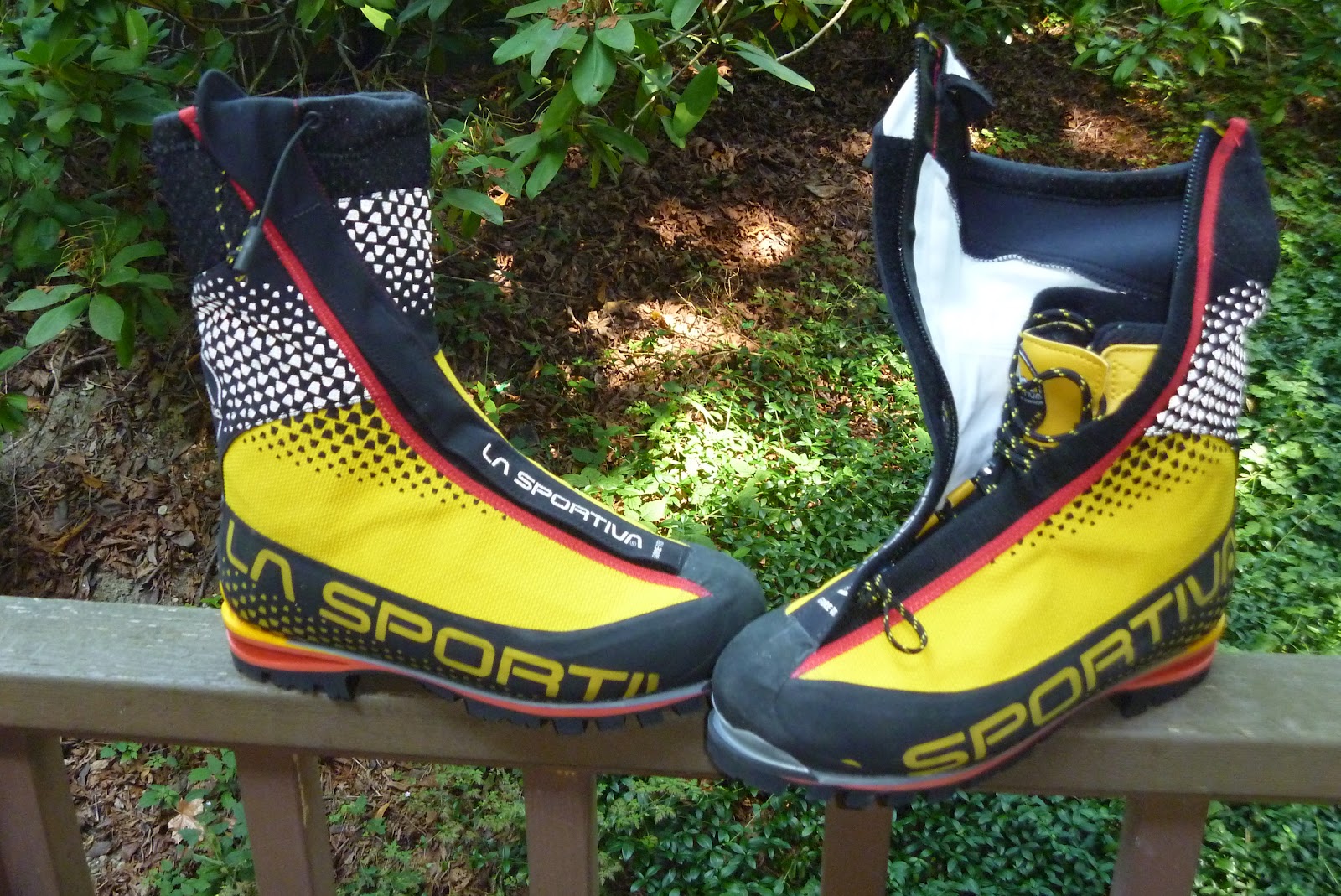
The La Sportiva Batura 2.0


To my amazement the most often read blog entry on Cold Thistle is the Phantom Guide/Batura boot comparison.  The page reads on that one post more than double the next most popular blog.   The comparison was first posted in April of 2010.  Almost two full years later and the same blog entry still gets the highest number of reads month after month.

http://coldthistle.blogspot.com/2010/04/scarpa-phantom-guide-vs-la-sportiva.html


First generation Batura on M6

While I have always had great hopes for the "super gaiter" style single boots I had no idea just how popular they obviously have become.   I still think the technology could be bettered with a light weight and low profile double boot.   The boot manufactures and the buying public seem to disagree with my theory.

Ok, so call me cynical.

I wasn't impressed with the Batura 2.0's name.  I mean how different could the "2.0" be from the previous 2 or 3 variations or generations of the Batura?  Or for that matter from the Phantom Guide or one of my favorites the Phantom Ultra?

I understand keeping the name " Batura" attached to this model.  The "2.0" was kinda a joke to me on first impression.  How different could the boot really be?  In this case a lot different.  It isn't the same boot really, or even a variation of the old Batura, if you look closely.  If you are like me, I first coughed and muttered BS under my breath when I first heard the rumors of "a much better boot".  But I have changed my opinion on that, it is in fact a much better boot..

That was easy to figure out once the newest 2.0 showed up on FED EX.

Just pulling the boots from the box was a wake up call.

For any one who has climbed in a double boot...any double boot and also climbed in a super light Fruit boot you have to wonder why the two technologies haven't merged over the last decade with better effect.

My idea of a  mountain boot these days is the weight and technical ability of a fruit boot like the incredible Boreal Ice Mutant.  More realistically a Scarpa Ultra with some additional warmth and lighter yet in weight?  The support on ice and warmth of a Spantik or Baruntse would be a bonus.  And the over all profile of the Trango series.    The Scarpa 6000 comes pretty close to that idea but lacks the support on endurance ice in comparison to the La Sportiva models.  And its volume is getting up there in comparison to the Ultra for instance.  After all it generally takes more volume in a boot to offer more warmth, right?

But  if I make that call on the Phantom 6000 then the Batura comes up lacking on endurance ice as well.  A real fruit boot on similar terrain?  Pity the fool!   But a really light weight boot given the right support is such a pleasure to move in on most terrain.

Like the choices made in steel for ice tools, every decision you make in design and materials limits the over all use of any product.  So you first define the product.

Obviously the Batura is no fruit boot but neither is it a double boot.

La Sportiva NA president, Jonathon Lantz calls is a true "1.5 boot".  Half way between the best single boot and the best double boot for warmth.

The Batura has just been defined for warmth.

For difficult technical cold weather ice, mixed and alpine climbing we all know you need a few things incorporated in the design.  Low profile and small volume over all.  Think fruit boot here to be take every advantage of the terrain.  The flip side for technical ground is an awkward and big in volume, ski boot.  Which I assume we all want to avoid.  Make the sole rigid but no so rigid you can't walk in them.  Make that midsole durable so the boots never change in flex.   It is a climbing boot so you want a flexible ankle with enough support for endurance ice when required but enough flexibility for hard technical ground with and without crampons.

It is quite a wish list when you write it all down.

If this were easy we wouldn't have dozens of pairs of boots from many different manufactures trying to attain the same goal with varying levels of success.

The Batura has been successful as a "1.5".  Nothing new here as the basic design has gotten better every year since 2007 from my personal perspective.  There is so much potential yet in this boot style.   The same basic technology can be easily traced back to the early 1970s and Peter Carmen's Super Gator.  And it has worked well in the field ever since.   I am thrilled La Sportiva and now Gore has continue to evolve this style of boot.

So what exactly is different from the Batura Evo?
To continue the evolution of the Batura,  a second Gore-Tex membrane was added .  Now both the outer gaiter and in the inner boot have a Gore-tex layer for more complete protection.

The plastic zipper has also been scrapped in favour of a simple zipper with a Velcro hook and loop closure on the gaiter.  I only which they had added another inch or two to the gaiter.

Otherwise, construction appears to be the same as last year’s model, and the boot continues to be built on a Nepal last (i.e. if Nepal EVOs fit you, these should have the same fit).  The 2.0s feel seriously light. I mean three-season alpine boot light!

Actual weight on my scale?

1130g one 43 Batura Evo 2011
890g one 43 Batura 2.0 2012

Best thing I can do is make a side by side comparison,  Batura Evo to Batura 2.0.

Height of gaiter - same

materials used - lighter in weight for the 2.0


dbl layer Goretex - new to the 2.0

lower profile boot/toe - new to the 2.0

Left to right, new 2.0, last year's Evo and a Ultra


Below, carbon mid sole - new to the 2.0 on the right....earlier Evo version on the left.  Thinner for better feel but also warmer.


Above, the additional sole rocker and carbon fiber midsole of the 2.0 is shown on the right.
On the left is the previous generation Batura EVO.


foot closer to the rock/ice - by design in the 2.0

zipper and Velcro closer on gaiter - new to the 2.0

rocker
lace lock
ankle padding and stiffness
tongue bellows
fit and lacing
lighter in weight


Below, 30mm toe rocker on the Ultra,  38mm toe rocker Batura 2.  Making the Batura 2 easier to walk in.  Much like the rocker profile on the Spanik.


Note the differences in sole thickness with La Sportiva on the left and Scarpa on the right, where you attach the front crampon bail.  The Batura sole profile is a much easier fit to any current crampons

The first thing I noticed is the boot's weight. That you notice right out of the box. In a size 43 the 2.0 is a full 240g lighter per boot than the previous Batura Evo.

240 grams = 8.5 ounces per boot

That is a savings of 17oz per pair in a size 43 over the current boot.. You'll save more weight as the boots get bigger.   Lack of the boot's tongue and the new carbon fiber mid sole will show there.

Interesting that they new Baturas are so light. A good bit of the weight savings was done by using a super thin, honey comb, carbon fiber mid sole. Carbon is being used in the Olympus Mons, the Spantik and the Mega ice, oh and the Stratos AT boot. My take is the Batura has been bumped into a totally difference class of boot by La Sportva simply because of the manufacturing techniques and costs associated with the new Batura 2.0 design and manufacturing effort.
The new mid sole is now lighter, warmer because of the added air spaces in the honey comb and more consistent in flex.  Jonathon Lantz says, "this mid sole is slightly softer in flex but will never get softer,  as the previous 9mm Ibi-Thermo mid sole material did in use".    You couldn't tell that by my samples. The sole is rigid on these!

The thickness of the insulation has changed. For the moment at least Mr. Lantz wasn't offering anything very specific on the insulation. "Lighter and warmer" was the definition :)

No surprise I like a rigid soled boots and a stiff cuff. Generally I like my boots more rigid than most fabric ankle boots are capable of. Good news here. You have to look close to feel it but the actual boot that supports your foot is now made of a slightly stiffer Cordura fabric. Point is the added stiffness in the ankle was intentional and a good addition imo. Make no mistake though, it isn't a fabric version of the Nepal Evo by any means. And I would still be hard pressed to say the 2.0 is any stiffer than a pair of Trango Extreme Evos. Plenty of support but not so much as it limits your technical climbing ability. The Batura 2.0 still incorporates, "The 3D Flex™ ankle hinge allows side to side movement for better footwork while still providing longitudinal lockout when front pointing."

It doesn't appear the stiffer Cordura material will change the fit. But the super streamlined new bellows tongue design, new insulation material and two layers of Goretx will. That is complete coverage by one 3 layer Gortex on the exterior gaiter and another complete sock liner of 2 layer Goretx on the inside. of the boot.

"To stay warm you must stay dry."

If you have followed the previous blog posts on winter clothing you already know staying dry is the key to staying warm in a cold climate. One of the distractions for me in the older Baturas is they held moisture. You had to be very careful on how you manages the sweat from your feet and if out over night how you kept you boot dry internally long term. I have used both Seal Skinz socks and Mitchums antiperspirant to lower the moisture coming from my feet in an effort to keep the insulation in the Baturas working at its best.

Boot soles?  Lighter weight?  One word, traction.
The Vibram Mulaz sole climbs better on technical rock.  But the LaSportiva / Vibram claim the Impact Brake System sole is better for long approaches and big days in the mountains.

I'd rather see an additional drop in weight and the Vibram Mulaz sole used on the new 2.0.

Each boot takes 34 days to put together, most of that glue-drying time, and they continue to be handmade in Italy which makes me feel a bit better about the suggested $650 price tag.

We seldom get a view behind the curtain when it comes to research and development from any European manufacture. (Or the U.S. for that matter)   But in this case I did get a glimpse of the testing that La Sportiva and surprisingly Gore in Italy did on the newest Batura.

Last year to develop the new technology for the 2.0 version, Gore Italy and La Sportiva did some innovative  testing that I have never heard of being done for a mountain boot prototype.  Over several weeks in the Slovenian Alps, Gore scientists and La Sportiva boot makers collected the data from heat and moisture sensors and the personal feedback from 40 pairs of tester's boots and the testers themselves.  That data was down loaded twice a day for weeks.  I am impressed!

So when you ask yourself why La Sportiva uses a Gore product in their boots it should be obvious. Both Gore and La Sportiva  have developed a mutual trust and both are willing to go to the extra effort to  push the technologies available for our benefit.

These are comments from others already using the Batura 2.0:

"the new version with GoreTex Gaiter and GoreTex boot"

"They give a snug fit while letting the toes enough spare place to move which I really like for avoiding
cold feet and kicking hard ice."

"Although if wet, for example if you sweat in them too much while
an approach in warm temperatures they are still hard to dry."

"In general I think the made a good trade of concerning the insulation.
The are thin enough, so that you can wear them in the alps in the summer
time without excessively sweating in them, further more they are warm
enough for ice climbing on cold winter days. But I have to admit that it
can get a bit chilly in them on really cold belay days.

I've had cold feet in them while ice climbing on a day with -17°C."

"The Baturas have indeed changed a lot, the ankle is a lot more forgiving than the old version and I think I could live with them I that respect. The last however has changed unless I’m mistaken. They used to feel like a (slightly) roomier Nepal Evo. Now they feel like a Trango. I get a slight toe crush as I do with my Trango Evo which is not good for a warm boot. The heel has also gone the way of the Trangos, I now get considerable lift which I never got before.  I would also add that we're stiffer
than pretty much any other fabric boot I've seen."


■A six layer fully synthetic boot specifically designed for winter mountaineering.
■Board lasted construction.
■Upper:
- Exceptionally resilient nylon.
- Insulated anti-dragging felt.
- Insulated polyethylene (PE).
- Insulating aluminum layer.
■Gaiter:
- Elastic Cordura® provides waterproof protection, while allowing ventilation for a comfortable environment.
- Schoeller® - Dynamic™ with water repellent membrane.
- Vibram® rubber rand.
- Elastic nylon with impermeable insulating layer.
- Asymmetrical, waterproof zipper for easy, on the go access.
■Lining:
- Polyamide Thermic layer for extra warmth.
- Durable mesh layer extends wear and ensures moisture is transferred away from the skin.
■Insole:
Insulating Ibi-Thermo 9mm.
■Midsole:
- 8-9mm TPU.
- PU Inserts.
- SBR Aircushion.
■Outsole:
- 8-9mm TPU.
- PU Inserts.


Previous Evo version with a plastic mid sole and simple gaiter zipper


The newest Batura 2.0 with carbon fiber mid sole and a Velcro closed zipper on the gaiter.


new Batura 2.0 and the new Salewa Pro Gaiter both in a Euro size 42

Thursday, April 19, 2012

Wednesday, April 18, 2012

Hopefully my final comment on BD stainless


Is it just me or is it really hard to get a simple and straight forward answer in any public forum?

I posed this question on the BD website (and on the Super Topo thread) and added the bold insert here on the "recall":

Dane Burns @ Cold Thistle
17 Apr 2012, 11:52PM
"In the Fall of '10 or early winter of '11 BD obviously made an inline change and added 30% or more material to the front point area on the frame of the Sabers where they have been breaking.

 We have been calling them Gen I and Gen II for clarity's sake.

As late as last Fall (2011) you could still buy Gen I Sabers at retailers online and in person.

Was there ever a recall internally of the Gen I crampons and replacement with Gen IIs. (the answer is yes in at least one retailer's case)   If you own Gen Is will BD replace them with Gen IIs prior to a failure? Thanks for the reply."

The BD answer is here:
http://www.blackdiamondequipment.com/en-us/journal/climb/all/qc-lab-gear-doesnt-last-forever--crampons

and reprinted here:

18 Apr 2012, 4:04PM
"@Dane Burns As previously stated in our QC Lab post on the Black Diamond Journal and in Peter Metcalf's post on Supertopo.com, our designers and engineers always look for opportunities to improve designs through in-line adjustments. These iterative design tweaks are part of any BD product, be it a carabiner, crampon, ski boot, headlamp or trekking pole. And, as stated previously as well, we stand behind all of our products, including all stainless steel crampons."


Looks to me like they are standing behind the crampons.  Swapping Gen Is for Gen IIs should be easy as BD really does stand behind the product.  Here is their warranty info:

http://www.blackdiamondequipment.com/en-us/customer-service/warranty-repair

North America:

Black Diamond Warranty and Repair
2084 East 3900 South
Salt Lake City, Utah 84124
801-365-5555
warranty@bdel.com

The EU:
Black Diamond Equipment AG
Christoph Merian Ring 7

4153 Reinach, Switzerland
p: +41/61 564 33 23
f: +41/61 564 33 24

service@blackdiamond.eu

Here is how you tell the difference:


"Interesting observation from a picture. 2nd gen Saber on the left and 1st generation Saber on the right. Serac's look to have added the same amount of material to the forward rails. Difference across the flat, in the same area as the breaks above, has gone from .53" to .70". Or if my numbers are correct, a 38% increase in material to the rails. The center bar on the front points went from .50" to .62" or 24%."

Tuesday, April 17, 2012

Sunday, April 15, 2012

April Give away? Melissa, Gordon and Kelly!


I've been out climbing and forgot about the April give away. Ya gotta be a member to win.  A Blue Ice chalk bag, a Boa leash and one other piece of fun climber's kit will be given away.  Three chances to win!


OK then!

The free gear?

The Blue Ice chalk bag?  One of the very few in North America I suspect!
It goes to: Melissa Harms


The Blue Ice Boa Leash?   
It goes to: Gordon Green

And an amazing assortment of MOJO Cliff bars goes to : Kelly
Hurry with that email because they are a pretty good snack!


Send me an email..one way or another and I'll get your prize mailed out to you.  Till then there is always the next drawing ;)


Light weight kit?


This from a blog reader today,

"Sorry to go off topic, but from looking at your pack contents photo, there were a few pieces of kit that could be substituted to lower the weight/bulk.Swap the GSI cookset, Snowpeak stove and MSR canister for a Jetboil Sol Ti cook system plusa 100g gas canister. Swap your BD krabs for DMM i-beam versions, eg Spectre 2 or Alpha Trad? Finally you could swap the friends for the new 'Helium' version, the Reverso 3 for the 4, and maybe even the harness for an Arc'teryx M270. All 
together I think you would be saving over a pound in weight. What are your 
thoughts"
 

Thoughts?  Good idea :)  I thought it worth weighing the suggestion, Jon :) 


1. Jetboil stove 258g
   100g fuel can 196g (110g fuel)

   Snow Peak stove 128g
   GSI cook kit 162g
   MSR can 374g (227g fuel)

My kit is 32g heavier (fuel cell sizes change depending on the project) 
But bigger fuel cells are slightly more efficient for what you carry in fuel
My Snow Peak stove and cook kit are way smaller/less bulk over all than a Jetboil


2. DMM Spectra 2 biner 32g
   DMM Alpha Trad biner 34g

   BD OZ biner 28g
   Trango Super Fly 30g

with 25 biners my kit is 100g lighter or more

3. Helium Friend  [1] 3.35 oz [2] 3.84 oz [3] 5.11 oz 

   Rigid stem Friend [1] 3.1 oz; [2] 3.80 oz; [3] 5.00 oz (sewn Spectra slings)

Carry only five cams and I am at least 25g lighter 


4. Reverso 4 56g  (edit of correct weights on my scale)
   Reverso 3 78g

same here


5. Petzl Hirundos 315g in a large
   Arcteryx M270  310g in a large

5g heavier here


Total difference in weight between the suggested kit and mine?

I am 63g lighter if not more from Jon's suggestions.  Or 2.2 oz :)
I don't doubt the Jetboil is a better stove than the Snow Peak but I normally usea MSR Reactor if I want a "real" stove.  I like the Snow Peak because of the verysmall volume it takes up in my pack. A full pound savings was being very optimistic on Jon's part. But you never know so I took the time to weigh what I have hereand make a side by side comparison. I have both Helium and older rigid stem Friends and already knew what the result would be there. Take the time to weigh and know what you have in your own pack. Jon, thanks again for the suggestion!

The Black Diamond Crampon report


"A piece of climbing gear you don't trust 100%  is probably best retired  or simply destroyed.  eBay is not a good answer here."


Dane Burns @ Cold Thistle


The full BD report is well worth the effort and the read imo.
QC LAB: Gear Doesn’t Last Forever – CRAMPONS


http://www.blackdiamondequipment.com/en-us/journal/climb/all/qc-lab-gear-doesnt-last-forever--crampons


Bottom line from Black Diamond

• Vertically oriented front points are best for climbing water ice and/or heavy climbers, and tend to do better in cyclic fatigue.
• Horizontal front points are best used for the alpine.
• Flexible center bars can increase the lifespan of your crampons, but at a cost of performance.
• Boots aren’t as rigid as they used to be and break down/wear in quicker.
• Use flexible center bars with truly non-rigid boots.
• Gear doesn’t last forever. 


My take from the report is there is still a lot of guess work as to what is really reliable and what is not for boot and crampon combos at BD.  I tend to want my own gear to be 100% reliable without having to second guess every little decision.  And I'd like to enjoy what I consider the highest performance currently available from both boot and crampon.  That combo for my own needs would seem to be labeled as "unreliable" by BD.  Anecdotal evidence would seem to back up that conclusion.


A crampon and boot combination I really like on steep water ice.  But not a combo either I or BD recommends.


While I don't agree with every conclusion or all the numbers as they have been presented I think the newest BD report does go a long ways in telling us how Black Diamond has decided to answer the problems they have experienced with stainless crampons.  Any answer is a good answer imo when it comes to climbing gear.


From BD's own data:
Sabre Pro SS
Average Cycles to failure: 12,312 +/- 3,047

Sabre Pro CrMo
Average Cycles to failure: 15,079 +/- 2454

In summary, the CrMo fails after completing 23% more cycles than the SS.


A rather esoteric boot here in North America, the Scarpa Phantom Ultra.
 
Previuous masthead photo...dbl click for full effect
 
Because of this year long discussion, my current crampon choice, with a rigid center bar and this boot is obvious in the masthead photo and below, Petzl Dartwins.   While not perfect imo they and the Dart have no significant history of failure that I know of with any boot combo.


" Flexible center bars can increase the lifespan of your crampons, but at a cost of performance" BD QC 


Saturday, April 14, 2012

Friday, April 13, 2012

The Dru Couloir Direct!

Great video from Jon Griffith, at Alpine Exposures.  Enjoy!

Thursday, April 12, 2012

It isn't climbing but it is life

I recently have had a hard time keeping  much of my private life out of the blog.  No one but me interested anyway.  I would rather write about and concentrate on new gear and amazing climbs and  spectacular skiing..

Today for the first time in months I was able to get a run in.  Hard to not celebrate that!  So I look back to see just how much I do have to celebrate.  It is a lot.

But there is a dark side that needs to be looked at aired out and retold as well.  Not a picture I would ever look at if I wasn't painting it.  But now I think we all should,  I am the lucky one.  But there are thousands who aren't so lucky.

Maybe this will help just one.  Even if it is just me.  But I had to put it some where just to keep me sane!

http://enhancenotdefine.blogspot.com

The picture below is the artist's  proof of a print I am having made up for my Oncology Dept.  No question the eventual poster and leading this climb have been part of my healing process.


It aint winter! But it is pretty cool!