Pageviews past week

The cold world of skimo & alpine climbing

The cold world of skimo & alpine climbing

Wednesday, February 13, 2013

How I measure insulated down jackets?

I've looked at a lot of down jackets here at Cold Thistle.  Synthetics I generally use the weight of the insulation, 60g per square meter as an example or 100g per square meter.

Down jackets I want to know a couple of things.

Construction?  Fully box baffled or sewn through.  There can be a lot of different combos along with that.  But that is the first.  What is the construction?

Second I want to know what the quality of the down used.  The fill rating?  750 cu inch per ounce or 800 fill or 1000 fill?

How much actual down fill, as in ounces used?  And the jacket's size.  Most importantly how that size fits me personally.

Three additional measurements matter to me.  Can a full size climbing helmet EASILY fit inside the hood?

Length of the jacket's back from shoulder seam, @ the base of the hood to the hem.


And finally the height of the insulation measured 1/2 way between the neck and the point of the shoulder with the jacket laid flat and completely zipped up.  It means little other than as a comparison of loft in the jacket one to another.   This number could easily be fudged to gain or loose insulation depending on your bias and sway the charts. ( even the pictures are difficutlt to read accuratly so I don't post them intentionally)  I know that and try to make a consistent and realistic measurement so that I show no favorites here.  It is also why I don't go smaller than 1/2 inch in differences.

Close up of the height of insulation at the shoulder.  This jacket actually has 3" of loft  Although the angle of the camera shows almost 3.5".  You have to be consistent on every measurement and honest when you post the numbers. 


Shoulder between point of shoulder and the hood on a jacket
 

The Mont Bell Permafrost down jacket?


I had seen Mont Bell garments around for a few years.  I  liked many of the designs but until recently the sizing was off for me.   I dropped weight and Mont Bell made an effort to re size.  Now Mont Bell fits true to size for the North American market.

My first real exposure was actually "forced" upon me.  I had agreed to do a synthetic jacket review for CC.com.  They had wanted me to include two Mont Bell jackets.  Fair enough and glad we did include them.  I learned something from it.

The Mont Bell synthetic versions really impressed me.  I see a lot of gear, as in, a LOT of gear.  And I used the Mont Bell Synthetics last spring and through the summer.  I kept one (Thermawrap Pro)  and continue to use it now in winter.  It is a great mid weight by any comparison.  And like all the Mont Bell garments I have seen recently an exceptional pattern and fit for me personally.

More on the original synthetic review here:

http://coldthistle.blogspot.com/2012/12/synthetic-insulation-60g-to-100g.html

It was well over 3 years ago now that the idea of a "gear test" and the resulting, Cold Thistle blog, came from my search for a very warm, down "climbing" jacket. 

"I shall not today attempt further to define the kinds of material I understand to be embraced within that shorthand description ; and perhaps I could never succeed in intelligibly doing so. But I know it when I see it[Emphasis added.]
—Justice Potter Stewart,
 
I've been around long enough to "know it when I see it" when it comes to a down jacket appropriate for climbing.

I've since looked at a lot of jackets.  Some I tossed aside unworthy, early on and didn't add to this list.  Many (5 and counting)  of these jackets have been changed a lot since I did my first reviews.  So make sure you know what you are looking at.  The most recent update (data is from the earlier reviews though)  below of the jackets I have thought met that criteria of  "climbing jacket":

                                       
L or XL                             weight         insulation @ the shoulder              box wall or sewn through

xEddie Bauer Peak XV         1091g/ 38.5                             5"                      box
xNarrona Trollveggan           1063g/ 37.5                             3"                      box
xRab Neutrino Plus                794g/ 28                                 5"                      box
xArcteryx Duelly                    794g/28                                 2.5"                   non laminated syn
xNarrona Lyngen                    737g/ 26                                3"                      sewn + layer
Mont Bell Permafrost             694g/24.5                             4.5"                   box
xRab Neutrino Endurance       650g/22.9                              3"                     sewn
xMtn H Nilas                           652g/ 23                               3.5"                   box/sewn thru arms
xEB BC Micro Therm             590g/ 21                               2.5"                   sewn + layer
Mont Bell Mirage                    420g/ 14.7                            3.5"                   box
xRab Infinity                            402g/ 14                               3"                      sewn


There is a sweet spot between design, use and weight. Hard to define what will work best for you. But for my own use generally the warmth to weight ration will cut through all the fog. What works best for me has little to do with the quality of these jackets. All are high quality, state of the art, down jackets. Any one of them will keep you warm on most occasions. Each has a forte' and specific use worth searching for if you want to spend your money wisely. Without having all these jackets at hand in front of me there is no way I could have made a educated decision on what was best for my own use. And I continue to be surprised almost every time I start making these kinds of comparisons.

Between the fully baffled Eddie Bauer Peak XV and the light weight, sew through Rab Infinity there is a lot of leeway, weight and warmth.

If you are looking the ultimate example of  warmth and light weight construction in a down jacket is boxed wall construction.  There has never been any doubt about that.  The best down jackets made 40 years ago were box baffled construction and the best now are as well.  It isn't a cheap way to make a jacket.  It is however the best way to use down as insulation.

On the list above only  these are full box baffled construction.

Eddie Bauer Peak XV* #                                                        
Narrona Trollveggan (the new one might make 4+")      
Rab Neutrino Plus * #                             
Mont Bell Permafrost* #          
Mont Bell Mirage (just under 4", more details in another review)   

And of those only three jackets* break the legitimate 4" of loft at the shoulder #.  These are all really warm jackets but going past 4" of loft is the exception here not the rule.     Of those three the Permafrost is the lightest and the least amount of loft..@ 4.5" of 800 fill down.  There is 9oz of the 800 down in a medium. 

The Mont Bell's are the only large size jackets in these comparisons.  The weights aren't going to be far off for comparisons if you wondered.  But a large Mont Bell now fits me like a XL RAB (MB lg is a bit bigger)  or XL Mountain Hardware Nilas (MB Lg is a bit smaller).  "Like" but the Mount Bell jackets actually fit better with my intended layering system than either RAB or Mtn H.

Unzip the hood from the  Permafrost and you drop 100g or 3.5oz.

4.5" of loft and now  the Permafrost is 594g, or 21oz.   Your decision on what is required of an insulated hood.  But the huge stand up collar and detachable hood gives you some options that don't often see in these jackets.   And something I don't generally like in my own jackets.  This one may be a rare exception.  I still have to wonder though what the weight would have been if they had ditched the stand up collar for a attached hood.  The detachable hood will easily take a climbing helmet with room to spare inside.  The zipper, baffle and detailing on the hood attachment is exceptionable.

The more I play with this jacket the more the Permafrost impresses me for warmth, detailing and value.  It fills a niche market no one else even playing in yet.   Something I am just beginning to realise Mont Bell does a lot.


More comparisons here:
http://coldthistle.blogspot.com/2012/03/more-on-mid-weight-down-jackets.html


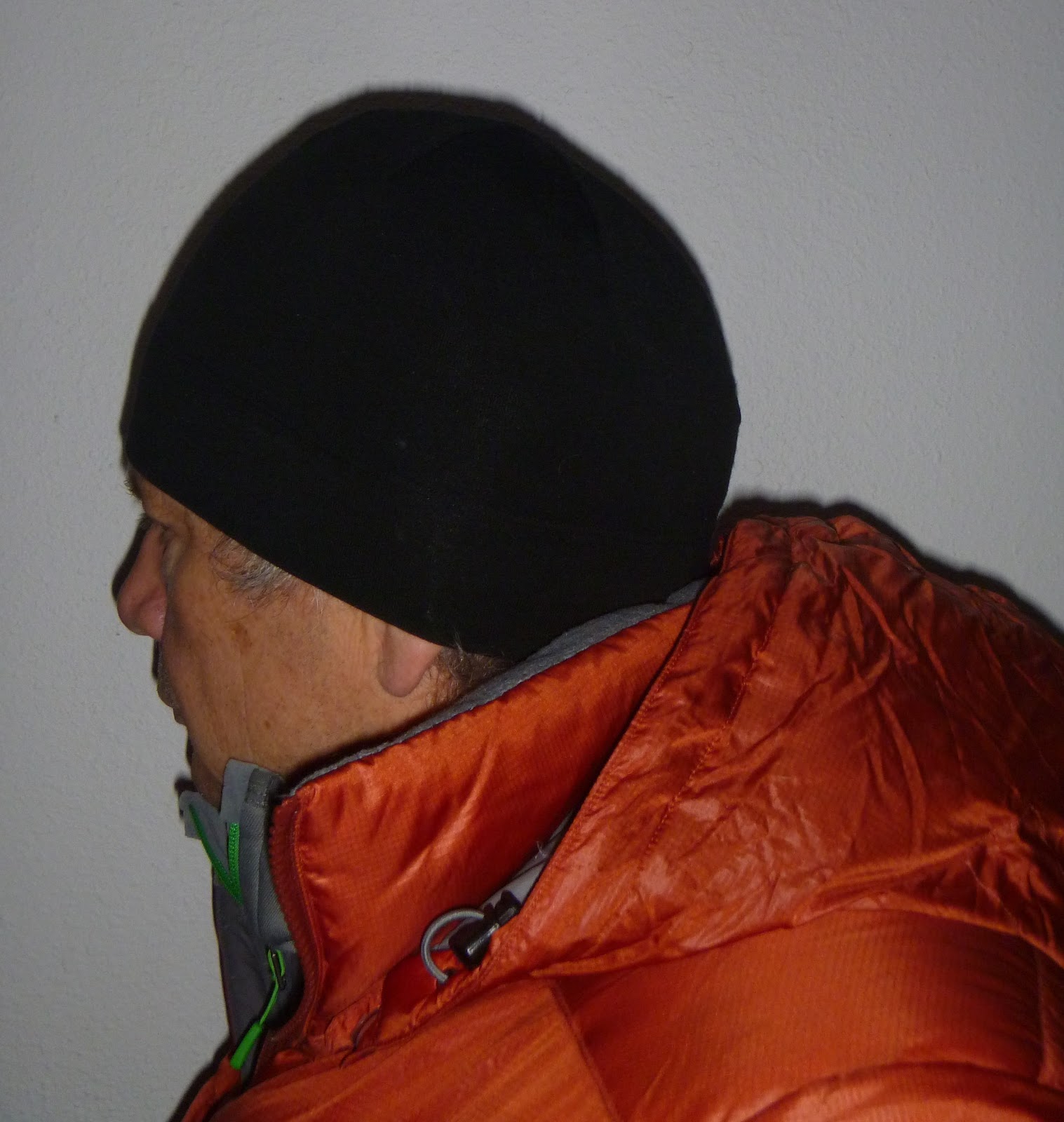
The Permafrost's excellent stand up collar and detachable hood


The RAB Neutrino Plus also has a stand up collar that includes the hood with a Velcro "latch". The "latch" allows one to climb in the jacket with the hood buried and free of snow when it is not up.


The Neutrino Plus also has a 30" back measurement in a XL.   The Permafrost is 29".  A little weight savings there.

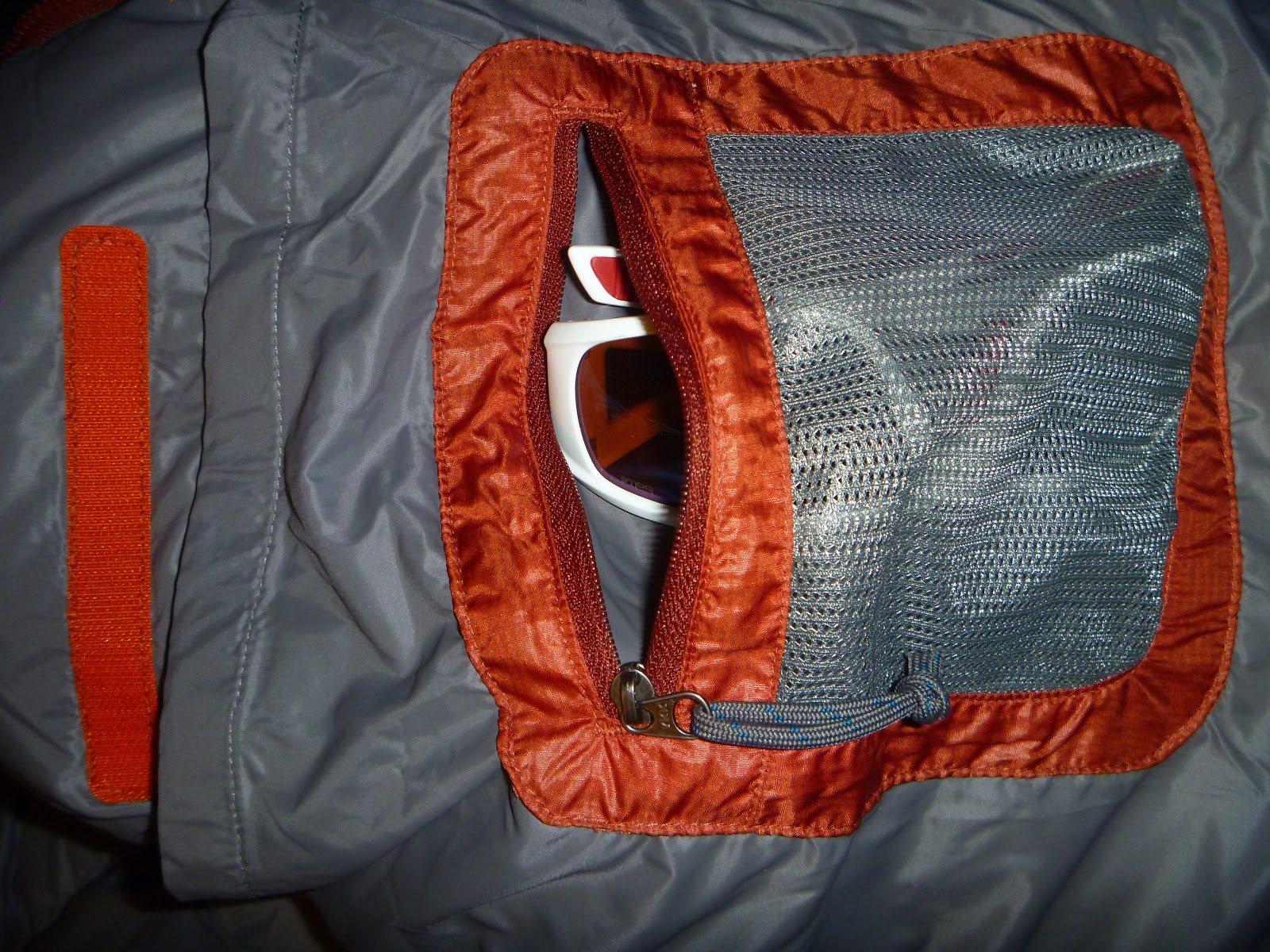
The best pocket combo I have seen in a jacket of this style.  Big gloves or 2 liters per side, easy, plus a sun glass pocket.   Hand warmer pockets with a micro fleece as well on the outside. 


Fair size sun glass pocket and the detailing of a Velcro closure on the big pockets.


The Permafrost has Velcro and elastic wrist closures which work extremely well. 


The neck and collar are both lined with a super fast drying, soft  micro fleece material. 


The entire shell has a DWR coating and is made of  Gore's Windstopper fabric.    Winstopper laminated fabrics have proven to  "offer total wind proofness and maximum breathability".


http://www.windstopper.com/remote/Satellite/toc/TechnologyOfComfortFrameset/index

All in all you have a very sophisticated jacket from Mont Bell.here.   Retail is $369.

I think it is well worth searching out the brand in your area and checking them out.

Backcountry.com carries them for mail order and  Pro Mountain Sports in Seattle does locally as well.

http://www.promountainsports.com/

How about a little humor?

http://teamcoco.com/video/bill-burr-doesnt-buy-oprahs-lance-armstrong-interview

Monday, February 11, 2013

Grivel Crampons? Respect is due....

G20 prior to the release of the improved 2012 G20


The blog allows me to see gear and comments from around the world on a daily basis and in a  timely manner.  

I had and used the G20 and G22 for a couple of years now off and on.  G12s previous to that.


While climbing in Scarpa boots the majority of time has made the Grivel factory front bail fitting rather problematic for me.  So I shied away from Grivel on my Scarpas and generally just climbed in the Petzl offerings.

Dave Searl loved his first pair of G20s to death.  I offer the title photo of this blog post as proof.  That is Dave's  "used" G20 above.   Used ( and worn out) mind you wearing the same Scarpa boots that I  seem to fret so on the fit.   :-)

http://coldthistle.blogspot.com/2011/11/grivels-g20-monopoint.html

Three places I don't fret about the G20's fit?   That would be the La Sportiva Spantik, the Dynafit TLT 5 or the Dynafit DyNA Series of boots.

The G20 and the G22 are the best fitting crampons I have seen out of the box for the TLT ski boots that I occasionally choose to ice climb in.


If I am climbing ice in ski boots, I am generally soloing.  And I really do fret about a crampon failure while in stainless.

Which brings me to the point of the conversation.   Back in the fall of 2011 Dave broke the connecting bar on one of his G20s while climbing at the Zoo.  The Zoo is a small mixed crag just out of the Chamonix valley at Le Feyet.  But plenty of climbing to be had there on a rainy day when the mountains are not an option.

The Grivel factory took a quick interest in the broken G20 and immediately replaced not just the broken connecting bar but replaced Dave's pair of totally worn out crampons as well!   That of course made Dave a happy lad!  And to be honest, really impressed me.  But the story didn't stop there. Hard to imagine I know, looking at how another crampon company has and continues to handle their own crampon failures...

Grivel didn't stop by just replacing Dave's the totally worn out G20s with new ones.  They took a very close look at why they failed.  Then they kept looking for ways to improve the earlier version.

Grivel went looking for the reason of the failure and how it could be done better and prevent the next failure.  No excuses, no questioning the customer' skill level, no blame on the use or abuse of the product,  no Internet blather and tasty talk, no "lost" crampons and  no obvious public tap dance.

Thank GOD!

It is clear now that two of the three biggest players in ice gear...what ever the problem.....just do the right thing and then....... get on with life.

My new pair of G20s and a pair of Haute Route crampons showed up on UPS today.   Which I paid for BTW.  They weren't freebies.

photo courtesy of Krister Jonsson
 
 
Both were purchased specifically for my Dynafit TLTs boots.    The G20s for real climbing, Cham's alpine ice in mind.  The light weight Haute Route version for the NW volcanos.  They both fit my TLTS almost like they were made for them.  Close enough for me not to fret anyway. 


My older G22s are the same perfect fit.
 
 
Respect and props are due Grivel here.  Grivel has immediately replaced the few pair of broken crampons I have heard of in the last three years.   (and none were an obvious flaw in design or materials)  They have also taken a critical look at the parts that were failing on occasion and redesigned them for the better.  No excuses, no song and dance routine.  They simply made it better.  IMO much better.  All this in less than five months of the first broken connecting bar to appear.

I had mentioned this before but failed to realise just how big the effort really was to come up with a better connecting bar for the G20/G22.  My G20s came with two full pages of printed literature describing what was done differently.  If you are new to Grivel, likely you would never notice.  I'm  not, and did.

http://coldthistle.blogspot.com/2012/03/another-look-at-grivel-and-g20.html

  "Grivel cares about the perfect fit." 

What I have quoted above is the first sentence in Grivel's informative two page, multi language hand out that come in the crampon box for the G20 and both versions of the G22.  Take it to the bank..or on your next solo.   Grivel does care about your crampon fit and your personal safety.   The effort didn't go unnoticed.  Respect is due.  Thank you Grivel!

Dane's new G20s and another perfect fit!
 
Thank you Grivel for allowing us that level of trust and keeping the stoke alive!


The Eiger?

Ally Swinton, on the Eiger's summit ice, photo courtesy of Dave Searle 


"With 1800m of climbing above us and no bivy kit or down jackets we wanted to get a move on so we put our heads down and soloed up to the base of the Difficult Crack."
Jon Giffith

http://daily.epictv.com/blog/2013/02/11/eiger-north-face-a-must-for-every-alpinist/

Sunday, February 10, 2013

Saturday's ski...


On Saturday I was lucky enough to do one of the many local BC tours.  The route has 4600' of climbing and is just over 13k long.  I hooked up with one of the local guide serves here for the day to get an idea of what people around my area were using for gear.    I thought  it would be fun to ski with a new group and see some terrain I hadn't yet.  Our day tour was close to Seattle and started, then returned to Alpental's upper parking lot.

The light was flat and we skied in and out of the cloud cover all day.  Never breaking into the sunshine.  I missed some of the really spectacular scenery I know surrounded us.  But that made some of the most interesting things I saw in our day's travel the gear being used.  I'd bet during the day I saw 30 or more BC skiers.  And it was a nasty, foggy and damp day for the most part.  Likely twice that many up there skiing that I didn't see.   Every single one of the I got close to were on skis over 100 to 110+ under foot.  Mostly well on the 110+ side.   And every one of the skiers in a 4 buckle boot.  At least in our party of 4 everyone was on a tech binding.  Dynafit being the easy winner here in the US at the moment.

But we were the exception not the rule. 

The majority (if not all) of the skiers I saw in groups of let pass me in the track were in some type of plate bindings.  Marker and Fritschi were both well represented.

Boots? All four buckle. The lightest a Scarpa Mistral.  The most common seemed to be any version of a Black Diamond.  But I saw something from everyone in the boot business.   The TLTs or even lighter boots, however were missing in action.  That surprised me.  Even two winters ago, the first season for the TLT, the boots were shy mid winter but by April there were plenty of TLTs in the trams around Chamonix.  I also noted the hurry everyone was to get out of their 4 buckle boots at the end of the day.  The real hurry!  But then I was able to walk comfortably the first thirty minutes of hard pack trail on the way in.  While they skinned.  May be that was the difference in foot comfort at the end of the day.  May be it is the difference  on how one fits a down hill ski boot and the fit of a mountain boot used to climb and then ski in.  What are your priorities?


Skis? You name it and under 120 they were likely there. Saw more DPS skis in one day than I do at a lift area. 105s, 112s and 120s were represented. I have to admit my DPS Lotus 138s would have been really fun on the two biggest descents of the day. But they would simply be track pigs on the skin  even in the "Pure" form.


Poles?  The obvious adjustable touring pole was the most common.  But standard length ski poles were there as well.  I use full on, and long, xc poles.

My guess is there was only one pair of Lycra tights on the hill that day.  But to be fair the Movement pants are hard to obtain most of the year.  Lycra is not however.  If I weren't in the Movement pant I'd still be in something resembling Lycra.   While I played with my upper system the first half of the day, to finally get it right my pants and longs under them were simply superb beginning to end.

A fair percentage of skiers in one or the other of air bag systems.  That one surprised me at $500 a pop or more likely twice that.  Have to wonder if those same folks bothered with an avalanche class as well.  It reminds me of the ski helmet fashion statement.  Great idea but would one ever think about not skiing that close to a tree or actually not skiing obvious avi terrain?  With 120 under foot?  Of course not.   I am still pondering that mental equation. 

Not a "heavy" set up by comparison to what I saw on Saturday but an idea in the differences of "heavy" and "light".   Add in the packs, what is in the pack and your choices in clothing and things change even more.

My 105mm under foot and 4 buckle set up weights in at 20# and change with:
Dynafit  Carbon Zero 4 boots
La Sportiva Hi5 in a 188cm
Dynafit ST bindings
precut skins
BD Carbon adjustible ski poles

My rondo set (not race gear mind you) is 78mm under foot and 2 buckle weights in at just under 13#
TLT 5 P boot
Broad Peak ski at 167cm
Dynafit low tech Race
precut skins
Salomon Nordic composite 145cm pole


I know the difference between skiing "combat boots" and the TLTs.  Even the carbon cuffed Performance version.  And no doubt a big rocked ski under foot makes child's play of difficult conditions and good conditions pure joy.  I only felt at a real disadvantage once on this tour.   And that was at the last hour of the effort in the exit  gully.  I would have preferred a wider ski for the snow conditions.  But  a fresh set of legs would have made short work of it compared to a fat ski.  Money can buy the fat ski.  The fresh legs will take more time.

By comparison though...no one in our party was immune to the tired legs.  My legs were just 7#s less tired for the effort.  Thankfully.

The last decent gully in better conditions than what we had.

http://vimeo.com/33986867

Of course, I fell down the best bit of it :) 

RAB GUIDE GLOVE REVIEW

Belaying Jess up Twin Runnels of the Moonflower, C.Pope photo

RAB GUIDE GLOVE REVIEW

By Craig Pope


I burn though 3-5 pair of gloves a season climbing on ice alone. When u log a lot of rappels, mixed pitches, endless gear and  rope handling, gloves wear out.

There are three areas a glove has to excel:  warmth, dexterity, and weatherproof. Naturally, compromises in warmth/weatherproof facilitate the dexterity  used to climb M-hard, and visa versa.

When I'm out "cragging"  mixed rock and ice, I almost always pack around at least a few pair of gloves, and the one pair I always make sure to have  with me is the RAB Guide Glove.  One pair took a beating fora whole year, including 3 weeks in AK. 

With a warmer, more durable glove,  comes the price of reduced dexterity.  However, with the Guide Glove, the way RAB  joins the insulation/liner to the outer fabric/leather eliminates slippage of the liner material - unlike the majority of warmer, thicker gloves.  I hate pulling a glove off only to spend 5 minutes tucking the liner back into each individual finger. I climb PLENTY of hard, technical  ice routes with these gloves on colder days. What little the RAB Guide Glove lacks in dexterity, it makes up tenfold in waterproof, breathable Event,  a full leather palm and fingers for durability.   I rappelled at least 350 ice/mixed pitches in the one pair last year, and only at the beginning of this season did I finally have to retire them...almost. 

When climbing the Moonflower on the North Buttress of Mount Hunter last spring, I found myself wishing I had brought two pair of the Guide Gloves - especially when the other pair of gloves  eventually became nothing but weight in my pack.  From simul-ing lower angle terrain with knuckles constantly in the snow, to freeing M7 with a pack and managing gear, to being turned around by hours of mind numbing, hammering spindrift...my hands were sometimes cold, but dry and able to function on an 8 hr rappel in miserable conditions. All of my toes suffered frostbite - and I narrowly avoided amputation  (tight single boots and dehydration the culprits), but there was no harm to my fingers. 

When I can see the last dozen pitches in an Ice gloves future, it's always where the stitching of the grip material connects the sidewall construction, (generally fabric), And almost always on the last three fingers if not between the index and thumb... With the Rab Guide Glove, instead of stitching and sidewall construction, the pinky finger is wrapped on two sides with a continuous piece of reinforced leather - but, just the pinky finger is designed that way. I would love to c ALL fingers covered on three sides without stitching.  When I did burn through some stitching on the two middle fingers, and the "almost retirement" consisted of sewing it back up, and continue wearing em!

Leather stretches, and glove insulation gets packed out. I was glad I bought my pair with a relatively  tight fit.  If I am climbing a route that demands a thinner glove, The RAB Guide Glove is always
clipped to my harness or in my jacket for belays and rope handling.

Always on the harness...photo Jenny Gaddy, at FA "licking Razorblades" banks last wk


.

Friday, February 8, 2013

Monday, December 17, 2012

My Day With Jack

By Kevin Landolt 


"People were always getting ready for tomorrow. I didn't believe in that. Tomorrow wasn't preparing for them. It didn't even know they existed."
- Cormac McCarthy


Doug and Chris had attempted the line earlier that season and climbed to within a pitch of the summit plateau. It was dark and storming hard as they traversed the final rock wall guarding the top and a fairly straightforward descent down a gully to the North. They could hear the wind raging like a freight train above them, and despite their desperate search for a possible exit (a crack, a corner, a chimney, anything!) their headlamps revealed nothing but smooth granite staring back at them. Without bivy equipment or a stove, they had to keep moving to avoid freezing, and unable to find the fabled crack that lead to the top, they had to begin rapping immediately. Doug would leave a good chunk of his rack on that wall during eleven seventy meter rappels to the snowfields below, where exhausted, wet and cold, they found a bivy cave and passed the few remaining hours until sunrise snuggling and doing sit-ups to stay warm.

So, Sheridan invited me to join him for another go at Taylor’s Central Buttress. Doug and I are training in his small garage, which is packed full of free weights, climbing gear, and a small forty five degree systems board.
Oh yeah?
Yep, and Jack Roberts is apparently coming along as well.
Have you ever met Jack?
I’ve never met either of them.
They’re both good guys. Sheridan is climbing super strong and is always psyched, and Jack… well Jack is Jack Roberts for Christ sake. Not only has he been crushing it for decades, he’s just one of the nicest guys you’ll meet.
Yeah, that’s what I hear.
The route is big though… probably bigger than anything else in the Park. Get an early start.


It’s dark, it’s cold, it’s windy. It’s the usual RMNP winter alpine-start requiring a high-commitment exit from your vehicle at the always gusty Glacier Gorge Trail Head - where cars rock back and forth in the gale and red eyed climbers crank everything from Slayer to Wu Tang to The Be Good Tanyas and gulp down last minute mouthfuls of strong coffee, knowing fully well they’ll probably have to shit within the first quarter mile or so of hiking... We walk through the forest following the snow-shoe highway towards the Loch. At first we chitchat, and I feel awkward around these two men who are so much older, more experienced, and more accomplished than I.As the miles go buy we separate by bits of personal space, our heads down, our lungs burning, our minds all thinking separate thoughts – each of us is in our own world. Mine is a dream world as I walk across the frozen lake, my headlamp illuminating air pockets and hairline cracks - the ice varying shades of blue. I’m terrified of not performing today, of not climbing well, of not keeping up, I fear they will not like me.

It isn’t long before Chris and I are far ahead, past the Loch, slogging up towards Timberline Falls below Lake of Glass and Sky Pond. We stop for water and some food and watch the sky come to light, the shapes of walls and pillars emerge from the darkness. Chris tells me about Jack’s feet – the bane of his existence and the result of a lifetime wearing mountain-boots and climbing shoes, of enduring frostbite, immersion foot, countless hours spent kicking steps and front-pointing in hard ice. I remembered reading a story told by Dougald McDonald about Jack having to cut slots in his already roomy climbing shoes to relieve the pain while climbing a new route on Devil’s Thumb in the Indian Peaks Wilderness. Jack still managed to lead the route’s runout 5.10 crux pitch in style. Chris tells me how Jack placed pads between his toes and rapped his feet in cloth that morning on the drive up. Damn – I think, but at the same time I’m worried. It’s nearly light and we have a ways to go before we reach the base of our route.


There’s a sense of dread floating around in my head. Maybe it’s just all the talk of epics and suffering on Taylors Central Buttress, talk of difficult mixed climbing, deadly runouts and dangerous snow-covered slabs. Maybe it’s the fact that I’m climbing with two people I’ve never met before this day. Maybe I’m still nervous about performing well and leaving a good impression on these two climbers who’s accomplishments I so respect. I slog on towards Sky Pond, the Cathedral Spires rising on my right, Vanquished Buttress and Powell Peak to my left, the Central Buttress of Taylor rising before me, growing bigger and bigger and more scary. These mountains are nothing to Jack and Chris, who have climbed the world over, and who’s accomplishments have graced the pages of history and influenced the lives of so many of their peers, but to me this mountain is massive, the face a daunting pile of choss covered in unconsolidated snow.

We rested again at a boulder beneath the final snowfield leading up to the face. Jack is a small dot below, slowing but surely gaining ground. Chris and I stash our gear and snowshoes beneath the boulder, rack up for the climb, and then proceed towards the cliff, sloggingupwards through knee deep snow. Jack will be here by the time you lead the first pitch, says Chris. Apparently I’m leading the first pitch. After nearly falling into a moat guarding the base of the wall, I carefully dry-tooled up a steep rock step to reach a ramp of snow leading up and right towards the Central Buttress.The snow of course was barely consolidated and resting on a granite slab – terrifying stuff. I groveled up the steep snow, digging for rock edges to hook and searching vainly for protection.I’ve never before or after climbed such steep powder snow and the thought of it peeling off in a cohesive slab made me tense. About half a ropelength up the ramp I found a hairline crack and pounded in a knifeblade as far as it would go, (about an inch), promptly tied it off and continued upward. A large chockstone loomed above me. I had an eerie feeling as I gently moved up the impossibly steep powder snow. Occasionally I would find footholds on the granite slabs to my sides and I stuck my tools sideways into the snow as deep as I could to gain purchase. At last I reached the chockstone, beneath which lay a small cave. I practically dove for it’s safety as the snow disintegrated around me. It wasn’t a difficult pitch, it was tedious, and it was very dangerous. I found little protection for a belay, just one decent spectre driven into a clump of frozen turf and a number three Camelot slotted deep in a flaring, iced over crack, but the cave its self seemed a good natural stance to belay from, so I began to bring Jack (who had arrived at the base long before I finished my lead) and Chris up to the cave. Within minutes I heard a shout and felt one of the half ropes go tight – I looked in horror as the Spectre twisted in the turf and the cam expanded in the flare, holding, but obviously strained. The snow had finally peeled off the slab, taking Jack for a short ride, but he was fine.


I passed the rack to Chris and settled into my belay jacket. Jack was eating a cliffbar. I felt very glum. Jack’s fall had proven real the danger I had sensed on the previous pitch, and it was already noon… the short days of December combined with the deep unconsolidated snow made the likelihood of reaching the notorious last pitch before dark seen unrealistic. I had class in the morning and knew my folks would be freaking out if I didn’t call them from Estes before midnight (they’re from New Jersey and just don’t understand the idea of a forced bivouac, of waking up so early to go climbing, are skeptical when I tell them cell service in the Park is scarce, and just plane hate me climbing. Eventually my dad would buy me a Spot PLB and insist I carry it I were to continue living under his roof… needless to say I fucking hate that thing and don’t use it anymore…) I kept my sense of futility to myself however, and Chris – who I was quickly learning is always psyched and never afraid to suffer a bit – set off up a difficult M6ish corner around the chockstone. I was impressed by his tenacity and grace as he quickly climbed the pitch, torqueing his picks in a thin crack and finding the tiniest edges for his front points. He protected the line with hard won RPs and knifeblades slotted into tiny seams along the way.


I took the opportunity to spend a few minutes talking to Jack, who seemed quiet and content, just happy to be out in the mountains climbing. We talked about mixed climbing in the mountains and how different it is from cragging at a place like Vail, or Ouray. Groveling up these alpine routes in the Park required a broad array of skill that made the pursuit more dynamic, more dangerous, and to some more rewarding. Open up any American climbing magazine and you’re led to believe that alpine climbing is dead or never existed outside of Alaska, Canada, Europe, and the Himalaya. Ice climbing is alive and well, but you rarely find it here in the high peaks. Winter ice is all about frozen waterfalls and spring or aquifer fed drips. Ice in the alpine forms early in the Fall and late in the Spring and come from melt-freeze cycles and feeder slopes of snow. Winter climbing in RMNP is more akin to Scottish climbing (minus the 100% humidity) and mostly involves dry-tooling, turf sticks, and sketchy unconsolidated snow climbing. It involves long days, long approaches by foot or ski, a very active and dangerous snowpack, full on mountain weather (RMNP is often referred to as The Patagonia Training Center, and is widely regarded as one of the windiest places in the West) spindrift, and climbing traditional alpine rock routes, but with tools and crampons in place of sticky rubber and chalkbags. RMNP is the perfect venue for such an adventurous form of climbing – it’s not really popular, nor is it likely to be, but it is my favorite form of climbing and RMNP is my favorite place. A couple years later, after many more fine climbs with the likes of Sheridan, Doug, and my friend Ryan – I would begin my cancer journey, and these guys with whom I had shared such fine adventures would remain my most encouraging, most supportive of friends. A true testament to the “brotherhood of the rope”.

I don’t know what Jack Roberts thought of me. I was keen to ask him questions about his routes in the Alps and Alaska Ranges, and about his life guiding. He was extremely modest about his accomplishments and honest about the difficulties facing a professional mountain guide. He seemed happy though, and I imagine he was an excellent guide, someone who wasn’t afraid to share their passion for the mountains with others for fear of loosing some of their own.

The second pitch was indeed difficult, and the fifty feet or so of steep rock gave way to more steep and deep slogging. I think it was about noon when Jack and I finally reached Chris’s belay. Above us lay about eight more pitches. I voted for bailing, considering the time and conditions, Chris was psyched to continue onward, or maybe traverse left to an easier route called Quicksilver, and Jack said he could go either way – although he did admit we might be in a “world of hurt” if we continued – which assured me I wasn’t being unreasonable. We thought it over for a while but my sense of doom and the thought of spending another night rapping down wet icy ropes (I had recently endured a 24 hour epic day involving a lot of wet and cold rappels on McHenry’s) won out. “Fuck it dude, let’s go to Ed’s Cantina”. So we rapped off, conveniently using two of Doug and Chris’s old bail anchors.


We all walked out together at a slow casual pace, commenting often to one another at some beautiful sight – a bird, a thin line of ice running down the Petit Gully, the clouds building behind the Sharkstooth. We talked about women and climbing and Jack mentioned how difficult climbing and guiding can be on a relationship, and said “get out of it while you can, Kevin. Get out of it while you can!” A few minutes down the trail he turned to me and said “it’s probably too late though, eh?” We laughed and Jack told Chris and I about Ecuador, where he would soon be guiding clients up volcanoes. He talked about how his wife Pam, had spent the day skiing by herself, and how fortunate he was to have a wife who loved the mountains and was understanding when it came to travelling. He said: "she’s pretty good at taking care of herself". I asked him about all the routes in RMNP that he had climbed over the years and made a mental note to remember the ones he spoke most fondly of.When we stopped for water and food I was surprised to see him pull a large stainless steel thermos from his pack and pour himself some tea. I guess light is right, but weight can be great. Like all professional alpinists he seemed comfortable and at ease, quickly shedding a layer while his tea cooled, he echoed my earliest mentor Ed Crothers with the adage “sweating is for amateurs”. His systems were so dialed he accomplished his tea-break and layer change in the time it took me to remove my pack and take a quick drink of water (after spending five minutes fumbling around in my pack looking for the bottle). At dinner in Estes, he spoke fondly about his early days wall climbing in Yosemite, his eyes glowing with countless memories of days and nights spent on walls, making the second ascents of The Shield, Zodiac, Tangerine Trip, Mescalito, and more. He said that wall climbing was great for his free climbing, that he’d spend a week on a wall hauling, jugging, hammering iron, and that he’d feel lighter and stronger when he was done. I practically blushed when he complimented me on my knifeblade placement earlier that morning - The best piton placement of the day, for sure.


After dinner we all shook hands and went our separate ways. I never saw Jack Roberts again, although Chris and I continued to climb together and had several excellent adventures that season as well as the following. His ambition, skill, and devotion to climbing in RMNP is rivaled by few. I am grateful for his friendship and the adventures we’ve shared. The day Jack, Chris, and I attempted the Central Buttress on Taylor Peak, a climber was killed in a fall on a route called “All Mixed Up” just one drainage over from us. Climbing in the mountains is a rewarding, worthwhile pursuit, but it is dangerous - brilliantly so – and that is why so many of us love it. The risks we take enrich our lives and remind us of our own fragility, our own mortality. I was in the hospital fighting for my life when I heard the news about Jack Robert’s death. Looking back to that day in the Park I wish that I hadn’t been the one who wanted to go down. I wish we had continued, I wish I could have had at least a few more hours with that man. While the climbing community mourned his loss, I felt his death (a fall taken while climbing Bridal Veil Falls) was a testament to an amazing lifetime spent climbing, a lifetime spent taking and accepting risk. In the cancer ward at Presbyterian St. Luke’s Hospital where individuals even younger than I were dying everyday, Jack’s death seemed right, like a good way to go. Some people mock the “he died doing what he loved” thing, but when it comes to Jack Roberts, he surely did and I’m glad I was fortunate enough to have met him.


Note: The photographs that appear in this post are of different climbs and climbers in RMNP - I didn't have a camera with me on Taylor Peak.


Another critical look at Ice tools and Umbilicals


Ally Swinton climbing.  Photo courtesy of Dave Searle


I get the, "which ice tool and which umbilical,"  question at least a couple of times a week.

My 2 cent on the subject.

It is ridiculous, silly really. As in dumb, dumb and dumber.

Not the question or those asking, but the guys building this stuff. 

Like crampons there needs to be a norm in the industry.  Best system yet I have seen? An incidentally the most fail proof system to date?

Petzl Nomic (or Ergo) with a Blue Ice Boa leash.  And I have climbed on most everything available.  From 30+ year old home made umbilicals to the first Grivel clip on versions to the latest versions from Grivel and BD.

Here is why I think the Nomic/ Boa combo should and could be the norm if the manufactures would simply *think* about the process for a minute.  Huge disservice to us not to IMO.

Hole in handle and full strength? Easy to do in any axe during production.  Check
Eliminates any  issues with dropped/disconnected biners. Check
Easy and quick on and off the tools.  Seconds in fact. Check
As strong and as simple as you want to make the nylon.  Check
Cheap to manufacture. Check

Grivel made the first commerical umbilicals I am aware of.  At some point early on they offered a wire gate biner with a really stiff gate as the attachment method.  Wire gate biners will not reliably stay attached to a fixed clip in point on a tool  They will eventually unlatch and lever off.  Common occurance now.

Grivel solved the problem quickly by adding a locking screw gate biner instead of the wire gate.
BD simply copied the earlier and faulty Grivel system.  Prone to failure from day one.  Stiffening the wire gate is not the answer.  Just a band aid actually.

I know of one fatal fall ice climbing last season where umbilicals were in use.  I've been told that on inspection after the fall one tool had disconnected entirely from the tool and both gates on the umbilicals were on the wrong side of the biner gate opening. 

One has to wonder if a more reliable attachment system might have resulted in a shorter, more controlled initial fall, with  less tramatic results.

The current commercial umbilicals are not designed to hold a leader fall.  But everyone knows that is how they are being used.  And have been now for decades.  Insurance for the leader to avoid a potential fall and security so a tool isn't dropped.

Easy to solve this problem on any tool with a little redesign of the shaft.  Easy to up the strength on the umbilicals by ditching the "biner" of any sort and building from a better and stronger webbing.  There is a lot of room for improvement here with both the tool attachment point and the umbilicals themselves.

I've climbed on almost every modern tool.  And on every commercial umbilical since the early preproduction and production models from both Grivel and Black Diamond.  With the resulting minor failures as the umbilicals snapped off mid route on many of those combos.  It is just happen stance that I like the Nomic and have used he Blue Ice Boa leash.  I didn't plan this.  It was a first time ice climber (thanks Jim) that showed me a better and cleaner way to lash up the Nomic with a BOA leash.  Not the technique I was originally using

But there are lots of ways to do this and several decades of history behind it:

http://coldthistle.blogspot.com/2011/03/boa-leash-by-blue-ice.html

http://coldthistle.blogspot.com/2011/01/ice-tool-umbilicals-repost.html

http://coldthistle.blogspot.com/2011/01/umbilicalssomething-to-think-about-and.html

http://coldthistle.blogspot.com/2011/02/curious-case-of-commercial-umbilical.html

http://coldthistle.blogspot.com/2010/04/bd-testswarning-on-umbilicals.html

http://www.summitpost.org/phpBB3/tethers-t59130.html

Then there is the "Best" way.

This is not an endorsement of "just" the Nomic or "just" the Boa leash.  It is only a statement on an "easy fix".  This is the umbilical style that will works well on that particular style attachment  point.  It is so simple.  Why isn't everyone doing it?


the initial loop in the umbilical leash and a full strength hole milled through the handle of a Nomic


Webbing flattened and threaded through hole, very easy
 

Same picture different angle, seconds are all that is required here
 

Pull the loop through and spread it
 

Turn the loop back and circle the handle just below the hole
 

Pull the long side of the leash snug...you are done.  This tool is set up for a right hand to keep the webbing bulk to a minimum


"Right hand" tool again, showing the "smooth" side of the Umbilical that the palm of your hand would go in.
 

This shows the "bulk" side of the tool.  Not all that bulky, really. 


Easy on and off in just seconds even after being fully weighted.

Blue Ice Boa leash is currently sold out world wide.  Check your dealer's shelf in the EU.
None in North America at the moment.

Seriously, I couldn't make this stuff up!  (Thanks Charlie)
Check out the video below:

http://www.youtube.com/embed/pYr1DVtWujM


Wednesday, February 6, 2013

It is all the same..


When I was a kid a few of us that had skied together started climbing.  Almost immediately that next spring as the snow melted out higher and higher the question came up, "are we now climbers or skiers"?  I remember having the discussion, likely over a coke and pizza, not beer,  more than once.  Geeze we were young!


Pretty naive discussion then, but it seemed so serious at the time.  Funny I would have a similar discussion just recently.  Just not quite as definitive but just as serious.

I don't look at climbing or skiing (at least back country skiing) any different these days.  If you are a kid growing up in Chamonix (lucky kid) or other real mtn towns around the world and have the opportunity to get out likely you won't look at them as separate sports either.  More of a life style.  You ski to climb and you climb to ski, the activity is  simply defined by the season you are in.  Snow boarders of course have gone to split boards and own ice axes for self arrest.  It is just semantics really.  One way or the other you need to ski to get around in the mountains 12 months of the year.

Make the wrong choice and any of these activities can easily get you killed.

Think about it, all the same skills apply in any mountain environment.  And in general it is your brain, and actually turning it on, then listening to it, not the gear, that keeps you out of trouble.

So what is really fun for me is to take specialised gear that might be considered only good for one sport and mix and match it to my benefit and use it in the arena I choose. 

Three items come to mind off hand that I have wanted to write a little about since I got them early last spring.  But haven't yet.  There are others I have talked about previous and will again.  And more yet that I'll give you a heads up on as I have time this spring.

The Dynafit TLT P ski boot is a great example of cross over gear.  I written a lot about this boot.  They say the new version the TLT6 will be even better.  I let you know when mine show up.  I'm a little leery that they "are a better boot".  Anyone with wider feet will be sure to be happier!

The TLT 5 in any version is a good ice climbing boot and incredible ski boots.  Easy to walk in and good enough to actually run in if required.  Warm enough for most any mtn environment.  As is, they have been to the summit of Denali many times now with the P's Palau liner.  The "almost" perfect mtn boot.  Damn close if you live in Chamonix or Jackson.

Yes, it is true, I am risking life and limb betting on not having another BD stainless failure! But they fit my TLTs very well, so worth the risk on occasion if you check them for cracks constantly.  I've pulled the bot plates so I can do that easier.  While you are looking for cracks check out the net pocket located at my knee with the bright orange Flash Anorak stuffed in.
 
The second piece of kit I really like and many might shun is the Dynafit Movement pant.  Lyra in part, snug fitting.  A built in stirrup and reinforced gaiter to keep skis from chopping the pant up.  Snug on the lower leg so crampons won't snag them and the gaiter material is tough enough to ward off the errant crampon as well.  Handy net side pocket the right knee.  Incredibly well placed and useful in fact!  And a middle of the back, "energy pocket" plus a zippered right hand pocket as well.  By far my favorite pair of pants to BC ski in or climb the volcano's in the summer.  Great weight, plenty of stretch and generally warmth enough alone.  Add your favorite longs as required to make them four season pants.
 
The Movement pant cut out for the TLT boot buckles.  They are intentionally made to accommodate any ski boot buckle system or just left uncut and a fully functional pant with a sewn in stirrup. 
 
The Movement pant uncut using them for summer alpine climbing
 
White and grey are an unusual color combo until you are spending the day on a big glacier under a broiling sun.  Then it makes sense.
 
Skiing?


Climbing?  There really isn't much difference in the grand scheme of things
 
 
The last two pieces are from CAMP.  The Flash Anorak is simply brilliant imo.  It has no back.
 
"The Flash Anorak is unlike any other shell on the market—it has no back! This ultralight wind shell is carried in a pocket that attaches to the waist belt of any day pack. When things cool off, unfurl the anorak and pull it on without removing the pack. The shell is attached at the waist to prevent flapping and gives excellent protection from wind and even light drizzle. When no longer needed, simply take off the shell and stuff it back in the pocket without removing the pack. This is going to be a favorite with anyone moving fast in the high country."
 
4oz of wind and rain protection 

If you take off your pack you will need something else over the Flash


Because, if you look closely, the Flash Anorak has no back!
 
And in the bag it goes and around your waist.
 
Brilliant if you are carrying a pack anyway.
And you never have to take your pack off to put it on or take it off.
A lot of possibilities there if you open your mind. 
 

Don't let the uniforms scare you away from trying some really useful and unique gear!
 
And finally...the lightest (or at least one of the lightest currently) helmet in production?
 
That would be the CAMP SPEED.
"With a weight of 7.4 ounces, it's the lightest UIAA-certified helmet on the market. "  Jack turned me on to this one when he showed up in Chamonix in a the lid.  The color grew on me :)  But knowing Jack had changed brands and had been climbing in a Meteor prior (like me) did get my attention.
 
Petzl's new Sirocco helmet is claimed to be 5.8oz so it now owns "the lightest" bragging rights.
Take a Petzl Meteor and their newest Sirocco, throw them both in a blender and what you'd come up with is a CAMP SPEED.  The Speed is in good company with those two. 
 
Jack Roberts, doing what Jack did best.....teaching

 More here on the Camp Speed
 
Guiding in some of the most incredible terrain and snow on the planet, the Bugaboos, 1985.   It is all the same....but you knew that already, didn't you?