Pageviews past week

The cold world of skimo & alpine climbing

The cold world of skimo & alpine climbing

Wednesday, October 10, 2012

The Ultimate question isn't it?


Good interview here as well:

http://www.tetongravity.com/blogs/Interview-Tempting-Fear-With-Andreas-Fransson-And-Mike-Douglas-6378877.htm

and more here on another huge line....

http://www.planetmountain.com/english/News/shownews1.lasso?l=2&keyid=40154#


Tuesday, October 9, 2012

Two good repeats in the Mt Blanc Range

Great stuff here!  The new ice season has definitely started!

Both these routes were freed as hard mixed lines.

Jeff Mercier and Korra Pesce on a exceptional mixed line originally done in two days, August 1967 by Jacques Léon Dard Reppelin. It was repeated again in two days in July 1972,  by Jean-Michel Cambon and Jean-Marc Boivin.      And again in two days by Jean-Claude Droyer in the winter of '72 solo.

(my French translation my be faulty on the details above, my apologies if so)


And one of the few *complete* ascents of  Beyond Good and Evil by Matt Helliker and Andy Perkins.  This one a 20 year old test piece put up  by Andy Parkin and Mark Twight in 1992.

http://www.ukclimbing.com/news/item.php?id=67490

Kilian again!

Photo of Mont Blanc courtesy bigstockphoto.com


A few of us took note of this when it happened back in Sept. but I was  unable to put it into context here.  His run on the Grand is likely better understoof by the NA locals.

More here on that one:

http://outerlocal.com/hiking/the-grand-teton-a-runners-peak-outpost

This should help with the Innominata climb.

"Kilian Jornet, 25, one of the world's great endurance runners, has speed soloed the long, technical and exposed Innominata on the Italian side of Mont Blanc in a scant 6:17. The time is amazing on many levels. While technically the climb is easier than the north faces of the Eiger or the Matterhorn, the scale is much greater and the objective dangers are higher. Jornet, who is not even known as a climber, started from the church in Courmayeur at roughly 3,300 feet and ran the 12,000 feet to the summit of Mont Blanc, then ran over 12,000 feet down the French side arriving at the church in Chamonix in a total time of 8:43."

There is more and worth a look.

""Can you imagine what I could do if I had the physique of Kilian?" Steck told Rock and Ice."

http://www.rockandice.com/news/2250-kilian-jornet-takes-speed-soloing-to-next-level  

More on the Grand climb:

http://outerlocal.com/hiking/the-grand-teton-a-runners-peak-outpost

Running Grand Teton trailer from Teton Movie on Vimeo.

Monday, October 8, 2012

Calories in and Calories out?

Calories in and Calories out?  I had always thought all calories were the same.  They are not.

Loosing 50# in 9 weeks during chemo last winter made a huge impact (for the better) on my life.  I am still within 5# of that lower body weight.   Not having the support then that I wanted and am still looking for in diet and nutrition has sent me on a rather strange and long term journey.  Today a good friend sent me a couple of emails with links that I really didn't have time to watch.  But I did make the effort tonight.  They were well worth my time.  Thanks Bruce!

We train for climbing and sort through tons of gear and clothing but the real "tools" is our mind and our body.  How are you treating yours?   If you think that your age or life style changes are catching up to you and you are gaining weight because of it, this might be an eye opener.   One point I found very interesting was the difference in what and in what amount the additives changed in the mid '80s.

This is a short version on "calories".  The material gets pretty technical but it is well worth watching as many times as required to get the best understanding of the subject.


The original version is here:

Friday, October 5, 2012

Super light wind shells?

5.11 trad, circa 1988 with a Patagonia wind shell in tow


There are few pieces of gear that have been a consistent staple in my gear collection for a few decades.

I can limit it to boots, pack, crampons, and a set of axes for the most part.  And in that tiem frame all of them have changed several times over.  Except one.  When it comes to clothing two items have remained pretty consistent.  A decent lwt down jacket and a light weight wind shell.

Only the lowly wind shell has literally saved my life a time or two.   Literally considered "emergency equipment" for the most part.  Like in the picture above tied around my waist and unnoticed until needed.

Same shell on the summit of Rainier circa 1984


I generally take one of these along  when the weather is "perfect" in the mtns but I'll be out long enough or up high enough that  the weather can change in short order.   Alpine rock climbs with a good change of a thunder storm or a perfect day on the local volcanos that is bound to be windy at sunrise.  Or for my ultra light trips where I generally end up suffering a bit if my plans don't go as first thought out and I end up huddled around a fire all night to keep warm.

2012


Or when I just want something to add a little warmth and break the wind while while still breathing well as I try to move quickly on a easy approach like walking out to Professors in chilly temps.

Spring 2012 and still the same wind shell @ 6oz for my Large.


They seem to last awhile and are light in weight (around 5 oz in a large) and for the most part pretty wind proof and breath well.  The best fabrics these days also offer some rain protection with the most modern fabrics.  For my ancient gear I just give them a good soaking to get a DWR with something like Nikwax fabric coating.  And try to keep them away from an open flame and wind blown embers.

I get teased every time I put on my 80's purple Patagonia pull over shells (I have 2 ) because the bright colors gives away the age.  Not like my white hair doesn't!  So while my Patagonia piece is the for runner of the current Patagonia Houdini (retails @ 125 or under, some times WAY under so look around!) of today the only thing that seems hard on any of the them is fire.  After I collected a bunch of pin holes in my favorite shell during an unplanned overnight stop with a resulting fire to keep me warm till morning I went looking for a new shell.

I found three I think are worth mentioning but there are any number of them out there.  Patagonia Houdini is a good place to start if you don't like what I ended up with.

The first up is really the rock star of the bunch.  Camp's MAGIC ANORAK aka Flash Anorak.  Brian (who convinced me to buy one)  has a great write up on it here:

http://www.getstrongergolonger.com/journal/2011/12/24/camp-flash-anorak.html


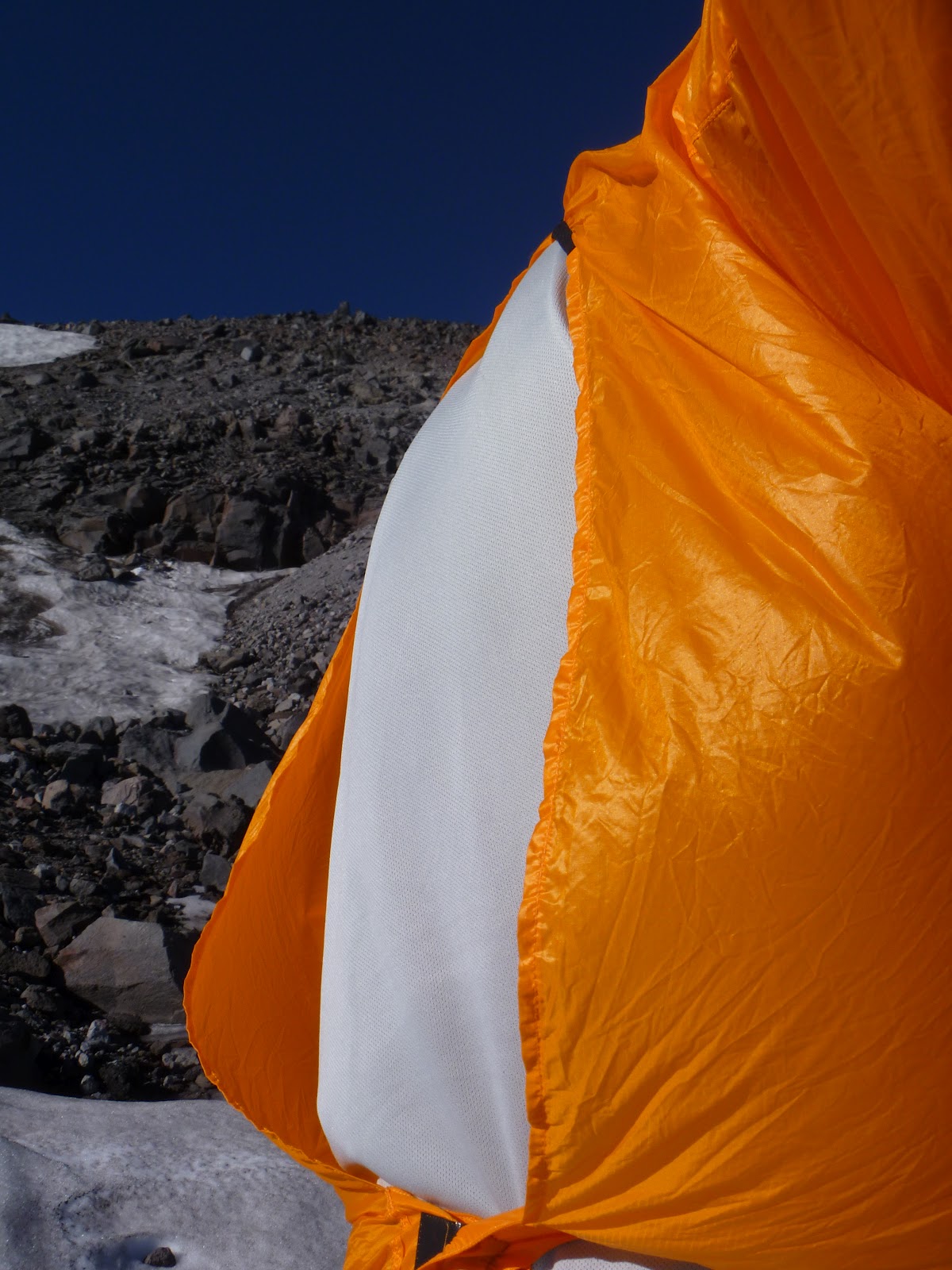
Yep, no back on this one and you cna add or take it off without removing your pack.  At first I thought it only a skimo gizmo for the race guys.  Now it is one if nto my favorite for serious stuff in the mtns.


MAGIC ANORAK
• Climbing, Running, Skiing, Hiking, Cycling
• The lightest, most compressible hooded wind shell in the world!
• Proprietary Araneum fabric is uncoated, yet windproof and water resistant
• Built-in stuff sack measures just 4” x 2.5”
• Chest pocket closes with a Velcro flap
• 9-inch front zipper for ventilation
• Velcro tab holds rolled up hood to prevent flapping
• Lycra cuffs on the bottom hem and sleeves
Constructed from innovative Araneum fabric, the Magic Anorak weighs only 3.4 ounces and fits in the palm of your hand. Araneum is a 20 denier nylon ripstop (35 g/m2) that is 33% stronger yet only 10% heavier than 15 denier fabric. The Magic Anorak is indispensable for light and fast outdoor athletes who cannot afford to carry extra weight, but may find themselves in adverse conditions. Clip it to a harness for long climbs or toss it in a pack as an emergency piece on aggressive cross-country hikes or ski tours. Because Araneum fabric has no coating (its technical features are gained from the tightness of the weave), the Magic Anorak can be washed time and again without affecting performance.
SPECS
ID: 1669
Sizes: S - M - L - XL
Weight (medium): 91 g, 3.2 oz  (4.2oz for my XL)
$89.95 USD


The RAB Cirrus Wind Top:

Next up is my now "every day" lwt.  The Camp Flash
was so good I figured I needed something with actual
full coverage for when...like I wasn't wearing a pack!
I am using this one every where and for things I would
never pull out an anorak for.  Running, biking and even
throw it in my pack for a day of cragging.  Or off for
a beer in town if the weather is decent enough to sit
on the patio.  Love the full zip but it still seems like
I am cheating some how.  But one of my now favorite
pieces of kit.


            Useful kit as Ally shows on the summit of Mt. Blanc.
photo courtesy of Ally and Jon Griffith @ Alpine Exposures

http://allyswinton.blogspot.com/2011/08/innominata-ridge.html

http://www.alpineexposures.com/


The Cirrus Wind-Top is the full zip version of the Cirrus
 Pull-On.

Using the same Pertex Quantum 15 Denier fabric as the Pull-On
the Wind-Top also features an under-helmet hood and 2 zipped
hand-warmer pockets.Designed for fast and light use the Cirrus
Wind-Top is a fully featured jacket that can be used over layers
to create a warm and windproof clothing system yet weighs in at
 just 120g / 4ozThe Cirrus Wind Top is ideal for adventure racers,
 mountain marathons, fell runners, mountain bikers, or even for
super lightweight alpine style ascents on rock where wind proof
protection is required.

Sizes: S - XXL
Weight: 120g / 4oz  (4.6oz for my Large)

$110 retail

http://us.rab.uk.com/products/mens-clothing/windshell_1/cirrus-wind-top.html


Last but not least is an interesting new shell from NW Alpine.

With a retail of $475.00 American DOLLARS I am not sure
what to think yet.  I have yet to wear a lwt shell out..even
the less than $100 ones.  But then I try to take care of them
and they don't generally get to touch granite.  Simply because
it will shred a normal lt weight.  Bill @ NW Alpine may be
on to something here.    My Eyebright weighs in at  5.4oz for
a size Large.  Mind you Bill is looking at the Eye Bright as
"the lightest fully featured waterproof/breathable jacket
on the market".

As in "fully featured" like any of the Gortex, H2No or Event
shells offered by others in a similar price range.  This could
well be the ultimate lwt waterproof and breathable jacket
and a lwt wind shell or body armor as a bonus.  If it is, with
the kind of durability claimed the $475. might actually
be a be a bargain. Just remember any of these shells will
melt if you add a little heat!


World’s Lightest Full Featured Waterproof/Breathable Jacket
The name Eyebright refers to the genus of many species of flowers
 that thrive in high alpine meadows where their small size belies
the strength it takes to survive in harsh mountain conditions.
The Eyebright Jacket is built from waterproof/breathable non-woven
Dyneema® fabric. Unlike other ultralight jackets that will tear at
the sight of granite, our fabric provides tear strength and abrasion
 resistance superior to any other material of it’s weight. The
waterproof membrane is one of the most breathable available
on the market. With fully taped seams, adjustable cuff tabs, an
 adjustable helmet-compatible hood, and chest pocket, the
Eyebright is the lightest fully featured waterproof/breathable
jacket on the market. Simply put, if you need a shell that
weighs almost nothing, packs small and can stand up to the
abuse of alpine climbing, bring this jacket on your next trip.
Available in white, made in the USA.


Wednesday, October 3, 2012

Rockies climbs..?

"Josh Wharton following a pitch in the upper gully section of Infinite Patience. Sustained grade 3 and mixed up to M5 for at least 300 m"

Photo courtesy of Gripped, Josh Wharton and Chris Alstrin  


Nice write up here:

http://gripped.com/2012/08/sections/articles/rockies-lessons-from-novice-to-intermediate/

Sunday, September 30, 2012

La Sportiva Olympus Mons, dbl boots part 4


The last of the blogs on currently easy to acquire (at least in North America) dbl boots.


But if you are here best to take a look at the other 3 contenders as well.  Also worth typing "double boots" or your specific model of interest (like "Spantik" or "Baruntse" or "Scarpa 6000") into the search engine on the blog.  There is more on every boot and some inner boot and fitting tips for all of them.

http://coldthistle.blogspot.com/2012/06/double-boots-climbing-specific-part-one.html

http://coldthistle.blogspot.com/2012/06/double-boots-climbing-specific-part-two.html

http://coldthistle.blogspot.com/2012/06/double-boots-climbing-specific-part-one.html


OK, the details?  First you will want to know that the SHELL of the "Oly Mon" is 90g or 3.17 oz @ 1230g heavier than the  Spantik SHELL @  1230g in my size 45s.  The fit of both boots is similar but not exactly the same.  The Oly Mans is a loose fit in the front of the boot.  It is not a snug technical fit.  But it will still climb anything most will want to use this boot on and much more imo.  If you have wide feet it just might be a good answer for really cold weather boots.  The Spantik on the other hand is a ratehr tight and technical fit on my size 12 and very narrow feet.  I find the Oly Mon actually more comfortable and easier to walk in.  Your foot also sets closer to the ground in the Oly Mons compared to the Spantik which is part of that.  I weighed only the shells here because I will use a Baruntse Palau liner in both boots for the best fit, more durable and easiest to use inner boot.

Even with the very thin lug soles on the Oly Mons sole (the reason you are closer to the ground) I have to wonder what that does for the warmth of the boot?

The lace system on the Oly Man is at least as easy to use than the Spantik.  Which is great for the conditions you would want to use this boot.  No flies there on either boot.  The Oly Mons is a VERY warm boot and has the volume to convince you of that fact.  The Oly Mons is 6.5" around the instep where my Spantik measures 5" in the same place.  Another 1.5" of insulation.   Sole length is virtually the same @ 13.25" on my 45s though so they aren't longer just more volume on the top of the boot to keep your feet insulated and warm.

Hard to visualize but the Oly Mans is likely 25% bigger or more by volume (which is what will keep you warm everything else being equal) over the Spantik.


Hard to believe the Spantik is a "little' boot when compared to the Oly Mons.   But it really is.


In his excellent article on Alaska climbing and gear my Brit friend Jon Griffith suggested, "If you want to climb technical routes then, for me, it's really it's just a choice between the Scarpa 6000 and La Sportiva Spantik. If you are going to be moving a bit slower then you'll really want to look into the big selection of high altitude boots available."

http://www.ukclimbing.com/gear/review.php?id=3994

One of the few things Jon and I might disagree on.   No surprise as others might disagree with me  as well.   At least for alpine climbing on routes of moderate difficulty by today's standards like the Cassin and other routes in Alaska where is really is as "cold as it gets" nothing wrong with having the warmest boot you can fine.  If you aren't paying a huge weigh penalty to use them. With the Oly Mons there is little or no weight penalty compared to what you are getting.  I have not played with the others in the "big selection of high altitude boots available".  But by any account the Olympus Mons Evo  (Oly Mon) is one of the high altitude boots Jon is writing about above.


Easiest boot for me to compare the Oly Mon to is the Spantik.  The lacing in the Oly Mon is easier for me than even the Spantik (simple Velcro tab) to and get a great fit.  You don't have to really crank it down all that hard.  Which I do on the Spantik to get as good of fit.  But you can snug the Oly Mons down when required.  The foam and fabric "outer" boot seems to form around the inner easier (either inner) and give very good support for technical climbing for a boot this size.  And I still have good toe room which will equate to extra warm.   The gaiter is a little funky. (and nothing should be "funky" on a $1000 boot for crimney sake)   To actually use mine any where the warmth would be required would also mean a trip to the cobbler to have the gaiter taken in first on the the lower leg in for a more snug and tapered fit.  If for no other reason than to keep the snow out.  Easy, but really?  Why do I NEED to do this on a $1000 boot?

The gaiter's zipper and Velcro closure is good.  The top closure not so good and not adjustable.  Even when I had a couple of more inches in my calves prior to chemo the elastic top was only snug with something akin to a down suit on.  But the the gaiter is slim enough for even a klutz like me to generally keep my crampons out of the gaiter.  The gaiter's  closure needs some work and I'd rather have an even more tapered gaiter or something that I could adjust the gaiter width with.

The gaiter will also had an immense amount of warmth to these boots if you have to break trail or just wallow in the cold Alaskan powder behind your partner.  But no over boot to fuss with and nothing to add.  It is a simple system really.  This boot is also one I would look at using a basket front attachment for crampons.  Much easier to use in really cold conditions and very secure.  Not required but worth thinking about.

Make no mistake the Oly Mon is a very specialized boot.  Perfectly suited for Everest or Denali's Cassin or West Butt in April and May.    Some compromises have been made to up the warmth and keep the weight down.   The sole rubber is made of very soft and a very sticky rubber toe cap.  This boot is made to use on snow and with crampons.  Use them on a gravel trail or a rubble field and you'll quickly wear them out.

But if you need to do some reasonably technical mixed and you know the sticky rubber and good feel will be there if required.  

Good review of what this boot will do on technical ground that mortals can make comparisons to here:

http://e9climbing.blogspot.com/2009/04/robert-jasper-drama-and-m7-in-olympus.html

I really like this boot.  I don't like the price tag (*$990 retail) but then Porsches and Cervelos are in a similar market niche.  The best you can get and not for everyone or every use.  For most I think it is a better boot than the other three listed previous for any climb on Denali or above 6000m in the coldest  ranges.  Others will disagree.  I've never used a boot even remotely this warm or this light in 8 trips to the Alaska range.  But I would like to once I get the gaiter sorted out.

I always found you could go pretty light up high if your feet are going to stay warm.

To be honest if I could only afford one pair of dbl boots the price point and my budget would likely  decide for me which boot I would use on Denali the next time.  For the harder technical lines if I were quick I'd take the Spantik or 6000.  For a 3 or 4 or day climb of the Cassin or a casual trip up the West But?  The Oly Mons would be my boot of choice above 10K.   If I were going to Denali and had room on the credit card I'd likely order all four of the boots mentioned in the dbl reviews from Backcountry or Zappos (someone with easy returns) and try them all on and THEN decide.  Once you have made your own choice send the rest back for the credit.

The La Sportiva company line?

This super lightweight double boot has a PE thermal insulating inner boot that is coupled with a thermo-reflective outer boot with an integrated gaiter.
We used a super insulating lightweight PE outsole to keep the weight down and the TPU midsole is excellent for crampon compatibility and stability on steep terrain.
IDEAL TERRIAN: High altitude 8000 meter peaks


WEIGHT: 39.86 oz • 1130 g
LAST: Olympus Mons
OUTER BOOT: Cordura® upper lined with dual-density PE micro-cellular thermal insulating closed cell foam and thermo-reflective aluminium facing/ Insulated removable footbed/ Vibram® rubber rand
INNER BOOT: Water repellant breathable upper with polyamide external layer/ Dual-density PE thermal insulating micro-perforated ventilated foam/ Tri-dimensional structured polyester lining combined with pile
GAITER: Breathable Cordura®/ Kevlar anti-perforation fabric/ Riri Storm® zipper (UV resistant & waterproof)
INSOLE: 5mm Carbon Fiber + 2.5mm PE micro-cellular thermal insulating closed cell foam topped with a thermo-reflective aluminum layer reinforced with perforated hydrophobic non-woven facing
MIDSOLE: TPU/ Micropore EVA
SOLE: Insulating Vibram® PE w/ rubber toe inserts
COLOR: Yellow/Black
SIZES: 39 - 47 (half sizes)
ITEM NUMBER: 290
PRICE: $990 USD


Owner's handbook and  MUST READ about this boot.

http://www.sportiva.com/resources/images/Buttons_Graphics/OlyMonsTechBook.pdf

(same inner as the Spantik BTW)


Heat Moldable Liner Important Instructions:
La Sportiva recommends that you read the following instructions carefully before proceeding to heat mold your boot. The company does not accept any responsibility for damage caused to third parties due to incorrect use of product. La Sportiva recommends that heat molding is carried our at a specialist shop.
Steps to follow for the correct adaptation of the shoe to your foot:
1) Turn on the oven and set to the ideal temperature of 130 degrees C.
2) Put the La Sportiva liner in the oven and leave to warm up for 10/12 minutes.
3) Make sure the external boot shell is completely open and that it is kept at room temperature.
4) Insert the foot bed into the liner to determine the "top-cap" height within the boot. Use a sock to help the foot slide easily into position.
5) Remove the liner from the oven and insert your foot. Make sure that the underfoot seams present are not deformed. Proceed as quickly as possible so that the lining does not cool down thus losing its properties.
6) Fasten the liner tightly.
7) Allow the foot to slip within the liner and the liner shell, keeping the gaiter open. Be careful not to damage the liner in any way.
8) Make sure the heel is well positioned towards the back of the liner.
9) Buckle the external shell with just sufficient adjustment in tension and set the boot aside until completely dry (about 10 minute)
After Care:
  • Remove the liner after every outing
  • Allow the boot to dry naturally, never by a heat source
  • Avoid over heating the liners. Store in a cool dry place during the summer months
  • The liners can be hand washed in cold water

    Friday, September 28, 2012

    Climbing fitness?


    Yes, that warm up really was 18 pull ups!    I searched out and talked with John a couple years ago knowing he had over come the same injury I had at the time, which was complete distal detachment of both bicep.  IIRC his advice was something like, "after surgery, suck it up and get back out there!"  I think he was in his mid 60s at the time and already back doing what you see here after those injuries.  Inspirational video.


    Thursday, September 27, 2012

    AAR on Manaslu from Glenn Plake

    iframe src="http://player.vimeo.com/video/50287644?color=999999" width="500" height="281" frameborder="0" webkitAllowFullScreen mozallowfullscreen allowFullScreen>
    EpicTV Weekly 22: Manaslu Avalanche: Glen Plake's Story from EpicTVAdventure on Vimeo.

    Sunday, September 23, 2012

    Avalanche on Manaslu


    Avalanche on Manaslu: Glen Plake is Alive, Rémy Lécluse, Greg Costa and many others are still Missing.


    More here:

    www.epictv.com
    

    http://daily.epictv.com/blog/2012/09/23/avalanche-on-manaslu-plake-alive-remy-and-greg-missing/

    Saturday, September 22, 2012

    Measure!


    I spend a lot of time measuring things.  I measure my work in steel to .0001" or better.  I get a consistent body weight every morning at a certain time to .1 of a pound.   I want to know how hard I can climb on rock to the letter grade or how fast I run a 5 K to the second.

    I want to know if I am in the black on a target.  Is it in the X ring or just a 10.  I want to know how many pull ups and sit ups I can do and my blood pressure and resting HR every morning.  My Max HR on the bike and on a run.  And I want to know what my dbl boots and my bikes weigh to the gram.

    I measure because I want to do better.  If you aren't measuring how do you know if you are doing better?   The fact is you don't.   The flip side of that is if you aren't getting better you are getting worse.  If you don't measure you don't know what is better or what is worse.  There is nothing that takes any kind of physical skill that stays the same for long.  Use it or loose it.  Measuring it will help you keep it or better yet get better at it.


    Cancer, Climbing and Endurance Sports.

    Bald as a cue ball but thrilled @ my first day out in the mtns last spring


    Cancer is a discussion I would have avoided like the plague a year ago.  Even with family members dying from it I was intentionally in denial when the subject came up.  Just didn't want to go there for any reason.

    When I was diagnosed the two things that scared me the most were...how I was going to get through the treatment and how I would rebuild after the treatment.  Yep, admittedly, it became all about me from day one.

    From day one my Doctors told me that I would loose 25% of my body mass in 7 weeks.  Once I got my head around that number and figured out just what it would mean I was worried.  And they were spot on at the end result.  The current crop of oncologists know how to kill cancer.  Keeping the patient alive while still being able to enjoy life after the "CURE" is the real issue after the fact is my thought, then and now.  That at least from my admittedly limited experience.  They (the Docs) have little clue on how to deal with the aftermath.  On the recovery end of things I am healthy now in spite of my Oncology staff not because of them.

    I am alive today, but without treatment, last year's prognosis was I would be dead by now.  I had asked....back in Sept of '11.

    As I always say...what works for me may not work for you.  

    So I am using this forum and the traffic generated here to make Internet searches easier for those like myself that were/are looking for a info about treatment and the aftermath experience of  "Cancer, Climbing and Endurance Sports."  Not that I am an expert on any of that.  But *ANY* info is hard to find.  Good info from those that have BTDT even harder if my experience is any example.

    I know several guys with a wealth of experience in training all sorts of athletes, endurance athletes in particular.  Some with world wide reputations doing so.   To my surprise none of them had any worth while experience with cancer or cancer patients.   Every CANCER is different as is every treatment protocol.  So it is no wonder they came up empty handed.

    There are several million women who have benefited from the Danskin Series.

    http://www.xxtramile.com/charitable.html

    More yet from Livestrong both men and women.

    http://www.livestrong.org/Get-Help

    I looked at both.  And my wife and I spent hours on the Internet looking for useful info  and talking with sources that  many sent me too.  (Thanks Brian ;-)  The biggest help by far?  My nursing staff.  Make sure you ask yours the questions that are nagging you.

    This week as I was doing my 2nd PET scan another climber and cancer survivor (Rusty) sent me an email.  Both of those events made me rethink writing more on http://enhancenotdefine.blogspot.com/

    http://enhancenotdefine.blogspot.com/

    That blog is now an open forum, anyone can post or ask questions.  There are no filters.

    It is a bit of a mess at the moment but I will start adding climbing and endurance sport related comments as I have time.  Guest blogs from those that have BTDT are welcome!  I am hoping it will become a good resource so no one has to go through the same dark tunnel I did.

    Friday, September 21, 2012

    Typical day in the Alps?!

    May be for the "Machine" ;-)

    Thursday, September 13, 2012

    Sun glasses part One?


    There was, once upon a time, an era in gear where you could have bit of kit that could do most everything well.   Or so it seemed.

    Funny when you look into the minutia how things have changed.  Sunglass innovations over the last 50 years being no different than anything else we climb with today.

    Let me start with another preamble.  What works for me may not work for you!  I leave on the wet side, in the foot hills of the Cascades...a short drive from Seattle.  When we do get bright sun light here it is surrounded by green.  A sea of green in fact.  So even bright sun light here is tempered by the lush green surrounds that are easy on the eyes.   That is good for me as I have very blue/gray eyes.  Blue eyes are no the best in bright light.  I typically don sun glasses earlier and leave them on longer than friends with a darker eye color.  

    On snow or water I want a pretty dark lens.  On days when others might not notice the sun I'll still want some protection from the sun.

    What I got in the past was a glacier glass that was either generally too dark, like the Varnet Cat Eyes in the picture above at 11K on Denali's West Butt.  More likely I would use  a lens that was some what lighter in shade that wasn't great mid day but could be used dawn to dusk.


    Galiber Glacier glasses on the left with light colored lens used spring bc skiing.


    The same Galiber Makalu glasses on the summit of Liberty Cap.


    At least for me in the mountains, the Varnet, no matter how fashionable, the lens was nearly always just a bit too dark.  The Galiber lens generally too light in bright mid day sun.   Both were glass lens.  But the Galibier would fold flat, had a very durable metal frame that packed into a no frills aluminum case.  I used those glasses for years of climbing.  Finally selling them recently on Ebay for $300 to a mountaineering paraphernalia collector.  The same glasses that sold in the mid '70s for $38.00.  Galiber's "best" version, The Everest,  was photo sensitive and sold for $50 when a Chouinard piolet sold for $35.    Sold knowing full well, today I could do better  for eye protection.


    I've used (and still do) various models of Oakley sunglasses since the companies inception.  The shooting sports were the first place I saw polycarbonate lens quickly take over the market for eye protection.  Oakleys have literally saved my eyes more than one while shooting.   There you take the "protection" seriously if you want to keep your eye sight.


    But as good as the early Oakleys were for eye protection while shooting I never found them particularly suitable in the mountains.  They were bulky, fragile and just didn't offer the protection I needed on snow.   I haven't seen that change enough to convince me look at Oakley again for mountain glasses.  And at their current price points for what you are getting...I have left the brand behind for my own use cycling, triathalon or running glasses as well.   There are better glasses in my opinion for every use and much better values to be had.

    But let's look back a bit before looking forward to what is easily available now.

    Glass lenses?  You would be hard pressed to find a glass lenses these days.  Varnet and Maui Jim being two exceptions.  And both lens worth the effort and money imo.  I have glasses from both that are now 20 years or older and still in perfect condition.

    yellow
    green
    brown
    gray

    Here's are some advantages to certain colors and the best sports for each color:
    Sunglass Lens Tint Color
    ColorUsesSports

    Yellow or orange
    Provide less overall brightness protection, but excel in moderate-to-low level light conditions. They provide excellent depth perception, which makes them perfect for skiing, snowboarding and other snow sports. They also enhance contrasts in tricky, flat-light conditions.cycling (yellow is excellent for seeing better in fog); indoor basketball; handball; hunting; racquetball; shooting; snow sports: skiing, snowboarding, snowmobiling; tennis.

    Amber, rose or red
    Makes the world seem brighter. They provide excellent low-light visibility and enhance contrast (perfect for skiing and snowboarding in cloudy conditions). They also enhance the visibility of objects against blue and green backgrounds, which makes them ideal for driving or exploring in forested areas.cycling; fishing (amber lenses for when you can see the bottom of the lake or stream); hunting; shooting; snow sports: skiing, snowboarding, snowmobiling; water sports.

    Dark amber, copper or brown
    Blocks high amounts of blue light to heighten contrast and visual acuity. Particularly useful to improve contrast on grass and against blue skies.baseball; cycling; fishing (especially in waters with grassy bottoms); golf; hunting; skiing; water sports.

    Green
    Heightens contrast (mildly) while preserving color balance.baseball; golf.

    Gray
    Color-neutral, which means they cut down on overall brightness without distorting colors. These darker shades are intended primarily to cut through the glare and reduce eyestrain in moderate-to-bright conditions.all outdoor sports in bright sunny conditions.

    Ya, I find this kind of stuff  funto know when you are going to drop over $100 on glasses.  More yet for a comparison.

    "Lens Color
    Lenses can vary, based on function, style and purpose, and the color you choose can affect more than just your fashion. While fashion is a huge reason people choose styles of sunglasses, picking the right lens will make a tremendous difference in functionality. Additionally, polarized lenses will make as much of a difference as color in terms of reducing glare and optimizing vision. Depending on the sport and the sun conditions, the right lens color will change your vision dramatically.

    Gray and Green – Gray and green colored lenses maintain true colors when looking around and are considered neutral lens options. They are best for bright sunshine.

    Brown - Brown lenses cause minor color distortion, but they also increase contrast. Brown lenses are best for overcast days or flatter light when the sun is still shining.

    Copper – Copper colored lenses are great for medium and high-light because they enhance contrast without creating significant color distortions. Many fishermen choose copper lenses because copper helps bring out the contrasts while keeping the colors real.

    Orange (Vermillion) and Yellow – Orange and yellow lenses are perfect for pilots, fishermen, hunters, marksmen and boaters because they increase contrast and depth perception. They do increase color distortion, so they are not right if you need to see colors clearly. Orange and yellow lenses are best for low-light scenarios (dawn, dusk, or storm days), when you still want some protection from the sun, but your main objective is to add contrast to the surrounding scenery.

    Rose: Great for low-light conditions, rose-colored lenses keep the colors relatively neutral, but they add a bit of contrast in flat light.

    Blue and Purple – Blue and purple colored lenses do not function to enhance vision and are mainly used for fashion purposes. Enough said.

    Clear: While they may seem to serve no purpose, since they don’t in fact block any sun, clear lenses are perfect for night sports. Many night skiers and evening cyclists, as well as night fishermen choose to wear clear lenses. They help keep your eyes from watering and they keep bugs and dust out of your eyes letting you focus on the task at hand."

    I use sun glasses for several activities including, driving, on the bike, running, climbing, shooting and simple eye protection. (ice climbing or shooting)

    So not every sun glass I use works all that well for every use I have.   What works for my blue eyes didn't work at all for my climbing partner of Japanese decent with brown eyes.   In part 2 of  "Sun glasses" I will discuss my observations on glasses new and old from Varnet, Bolle, Cebe, Native, Optic Nerve, Oakley, Maui Jim, Julbo and Bausch & Lomb.  No surprise that I have some favorites from that list.  You might also find my experience with what the various companies have offered for warranties interesting.

    Double boots part 3, The Scarpa 6000


    The Eiger, photo courtesy of Dave Searle collection

    http://davesearle.me/


    Here is how the current and easily available double boots add up.

    weight of one size 45 boot.

    Scarpa Phantom 6000 with Baruntse liner 2# 8oz /  1134g

    Scarpa Phantom 6000 new 2010 model 2# 10oz / 1190g

    La Sportiva Spantik with Baruntse liner 2# 14oz / 1247g

    La Sportiva Spantik standard liner 3# 1.5oz / 1362g

    La Sportiva Baruntse 3#4oz / 1470g

    La Sportiva Olympus Mons 3#6oz/ 1530g

    No surprise Dave Searle and I are both fans of the 6000.  The intimate details are covered here:

    http://coldthistle.blogspot.com/2011/11/scarpa-6000-boot-review-by-dave-searle.html

    http://coldthistle.blogspot.com/2010/08/its-back-scarpa-6000-dbl-boot-and-2.html


    As are Mark Westman and Jesse Huey

    http://coldthistle.blogspot.com/2010/08/more-on-spantik.html

    Friends Jon Giffith and Will Sim are fans as well.

    http://www.ukclimbing.com/gear/review.php?id=3238

    http://www.ukclimbing.com/gear/review.php?id=3994

    Jon sez:
    "I suspect that the 6000 is going to be a more pleasurable boot for technical ascents and for cold ice climbing areas but for big mountain routes the Spantiks gains the upper edge for warmth and with extra foot support for big ice fields (think about being on your front points for hours on end and you get the idea). This was especially brought home to me on the Colton Macintyre on the Grandes Jorasses last week when my partner's calves and achilles were screaming and mine were fine. This is by no means a complete comparison between the two but merely an overview as this will no doubt be of interest. However the key thing here is that really they aren't the same boot: if you want something light and technical then the 6000 is the better choice but if you want a more robust boot for the big mountains with a bit more support for romping up ice fields and skiing in then the Spantik would be the winner."

    I've owned and climbed in both Spantiks and 6000.  I would be climbing in the 6000 now if they were offered in true half size. (ya, dream on there)  I just had to make the decision again while replacing boots this fall.  When you have to decide between a bigger shell size (which is significantly larger) instead of a true half size I went back to the Spantik knowing I would have to dick around with the fit again in a smaller shell.  But for me dbls are difficult enough to climb hard technical ground in.   Making an big boot even bigger with a less than perfect fit is no help at all. Given the added weight of a size 46 6000 and dropping weight by using the Baruntse inner in a 45 Spantik,  the weight seemed a wash to me.  Advantage to a proper fit or at least the best fit (making them easier to climb in) on the Spantik.

    Plus I like the fact I have a more durable, warmer and easier to use inner boot with the addition of the Baruntse liner inside the Spantik.  Not happy about the 1/2# in gained weight over the 6000.  It wasn't an easy decision to come to on my part.  I settled for the best fit, for my crampons and my feet.

    If there are any other worth while comments or reviews on either of these two boots I haven't seen them.  If you know of any please forward them will you and I'll add links?

    All these boots are expensive and generally a major expense if your winter climbing demands them.  It is frustrating to me as a consumer to not be able to find more info on them.

    Part 4 is on the the Oly Mons coming shortly. 

    Wednesday, September 12, 2012

    Mt. Alberta...

    Worth the click!

    http://vimeo.com/49288195

    Thursday, August 30, 2012

    Freedom?


    plastic or leather?

    Was there ever any doubt?  The video is from April 2011.   The Nepal Evo and earlier Nepal have been around over a decade now.


    A better overview I think with one only one minor mistake....the Kayland M11+ is not what I would call a super cold weather boot. (black and silver boot with attached gaiter on the left of the screen)   Although it is one of the best, single layer, technical ice climbing boots available.

    Wednesday, August 29, 2012

    Drugs in sport?


    OK, no question I am sensitive to this subject.  The recent cancer and more major rehab efforts in the not so distant past than I care to remember high light that sensitivity.  But with what I realized just recently was over 40 years in endurance sports let me offer a few comments and more opinion yet..

    I first noticed "enhanced athletes" when one of my climbing partners was light years beyond any of his peers in strength.  He also had a health club membership that cost more than my monthly apartment rent while we were in our mid 20s.  His personal coaching staff and trainer costs were way beyond the club's membership dues.   Younger than me by a few years he had already successfully competed internationally in two different sports.   He was gifted, talented, strong. and well supported financially.  It was years later before I put two and two together and came up ( in my opinion) with the idea of his obvious use of performance enhancing drugs.

    The same guy worked hard and was obviously talented as well.  I've know a number of world class athletes over the years.   But it was obvious even then what he was getting from his work outs was not what we were getting from ours.

    Still it is only my opinion that my friend was using "dope" to enhance his own climbing.  After all, how many enhance their own climbing by a little "weed" these days?  Last trip to Index made it obvious many do.  Red Bull,  a triple expresso, Gu?  Where does it start or end?

    Herman Buhl used Dexedrine on Nanga Parbat.   These days we have living at altitude to increase red blood cells or buying a bed chamber to simulate sleeping at altitude to increase red blood cells or blood doping to inject your own red blood cells.  Diamox?  Better yet Oxygen?

    How many will take advantage of the IV option in the Grand Columbian Ironman distance race in September?

    "For all Iron and Super distances (Aquathlon included) athletes may optionally purchase an 1000 ml IV during registration for $35 that guarantees them accelerated post race hydration and accelerated recovery. The purchase will assure you a no hassle IV that will set you on course for a quick recovery. We will have medical staff waiting at the finish line to administer them."

    http://trifreaks.com/grand-columbian-super-tri/

    I know from experience how long it took me to fully recover physically from a sub 12 hr long tri course event.  No question an IV would have helped that recovery.  I used two "force feed" 1000m IVs after a nasty bit  of food poisoning when I was still required to perform, for "better or worse".   But how can you not consider that doping?   The same (IV) is a common occurrence in the pro peloton btw and totally legal.  And how do you decide when to do an IV and what to add to them.  It is so easy to add something to an IV.   I literally lived off nothing but IVs for 5 months last winter so I know some of what is possible once you start sticking needles in your body.  Yes,  that was just an IV, no food or water via the mouth for months.   It isn't just a slippery slope but a quick road to hell if you view doping as "hell".

    I have friends in the military who have commented about the use of "juice" used from Viet Nam to Iraq and Iran.  And none of them were pilots.

    http://www.csmonitor.com/2002/0809/p01s04-usmi.html

    For any climb going past a 24hr c2c effort there are a lot of ways to chemically enhance your physical abilities if you are willing.  Funny though as my only recovery for any climb has always been a hot shower, a good meal and some decent sleep.  Even the massages I have always saved for after a hard bike or  exceptionally hard run.   Just never had the money for a massage when I was climbing hard.

    Take a look around any big city triathlon or the local road races (bike or running).  Sorry but IMO 60 year old men just don't finish in the top 10 or even top 20 of a 500 person race without being a past professional or a damn good collegiate athlete in their 20s.   Even then top 10?  Not on their own is my bet.  The availability of drugs for the geriatric crowd these days is simply amazing and more common than you might think.

    "Through the intelligent application of today’s performance enhancing drugs, we no longer have to succumb to the natural stages of life. So long as that man is willing to do his part by putting the required effort into his training & nutrition, he will be able to stave off and even reverse the aging process on both the inside and the outside."

    http://www.ironmagazine.com/2012/performance-enhancing-drugs-the-middle-aged-man/

    http://www.prospectmagazine.co.uk/magazine/the-age-of-enhancement/

    But then may be I am full of shit and no one really has any idea what the human body is capable of yet.
    May be the world really wasn't flat after all.  Imagine the possibilities.

    http://www.runningandrambling.com/2009/09/fast-old-guys-rule.html


    Just food for thought.
    Next?  Back to the regular program of climbing and awesome gear.

    Thursday, August 23, 2012

    Lance and how it relates to climbing?


    "I know who won those seven Tours, my teammates know who won those seven Tours, and everyone I competed against knows who won those seven Tours. We all raced together. For three weeks over the same roads, the same mountains, and against all the weather and elements that we had to confront. There were no shortcuts, there was no special treatment. The same courses, the same rules. The toughest event in the world where the strongest man wins. Nobody can ever change that. Especially not Travis Tygart."  Lance Armstrong

    Personally?  I say fook the posers and USADA.

    I don't get too wound up about anything, past my family, dogs, bikes and climbing.

    I knew of Lance long before my own cancer showed up last fall.   I learned something about Lance when we "shared" the same chemo treatment, cis-diamminedichloroplatinum, trade name Cisplatin.

    I got three, one day doses of Cisplatin.  Each literally shattered me physically.  And each dose  much worse than the previous cycle.  Lance did 4 cycles, each cycle 5 days long!  That is one  definition of real suffering.

    By most accounts I figure I am a fairly tough guy when it comes to pain.  Lance lived through a entirely different level of pain.  Not one I would willingly follow.

    How does this relate to doping and climbing?  When some yoho tells me they lead 5.11 trad and then can't get up a 5.8 crack without a hang or then wants to lead WI5 ice when they can't get up a Grade 3 cleanly, I shake my head and ruefully crack a smile.  "Waste someone else's time...not mine", is what I am thinking and not very kindly at that.

    I don't care how hard you climb...just be honest about your skills with yourself and your partners.
     
    Lance took on the best of his time and came out on top.  I can attest in a small way, that it took some serious effort in a couple of ways to get there.  More than most will have in them.   The same way I know what it takes to climb trad .11 or vertical ice.  The same way Ullrich, Basso, Pantini, Zulle, Kloden and the rest knew Armstrong deserved his wins.

    Armstrong was never Cesare Maestri.  I am really sickened by the posers writing all over the Internet about Armstrong.  Most are  typically people who have never suffered or succeeded in sport or survived a serious illness and have no idea what it really takes to "win" at either.   I think Travis Tygart, and USADA has done a terrible disservice to the sport of cycling and Armstrong that can never be repaid.

    As I said previous......I hold really strong opinions on only a few things that I'll care to share in public.  But in Armstrong's case, "FOOK 'UM!"

    What are you on?


    Update. August 30 2012

    Got this link from Livestrong this morning asking for MONEY.  As a cancer survivor myself  and  9/2/11 diagnosis anniversary date coming up, I find LA wrapping himself in "cancer" instead of following through on his own claim of innocence shameful.  I am not pleased with USADA nor am I pleased with LA's reaction.  There are no winners here and much has been lost by both sides imo.   Lance has given only one thing to the Cancer community while taking in MILLIONS.  That was a gift of  HOPE.  And worth every penny no matter what the money trail is.  By not fighting the USADA what ever hope Lance did give is now gone IMO.   Lance is right about only one thing.  Time to move on.

    I don't give a shit if he doped.  I do care if he continues to lie about it and hides from the truth while wrapping himself in the mantel of curing Cancer.

    It is now time for BIG George ( George Hincapie) to earn his reputation.  He needs to stand up and tell the truth about what happened @ US Postal.

    Take a moment to read these:

    http://www.outsideonline.com/outdoor-adventure/athletes/lance-armstrong/Its-Not-About-the-Lab-Rats.html?page=all

    http://www.outsideonline.com/outdoor-adventure/media/books/Lance-Armstrong-Case-Closed.html?page=1


    Then watch the new video.

    Wednesday, August 22, 2012

    The 2 man Bivy Sack?


    The Things They Carried: The Bivy

    Climber Freddie Wilkinson reflects on how ideas advance gear, and gear changes adventure
    By:

    "The man who climbs only in good weather, starting from huts and never bivouacking, appreciates the splendor of the mountains but not their mystery...." —Gaston Rebuffat, 1953

    "The first time I held a grown man was on the South Face of Cerro Poincenot, in Argentine Patagonia."
    Freddie Wilkinson

    More here:

    http://www.outsideonline.com/outdoor-gear/gear-guy/The-Things-They-Carried-Bedfellows.html?page=1

    Wednesday, August 15, 2012

    Alpinist Andy Houseman's Interview, Denali's Slovak


    And his partner Nick Bullock?

    http://dmmclimbing.com/news/2012/07/reflections-on-the-slovak-direct/


    Monday, August 6, 2012

    First STOKE of the season!

    Just having coffee with Pete and Marko at OR last week got me revved up for the rest of the alpine season and the winter to come.  The video?  You can decide for yourself :)

    Systems?

    I have been thinking about this subject since last last winter when I was first able to get back out on some Canadian ice.

    Conversations over the week at OR just reminded of of the subject and encouraged me to finally put this one out there.  OR is if nothing else the ultimate gear head meeting in North America.  There are bigger shows but not on this side of the pond.

    The comment I hear again and again is "how easy" the newest gear makes life in the mountains.

    I agree 100%.

    My story?  I am climbing harder in the mountains now while being older with less skill, being less fit and with less courage than I was 30 years ago.  How is that really possible?

    First one that we forget is climate change.  It is in fact warmer every winter.  So for much of the climbing I do the conditions are a lot warmer.  That is a big one we often over look.  I am not sure the "systems" I use now would work as well if the conditions averaged were another 15 degrees colder.

    None the less all of "us" are finding what we climb in for clothing today really has made climbing in general much, much easier.  The first rule of thumb is "stay dry to stay warm".

    I'll start from the ground up and describe what I am using in typical winter conditions, in mid February on the north side of the Midi in Chamonix to Andromeda in the Canadian Ice fields.

    I am using a very light weight, lightly insulated boots given the chance.  Fit is always a personal issue but so are the technical features such as crampon fit, mid sole flex, warmth, foot, ankle, calf support.

    30 years ago if some one had told me I would be using a "soft" ice climbing boot on vertical ice in the future I would have laughed at them.


    Yet the boot pictured above, the Scarpa Phantom Ultra, if given a choice is the boot I prefer to climb in today.  And while the boot pictured above is my size, I out weigh the user in this photo by 30#.  So in actual use I get an even softer flexing boot.   It makes them easier to walk in.  But given a slight change in climbing styles it also makes them a much more versatile and generally easier boot to climb in on technical ground for me.

    Mind you I don't want a boot that is any softer or less supportive!   But this one (boot styles and technology)  surprised me in many ways.


    The Phantom Ultra is by the manufactures description, "is the lightest of the next generation of the Phantom series. The new uppers are a made with combination of materials designed to save weight yet provide enough insulation and weather protection for Scottish winter climbing and summer alpinism."

    Please be patient with me for a bit here as I relate all this back to the topic of  "systems".

    A softer flexing boot allows your feet to stay warmer because it is moving and flexing more naturally. Given enough insulation from the ground to combat the cold temps and enough protection above the sole to keep moisture out you can have warm feet if your feet stay DRY and have good circulation in a similar boot.  Think of the old Army Mickey Mouse cold weather boot compared to a Spantik for flexibility.

    Mind you I don't want to stand around in -30 temps in a pair of Ultras but I have.  And amazingly I stayed warm enough.

    I believe (after all this is just theory on my part) that the Ultra stays drier inside during use than the older generation Batura or its big brother the Phantom Guide, because it lacks insulation and breaths better.  Your feet (at least mine do) sweat a lot.  Getting rid of that moisture is a priority.

    Such a priority even the difference of using a pant gaiter over the boot instead of putting the pant into the boot gaiter is important to staying dry and keeping your feet dry.  And of course what the boot gaiter is made of and its ability to pass moisture is also equally as important.

    Systems?  Light weight four way stretch materials that are both water proof or water repellent make a huge difference in pants.  The differing layers that can be worn under the "outer shell" or just as likely, now bonded to the outer shell are almost unlimited.

    I have gone from 3 pairs of medium to heavy socks in my mtn boots to two pairs of really light layers.  The same thing has happened on my lower body.  I am down to a pair of long johns and a outer layer pant for the most part.  But I can see a time (and have used prototypes) that mean only a pair of half johns or boxer shorts and the outer layer....insulation included.   All the stripping of additional layers means more *comfort* and freedom with every step and climbing movement.  And with the current stretch materials added less effort involved.

    These days, water proof, breathable (really breathable), 4 way stretch, durable and super light weight is not only possible but could be common place if you know where and what to look for.  Having seen some of this already I am getting even more curious as to what is available and even more demanding of my own choices.

    Sad but true, if you are climbing in gear that is even 10 years old, and more likely even five years old, you are wasting energy.   That is a fact.  As much as I don't like a market driven economy in climbing..especially alpine climbing.... these changes are here to stay and the changes are making our goals in the mountains (or just outdoors) easier to obtain.

    From easier to prepare and carry food to lighter weight, more flexible and more durable clothing things are changing for the better...rapidly.

    On the upper body I have gone from several layers to 3 as a system.  The garments used may change depending on the temperatures expected but it is the same system.  I am hoping to hear from some of the more active outdoor designers themselves about the systems they are using.  I don't even see everything that is available in materials let alone get to test all of what is available out doors.  The OR show just drives that home to me with every edition.    More feed back from some of the guys at the "cutting edge" is really exciting for me.

    It is really fun to still be involved at a time when every piece of kit from crampons, harness, tools,  boots, gloves, clothing through to helmets are changing radically in such a short time.

    The newest helmets are 165g...a 1980's state of the art helmet 648g

    A Nomic is 600g and 1980's Clog 875g

    Clothing has gotten warmer, drier and much, much lighter across the board in everything from socks to gloves......while adding full four way stretch.

    Cold weather, technical boots and crampons combos are still stuck at the magic 1350g (3# for a size 45) after a full 30 years of "development"!


    There is always more to come!