Pageviews past week

The cold world of skimo & alpine climbing

The cold world of skimo & alpine climbing
Showing posts sorted by date for query 6000. Sort by relevance Show all posts

Tuesday, November 28, 2023

Warm feet? Do I want a Double or Single boot?

 Or maybe better asked, "How to avoid this?!"


This is the Internet.  So, the following is basically a "rinse and repeat" of earlier info posted prior.

I'll get to the boot question in a minute.  But if you have never had cold feet, feel free to skip this one.  Cold feet have been a reality for me since my very first outdoor endeavors, literally starting in the 3rd Grade!   That was a long time ago and I have learned to manage cold feet for the most part, even after some serious chemo induced neuropathy, but warm feet are still an ongoing process, decades later.

I can barely remember now, crying from the pain in my feet as a 3rd grader, and twenty years later the pain of having to walk off Mt Rainier in cold mid-winter condition in only my socks.  My feet swollen and frost bit from a bad bivy on top of Liberty Cap and unable to wear my boots once my feet unthawed.

I like technical gear and those discussions.   But let's start this conversation with some basics that have little to do with the gear you buy.   This part is free, just needs to be installed on your hard drive, located between the ears, and is worth more than any pair of boots.


Been a while since I have made a serious blog post.  But if you can make use of the search function here, in the content are some comments on staying dry to stay warm. 

It took me a long time to figure out a lot of my cold feet issues are/were caused by wet feet.  I now suspect my feet naturally perspire more than the next guy's.

VBL socks and antiperspirants can help there.   I have used both to good effect.  I have climbed a lot in some very cold conditions, (-40C and elevations up to 22,000ft ).   I've only had minor frost bite once, that winter in Mt Rainier in 1976.   

Bottom line on wet feet?  If your socks get wet from sweat your feet will eventually get cold.  You can protect the insulation in your socks with a VBL (but they tend to slide around some) or by using a good dose of rub-on antiperspirant.    I like antiperspirant and a thin sock, relying in the boot for insulation.

More on the boots shortly.

You need to know the source of the problem before you can solve it, right?   So, no wet feet!

That is a good start.  A number of reasons I can now list as to why I froze one of my feet on Rainier.  All, but one, were trivial mistakes by a rookie.    The same mistake, most make, is the culprit almost every time.

Dehydration.

Get dehydrated and tired in cold weather and you are very likely to become a frost-bite victim.  Simple as that.  Both dehydration and physical exhaustion are pretty much a part of winter alpinism.  Do your part.  Stay hydrated, and go out physically fit.

Fitness?

No one wants to be a mouth breather.  And not everyone is Colin Haley.  If you can climb as fast as Colin, you might get up the Cassin, unharmed, in single boots.  If you plan of belaying all the mixed pitches and stay a couple of nights out on the Cassin, best to take a good pair of double boots and enough fuel (which means bringing a stove) to stay hydrated.  

Colin wasn't the only one on the mtn that year (2018) in singles.

"5) Better gear.
Compared to my previous attempts, my crampons, ice axes, helmet, umbilicals, and clothing were all lighter weight. Also, this time I carried single boots rather than double boots, and no stove."

Cassin Ridge Speed Solo – Skagit Alpinism (colinhaley.com)


Common sense once you figure it all out.

The black set of toes above?   Not mine thankfully.  And I wasn't on that particular climb.  But it was one of the coldest nights I have spent in the mountains sitting in a tent below them. They had an open bivy.  Temps lower than the climber and his gear were prepared for.  But I'd guess it was the dehydration and wet feet (from hard climbing all day) that were the real culprits.   It wasn't fitness or a gear issue IMO.   

Look closely at any climbing frostbite injury and very likely something similar will jump out as the cause.

Cigarettes?   Not an uncommon suggestion. Nicotine is indeed a vasodilator.  Best to do some more reading on the subject if that is the answer you prefer.   I'll stick with dry feet and a better water intake :)

"Vasodilators dilate arteries and/or veins. This results in increased blood flow and lowered blood pressure. Vasodilators are commonly used to treat high blood pressure (hypertension) and heart conditions."  


"Hello friends with terrible toe circulation, have any of you tried a full double boot and found it to be significantly warmer than a lighter tech option?" BM

Not an uncommon question.

Still, I don't think it is the right question on how to solve "cold feet".

Good hydration, dry feet, and right up there, as the "most important" basis for warm feet, is boot fit. If the boot doesn't fit well you are simply screwed from the get-go.

Almost everyone will find one brand of boot a better fit than another brand of boot. The boot you may have your heart set on (and your pocketbook) may be the worst boot for your feet. A smart buyer will use the Internet and their credit card to order in every boot that you think will do the trick and rug test them all for fit. Simply return what you know won't work and sort the rest in the comfort of your own home. The results may surprise you.

Dry feet? Check.

Manage your fluid intake? Check

Perfect boot fit? Check

The perfect boot? Ya, not so much ;)

A few have used fruit boots on Polar Circus. No need really, as the climbing isn't all that difficult. I've used double boots there several times in cold weather and really light weight tech boots there in nice weather and Spring conditions. 8hr suffer fests in the cold or 4hr romps under blue skies. Pick your poison for the boot and the conditions.

But that is what alpine and ice climbing are all about, right?

A lot of difference between "perfect" conditions and a bad day out.

Photo is from a few winters back. A bunch of us were trapped on top of the Midi in a storm. Notice what the locals are wearing for boots. I was the only one waiting for the tram the next morning, in single boots. And very glad I didn't have to spend the night in the loo again in singles.


Technical ground in double boots? Sure. But every ounce on your feet eventually adds up to pounds on your back.


If I can stay warm, I will always choose a lighter boot. The cost of the wrong choice may be steep.

"You must ask yourself, is it $1000 total, or $100 per toe?"  JJ


Last but not least.  How many pair of boots do you own?   For a long time I owned a pair of mtn boots and a pair of rock shoes.  It was all I could afford.  

These days I own 4 different pairs of mtn boots.  All sorted by weight and warmth.  Overdone?  Sure.  But having warm and dry feet, and the least amount of weight/bulk on my feet makes the $ spent per toe worth it to me.

My "old" double boots (the Scarpa 6000 I wrote about below) are still working fine. But there are a few new ones I'd love to try.   But up front, the boot needs to fit your foot and your use, not mine.  Good luck!


And finally, all viable, modern options, to extend your comfort level of your own boots.

Lenz socks

Thermrup insoles

chemical toe warmers


Thursday, February 25, 2016

Scarpa Phantom Tech review


I wrote the Phantom Ultra reviews starting in Sept 2010!  It took some 3 years to catch up with the significance of this boot.

http://coldthistle.blogspot.com/2010/09/scarpa-phantom-ultra.html


                                                  Photo courtesy of Jonathon Griffith
                               

Ueli Steck wasn't one to wonder if a lwt boot would suffice on cold ice. The Ultra was never imported into North America but available in Europe. I still think the Phantom Ultra was a much better boot than the Phantom Guide having used both boots.

I try to keep up on  a few things..alpine boots being one of them.  I've not missed La Sportiva's new dbl boot entry or Arcteryx's new "dbl" boot line .  I was involved on the ground floor in both ideas.

I think the next step in the evolution of boot technology was the Scarpa Rebel Ultra.  I suspect Scarpa did as well hence the name.."Ultra".


Having used the Rebel Ultra mid winter @ altitude in the Alps I can say it worked fine...but could be a little warmer :)  The Phantom Ultra was just a little warmer.  I suspect the newest Phantom Tech to be a even better boot than the Phantom Ultra was and ....every bit as good of boot as the Rebel Ultra is now.   Thanks to Grammy for the updates. 

Photo courtesy of Chris Graham 
More coming shortly on the Phantom Tech from a few of us that buy are own boots, and that are just now starting to use the Phantom Tech..

I'll update this review as I get more info.

Today it is weights.

All boots are size 45 and weighed on my postal scale

Rebel Pro Goretex  852g
Rebel Ultra             860g
Phantom Tech        970g (Scarpa listed @ 815g for a 42)
Phantom Ultra      1030g
Phantom Guide    1120g
Phantom 6000      1160g   (last generation with a Baruntse liner)   (Newest 6000 is listed @ 995g for a 42)

Quick high points?

The new Phantom Tech drops 2 full ounces per boot from the older Phantom Ultra.
4 oz. for the pair in my size 45.

Both Toes and heel crampon attachment points have changed for the better.  Any crampon will fit the newest Phantom  boot much better.

The boot sole and the ankle articulation of the new Phantom Tech are way, WAY stiffer than the ultra, Guide or Rebel Ultra.

While you wouldn't think the internals of the boot would have changed much..that would be an incorrect assumption.

Anyone climbing in a Phantom Guide now will be pretty impressed I think with the changes in the Phantom Tec.  There is a reason there is no longer a Phantom Guide model available. (at least in North America)  For once I actually agree with Scarpa's marketing plan here :)  It is a very nice boot.

Super light generally means less durable.  Slightly higher and much more durable gaiter than the old Ultra or Guide.  The new wrap around gaiter is suppose to be the chit.  I am with holding my opinion on that one till I get some time in the boot.

Over all?  It is lighter than the Ultra my previous high point for boot design.   It would appear to be warmer and at least from the rubber sole up.  And at first blush it seems to be a warmer boot than the Ultra.  Comparable to the Batura and Phantom Guide I think.  May be warmer than either.  Or at least that is what my trashed feet are telling me.   That info and the source is not as reliable as they once were :)  A super light technical ice and mixed boot.  It is not a double boot for warmth.  But it is the best thing I have seen in a "warm" single to date.

Boots this light and agile will change how you climb.

Monday, September 21, 2015

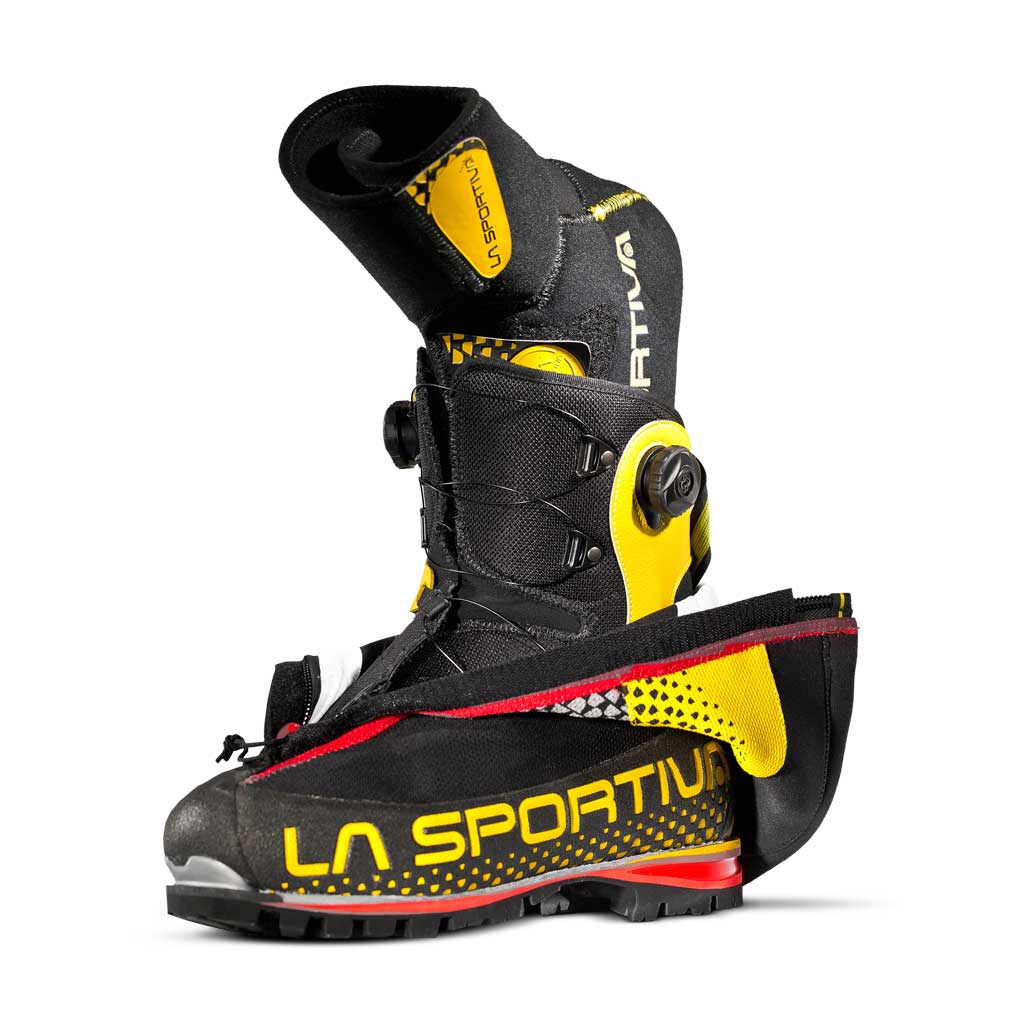
La Sportiva's newest double boot..

This is a boot I advocated for  the last couple of years at La Sportiva NA.  Seemed obvious to me.

@ a list price of $790. retail
LaSportivaG2SM
.

Wednesday, July 22, 2015

Scarpa moves on...new 6000 and 8000.


Thanks for the heads up James!

Wednesday, May 14, 2014

The gear list?

going, going ...gone!


Most won't care.  But a few have asked.   From the many options I have here to ski and climb in what did I take to or end up using full time in Chamonix?  Each was carefully chosen from a lot of options.
Never been to Chamonix when I didn't want to buy or think I "needed" something.  Of course I did eventually!  But this is what I actually used this trip to great satisfaction.  And better yet, never thought I lacked anything for gear or clothing.  I went heavy on ski and could have left the Hauscaran or the GPO at home...but not both.  The other two I used a lot.  Boots as well.  All good choices I'd take again. 

Saturday, November 2, 2013

Mountain Equipment Trojan soft shell Pant..

Monday, September 30, 2013

Fall to Winter


The Autumnal Equinox
The word equinox comes from the Latin words for "equal night." The fall and spring equinoxes are the only days of the year in which the Sun crosses the celestial equator.  From here on out, the temperatures begin to drop and the days start to get shorter than the nights

Sept 22 to Dec 21 2013


First snow fall of the seasons, Sept 24 2013 Sunrise, Mt Rainier


Every year as the temps drop in late September and the air begins to get crisp I start thinking about ice.  Not water fall ice mind you but alpine ice.  In the NW there is a lot of easily accessible alpine ice if the moon and stars align and the conditions get and then stay favorable.

Which means a big storm or two rolls through, and the snow stays up high.  Then the sun needs to come out and the roads stay open.  Big ifs.

Not this year.  September left 2 feet and more at 6000' just last night.  At least for the moment winter is here for the Cascades.


Thursday, September 19, 2013

Zamberlan 4000 Eiger Ice boot...

 
A few years ago at Winter OR I stumbled across a boot company called Zamberlan.  Honestly I can't remember if I had heard of them prior.  May be in Europe some time but I simply don't remember now.  Friend Jonathon Miller and fellow guides at the show really liked their Zamberlan boots and tried in vain to get me hooked up with Zamberlan that winter,
 

Wednesday, September 18, 2013

Mammut Eiger Extreme Nordwand TL Boots


Mammut sez:

"Despite a complete range of technical features, this full-gaiter boot is the lightest in its category, making it a perfect fit for the Eiger Extreme range."

Weight is not the end all for even a weight weenie like me.  But since it is the very first comment of the online Mammut description I'll address that.

Tuesday, August 6, 2013

The "new" alpine ice boots?

These are all new to me and the blog anyway.   After all the blog is suppose to about alpine ice and winter climbing.  Not the foo-foo world of skiing :)  Some really good boots available these days for cold weather climbing.  The key is finding the one pair that fits YOU the best!  Hopefully I'll be able to shed some light on that part of the process with the up coming reviews, weights and comparisons.

A few of the boots here now or coming shortly for reviews.  I can do better than the stock pictures I pulled off the net this morning :)

Zamberlan
3000 PAINE PLUS GTX RR


4000 EIGER RR


6000 DENALI RR


Asolo

 EIGER


La Sportiva Nepal Cube


Mammut Nordwand TL


Lowa 6000
 
 
and the newest Lowa 6000 below
 
 
Lowa Katok XT


Salewa Pro Guide


Scarpa Rebel Pro


Thursday, July 25, 2013

Why a double boot?


With reviews of the most popular double boots on the blog and more coming of similar models I think the use of double boots might need some explanation again.

The majority of my alpine climbing has been done in the Canadian Rockies in winter or in the Alaska Range in spring.

In both places a good single boot and decent gaiter will get you by, generally, in perfect conditions. The problems arise not in the perfect conditions but in the exceptions both in the weather conditions and temperatures. As important or maybe more import is the physical condition of the climber.

Open bivy high on the North side of Deborah May '76


Frostbite is not generally a cold issue believe it or not but simply a physical exhaustion and dehydration issue of climbers strung out in difficult conditions. Double boots are a reasonable insurance policy to avoid a cold injury when you are dehydrated and exhausted and still having to keep moving. Sounds pretty much like any worthwhile alpine climb doesn't it?

While expensive, quality double boots are nothing compared to the price of what even a short stint in the hospital from frostbite and the resulting down time will cost you long term. Not to mention the resulting cold sensitivity that will follow you well into the future. The result of a serious case of frostbite is you'll either stop climbing in cold weather or you'll buy double boots after the first incident. My suggestion is buy the double boots up-front and save yourself the worry and pain.

With all the new climbers able to get out and crag climb long before they jump on difficult alpine climbs single boots are the norm. The single boots generally climb better and are cheaper. The same single boots are generally over kill for most things, including Rainier in summer. So, of course we all want to use those same single boots...that aren't cheap either....all winter and on every climb.

A good percentage of the time you'll get away with it. In Canada these days most climbers won't go out if the temps drop below -15C. That is up from the old norm of -30C as the temps we generally called it off. One of the reasons is most boots are not comfortable climbing below -15C unless they are double boots.


Galiber Makalu dbl boots, late '70s.


The other important reason to invest in double boots is the amount of time you can comfortably spend out in a cold, harsh environment. No they aren't fun to walk in or climb difficult mixed terrain in. But both can be done adroitly with a little practice. You might find they climb ice better than your single boots in fact. On moderate, long, ice routes, most will appreciate the added support and calf relief of a good double boot. The most important reason to look at a double boot is the ability to keep the liners unthawed and warm over night and if required dry the inner out in your sleeping bag. If things really go to shit and you have an open bivy the fastest way to thrash your feet is to be laced into a tight pair of single boots. Better yet on a open bivy you can loosen a dbl boot a bit, gain some warmth usually by doing so, and still keep your 'pons bolted on the boot and not worry about loosing gear. It is a big advantage if actually required.  Getting your steel crampons off your boots or better yet your boots off your feet is alwasy a better and warmer over all option.

The advantages of a double boot are significant to keeping your toes and feet in good health. The down side is first the expense, and then the ability to climb difficult ground in them. That can be over come with time, by climbing more in your dbl boots. Lastly the bulk and weight. The newest boots are getting better.  The Scarpa 6000 and La Sportiva Spantik are both warm, light and climb well.  Worth the added effort to climb in doubles unless you feel like the risk of damaged feet is lower than I do.


On frozen feet after an open bivy at 13,800 in Nov.

Some will wonder about the Batura and Phantom Guide style of boots (single boots with attached "supergators") as a less expensive (if  $500+ is less expensive) option to a true double boot. This style of boot has two design features that limit their use in similar conditions. They are both very difficult to dry out and keep unthawed on over night or longer trips. And the ankles are generally a lot softer and more flexible than a true double boot. So you lose the extra ankle and calf support as well. My take having used a Batura for a few years is they are good one day boots on cold days but I would never take them out over night intentionally. Each style of boot has a place. Just don't trust the advertising to help you decide when and what is right for you.

Times haven't changed much. Good (read winter technical boot) double boots would/do cost a lot more than a good (read winter technical boot) pair of single boots. That changed for 20 plus years as plastic double boots dominated the market place. No matter your skill or experience level plastic double boots were common on almost every mountaineer's feet. And for good reason..they would keep your feet warm and dry in just about any condition...some times too warm. For years you could easily assume that anyone who did technical ice climbing or went out in winter would own a pair of plastic double boots.

Not so today. And because of it I am seeing and hearing of frost bite injuries again outside of the greater ranges....which had been, until just very recently, a thing of the past.
One of my litmus tests for winter climbing partners, 30 years ago and again now is, "do they own double boots?" It doesn't mean that you use double boots on every winter climb.
But if they do, I can generally count on the fact they take their own survival and climbing seriously. That is usually because of hard won experience in really cold weather conditions. So I can worry less about them getting a cold injury and both of us staying healthy on our adventures. And just as often the owner of a pair of double boots is likely to value his partner more than some one with less experience would. Surprised? You shouldn't be. It is all in the details.

If you plan to go BIG and go LIGHT....the place not to short yourself on gear is your boots...go BIG there first!

More on the end result of "minor" frostbite.

http://www.summitpost.org/frostbite/856321


A pair of Herman Buhl's cold weather boots.

By comparison a light weight double boot for their time.  Something the first Kolflachs were.  And the recent TLT5 hinted at  prior to the full blown ski boot with the introduction of  TLT6.

The climbing world still waits for the super light technical double boot to catch up with the modern technology available.


Hermann Buhl (September 21, 1924 – June 27, 1957) is considered one of the best post-World War II Austrian climbers and one of the best climbers of all time. He was particularly innovative in applying alpine style to Himalayan climbing. His accomplishments include:

1953 First ascent of Nanga Parbat, 8,126 metres (26,660 ft) (solo and without bottled oxygen).
1957 First ascent of Broad Peak, 8,051 metres (26,414 ft).
Before his successful Nanga Parbat expedition, 31 people had died trying to make the first ascent.

Buhl is the only mountaineer to have made the first ascent of an eight-thousander solo. Just a few weeks after the successful first ascent of Broad Peak (with Fritz Wintersteller and Marcus Schmuck), Buhl and Kurt Diemberger made an attempt on nearby, unclimbed Chogolisa peak (7654 m) in alpine style. Buhl died when he fell through a cornice on the southeast ridge near the summit of Chogolisa. His body was never found.

"Buhl was very lucky on Nanga Parbat, escaping with just a few frostbitten toes. This story reflects Buhl's style of climbing; totally focused and by taking enormous risks he often succeeded where others failed."

Buhl on Nanga Parbat 1953


http://www.summitpost.org/article/173032/Hermann-Buhl-1924-1957-.html

Sunday, May 19, 2013

La Sportiva GTR and the Dynafit Broad Peak


Skimo or "Edged Alpinism" gear?


For many who enjoy ski mountaineering and are concerned about performance verses weight the Dynafit Broad Peak ski is a known quantity.

Nate covers the high points well here:
http://wilsonalpine.blogspot.com/2012/02/steep-chalk-at-village.html

Total review at Wild Snow:
"Dynafit’s other new ski, the Broad Peak (112/74/96 in 167 cm), is Stoke’s opposite. Built for edge hold when you encounter conditions such as white ice during ski descents of big peaks, the ski is still said to handle varied conditions, as a board of this sort would have to.  My take is that the Broad Peak is a quiver ski. You’d own it if you want something that’ll help you survive steep icy terrain you might encounter during spring ski descents and that sort of thing — or if you’re heading out for a quick blast up and down Broad Peak before your morning espresso."


Broad Peak Spec sheet:

Dimensions:112 / 74 / 96 mm
Turn Radius:(dual radius) [167cm] 17.7 / 17.1m
Profile:traditional camber
Construction:sandwich
Core:paulownia, beech and bamboo stringers, carbon reinforcement
Base:sintered graphite
Tail:flat
 
weight per pair  
 
1142g/ 5lb
 
Weight *per ski* with a Dynafit Low Tech Race (Ti heel spring) 1300g/ 2# 13.5oz
the pair with bindings = 5# 12oz


The La Sportiva GTR Spec sheet:

Size(cm):   168cm
Radius(m):   22
Dimensions:114 / 82 / 104 mm

Camber(mm):        7

Tip Rocker(mm):   192

Weight(g): 1230g per ski (verified)

3lb 1oz per ski with TRAB low tech race binding, (steel heel spring)

Weight *per ski* with a TRAB low tech race (steel heel spring) 1389g/ 3# 1oz
The pair with bindings = 6# 2oz


Dynafi LowTech Race binding comes in at  234g/8.3oz
Trab Race binding comes in at 282g/9.9oz

Dynafit Low Tech Race heel on the Broad Peak ski


Broad Peak ready to ski 5# 12oz
GTR ready to ski 6# 2oz

bindings? 1.6 oz difference for the pair.

Most already know how good the Broad Peak is.   Great ski on hard snow and ice.  Light weight and easy to carry.  I've skied them a lot of places and in every snow condition I can imagine.  It is better on hard snow obviously than in knee deep powder.  But the BP will ski anything you are capable of skiing is my take on it.  The steepest skiing and the longest tours I have done were all on my pair of Broad Peaks. 

But one too many rides over the handle bars on the Broad Peak in deep soft snow made me think that a little more modern and wider ski design, if I could keep the weight down, might be a worthy investment.

*pause for station identification*
I need to pause here for just a moment.  I've been getting lazy and have not kept up on reviews of the gear I am using this winter and spring.  I mentioned this ski to Brian over at :

http://www.getstrongergolonger.com/

So he soon had a pair in his capable hands as well. Brian skis more in a week than I likely do in a season.  The only race where I will beat Brian is to this review and the comparison of these two skis.  We are both getting a chance to ski on the newest Dynafit Nanga Parbat and Cho Oyu shortly.  So more to come on technical skis like the two described here.  Be sure to watch Brian's blog in the near future for his reviews of all these ski.    

Back to the comparison/review.

The GTR has a very modern, slightly rockered tip, good camber under foot and I think most importantly a little more width than the Broad Peak.  While it will float a tiny bit better and makes manky snow a little easier to ski, the down side is it is a little softer under foot and not as good on really hard surfaces IMO.  But so far in really poor snow conditions this has be a workman like ski.   Which means I have nothing bad to say about it.  That may not mean a lot but the conditions I have skied to date with the GTR have been dismal.  More side stepping and kick turns than I care to recount.  Nice that the ski will turn once you have he opportunity to get it done.

My custom cut narrow skins used on the GTR weigh in at exactly what my BP skis do.  But the Broad Peak factory Speed Skin is full coverage.  Both climb well.    Edge to the Broad Peak there.

To be honest I had thought my entire package of either ski and skin was closer than the 6oz on the scale shows.  6 oz means so little on a full day tour.  It is less than a full cup of water. 

Half dozen of one  6 of the other.

The question remains..."which ski do you think is better?"

The first comment I think needs addressing is, I don't think either of these skis is a quiver skis.  Bare with me for a moment on my reasoning here.

Skimo or "Edged Alpinism" gear?

I do have a quiver of skis.  I also have a "quiver" of ice tools.  But in actuality I don't have as big of quiver of either as one might first think.

For technical tools these days I have Nomics.  One technical tool that serves many different types of terrain.  Of course I have other axes/tools.  But one technical tool that I use.

Same with skis pretty much.  I have one ski that I consider a really technical tool.  That is the Broad Peak.  And now the recent purchase of the GTR make it two.

Either ski could easily replace the other IMO.   But *THE* technical ski is one I will not easily be without.  If you practice "Edged Alpinism" I'd suspect you have a ski that is similar to one of these two TOOLS.  Two is not much of a quiver. 

A few of the best SkiMo or "Edged Alpinism" web sites?  At some point it isn't "just" skiing any more.

http://slcsherpa.blogspot.com/

http://slc-samurai.blogspot.com/

http://jasondorais.blogspot.com/

http://theoutsideout.blogspot.com/

If I  dared ski some of the stuff shown on these web sites, I would pull out a technical tool.  That would be one or another ski of this type that I own at the moment.  Both of these skis are good tools.  But I don't look at them as ski as much as I look at them as just another piece of alpine climbing kit.  Just as I view an axe or crampon or a harness, these are simply tools.

I think part of this selection of gear is matching boots to skis.  Obviously I am using the lightest binding I can get to save weight.  I and others trust these lwt bindings every where in and out of the "no fall zone".  They are a given now for  "edged alpinism".

I use both the TLT5 Performance and the Mtn version of the same boot.  But there are other, lighter, high performance boots in several versions including those from Scarpa.   You can save a tiny bit of weight by ditching the tongue and power strap on the TLT and even more by using a lighter, full on (exensive)  race boot with little loss of performance on these technical skis.    The original Palau liner of the Performance or the  Intuition Pro Tour Liner will save some weight as well in the TLT.

I really like the more progressive flex of the TLT Mountain compared to the carbon cuffed TLT Performance.  Something to thing about if you are looking for new LWT boots.

My point is you don't need mondo ski and boots for this kind of stuff.  And a poor selection of heavy gear and the wrong clothing choices will drastically cut your likelihood of success on many projects.

It is easy to say, "boots" are your most important piece of gear."  And they might well be.  But it is the system of technical ski, lwt boot and race bindings that really make this system so efficient and a joy to use in the mountains.  Doesn't matter if you are doing "edged alpinism" of skiing some super fun, summer snow field with your dog.

As an example of a "heavier" but very similar system my 177cm Huascaran (113mm @ the boot) and a slightly heavier "race" Dynafirt Speed Superlight binding weights in at 8# 12oz for the pair and another 5oz for their skis.   A full three more pounds of the pair of ski, binding  and skins.  That is a lot of extra weight on a skin track.

These light technical skis are both stellar skis to get it done on.  At the moment I am swayed by the slightly wider GTR for my fun.  And the tiny bit more lift and ease on the turns that the width and rocker brings.   But I have the BP in the back of my mind every time I have to ski or side slip through a nasty patch of ice and wonder if the BP might have well allowed me a little more security there.

TRAB,  Atomic, Elan, Hagan and a host of other rando and rando race skis brands are out there.  Check out the other blogs if this kind of ski interests you.  See if you can mate up your own system for best effect.   I have little interest in true rando race skis.  But one or two steps up from the 65mm under foot race ski does interst me.

snowing and spitting rain here yesterday @ 6000'

Monday, April 29, 2013

Classic Spring skiing in the PNW.

Skiing the Muir snow field into the Nisqually chutes and lower Nisqually glacier to the bridge is a Cascade classic.  The bridge is seen in the distance @ 3900'.  The picture was taken from around 5000 feet. Muir is at 10,000'.  5 mile and 5000' gain on the skin up for less than an hour run down on moderate terrain early in the season.

Perspective on the size of things..


photo courtesy of unknown author via the internet


Below, looking back at the upper half

and down the Nisqually Chutes, mid section of the run.


and looking back at the majority of terrain skied from bridge level......likely close to 6000 vert showing here.


Likely as close as you'll get to The Vallee Blanche off-piste ski route in the CONUS.  Starting from the Aiguille du Midi the  Vallee Blanche  is 17km long with a vertical descent of 2800m.   Muir down is 9km and 1900m.  Add the summit of Columbia Crest and you get 13km and 3200m to the bridge.  Easy enough to make some comparison by those numbers.

Even on a busy day, skiing Rainier will seem like a wilderness and the food dismal in comparison to the Vallee Blanche.  Either way both runs are well worth the effort.  Different for sure but fun in their own ways.  Be a whole lot less folks skiing the Vallee Blanche with out the Midi tram.  
 

Monday, February 18, 2013

The Scarpa Rebels..... Part One "The Ultra!"


dbl click for a full view of the boot


Scarpa introduced the Rebel GTX Carbon last year.  Great boot for its intended purpose.  Which was alpine rock.   In Oct of 2010 I had already seen  "what was coming" on the feet of  Ueli Steck doing some hard alpine mixed and steep ice around Chamonix.  I had wondered if "that" boot would only be "on Ueli's feet"  or ever make it to market.    We now know that answer.  It has indeed made it to market!  The new Scarpa Rebel boot is called the Rebel Ultra GTX.

The other two boots in the Rebel  line are the Rebel Carbon GTX, introduced last year.  The newest Rebel Pro GTX introduced at the Winter 2013 OR show.  I'll review each boot in turn.  The Carbon GTX I've been in a year now so that one I'll rehash a bit later.  The newest Pro GTX I have yet to handle outside the OR show.  The new Ultra?  Those I now have in hand.  And for me, well worth the wait.  Thrilled, is hardly an over statement.

The original Batura on M6 2009


"2/20/08
Boots? Fruit boot technology is catching up to the Mtn. boot technology. You’ll climb different in them but you’ll also climb better. Ice becomes more like rock climbing in the soft ankle boots. Haven’t found one I want to send 1000m of hard 55% alpine ice in (until now) but it is entertaining trying to figure out how to rest the calves with French technique at every opportunity. More time in soft boots will likely encourage me to take them on endurance alpine ice.

Now we have both warm boots and soft ankle boots that have a rigid sole for even my size 12 feet. They can be amazing. Check out the usual suspects to see what fits you. I like the Batura for cold stuff close to the road (they are hard to dry out) and the Spantik for anything over a day out. There are much lighter boots I could be climbing in. We’ve only just seen the beginning to the newest boot technology. In the future look for a dbl. layered fruit boot that is warm enough for Denali which you’ll actually want to use for that M10 at your local crag. "

I wrote that 5 years ago almost to the day now.  And it is true the technology is just beginning to filter down to what is possible.  As I said above "until now".

The drop in boot weight for similar warmth and a lot more performance?

2008
La Sportiva Batura (45) 1st gen. 2# 7oz / 1106g   (one boot)
2013
Scarpa Rebel Ultra GTX (45)  1# 13oz  / 822 (one boot)


And by today's best for weight and warmth?

La Sportiva Batura 2.0  GTX   2# 2oz / 970g

Scarpa Phantom Ultra (2012)   2# 4oz / 1020g

Scarpa Phantom Guide (2012)  2# 7.5oz / 1120g

*Scarpa Phantom 6000 (2012) with Baruntse liner 2# 8oz / 1134g

http://coldthistle.blogspot.com/2013/01/scarpa-phantom-ultra-vs-la-sportiva.html


It is coming....

I know I'll take some heat for the next few comments.  But anyone with a clue will realise what I am saying next is not a diss to any one's abilities, but simply a recognition of where technology takes us next.

In the pre sticky rubber days, pre-Fire', climbs were harder.  If you were good at your craft the sticky rubber made a difference on what you were now able to climb.  It was in instant jump in your abilities.  That is fact.  When Friends came along just prior, those too allowed any one to climb things they might not have done other wise, safely.   The eventual change from a curved pick to a reverse curved pick was a huge jump on what mere mortals were capable of ice climbing.  Stretch garments that were also warm enough...another jump in technology and what would eventually be climbed.

Anyone that tells you gear doesn't matter is clueless. (no matter what your/his/her skill level)  From the RURP to the Nomic...gear matters.  You just need to be able to take advantage of the gear.  That I can't help you with.

Boreal's Mutant, "fruit boot".


So the boots?  There is a reason the hardest modern mixed gets sent in Fruit boots.  I have a pair myself.  Boreal Mutants in fact.  With crampons they weigh 2 # even per boot in my size 12.


My newest  Rebel Ultras with my lightest steel crampon 2#  9oz. total per boot.


The original Kolflach Ultra @ 3.5# with crampons. 


From April of 2010
"I'd really like to see a sub 3# dbl boot and fully technical crampon combination for my size 12 feet.  Size 12, Koflach Ultra, Aveolite inner boot, circa 1980, Chouinard hinged crampons, Beck/Chouinard straps. Total weight 3# 9oz."

The Rebel Ultra is most certainly not a double boot, but it is more than a simple single boot.  More importantly it is a 4 season (for many areas but not all) ice boot that has finally dropped a almost a full pound off the equation.    In comparison for hard technical climbing, the boot and the crampon have both been improved and now @ the 2# 11 oz. total weight.  The Rebel Ultra isn't perfect.  And it isn't as warm as it might be.  For the weight and performance right now, as in today?  No wishful thinking here.  Nothing even in the same league.   I have no doubt the industry is headed in the right direction with this boot.  Super low profile and volume for a full on mountain boot.  Rigid enough and most importantly,  supportive enough to climb endurance ice in,  as the Phantom Ultra has already proved prior.  The newest Ultra is a better boot yet for fit and support.  I'll be able to climb harder in this boot.  Most will.

 Dave in the Phantom Ultra on les Droites
 
When you are testing boots in the field, with the same crampons and go from 1210g boot to a boot that tops the scale at 822g there is a huge difference on your feet.   I did just that today.  Using a TLT5 P on one foot and the new Rebel Ultra on the other.  You couldn't easily pick a pair of boots that are so totally different in every way.   To start with almost a full pound difference per foot!  But both boots offer some real strengths.    Comparing them side by side was really interesting.  The first was just how warm and supportive the Rebel Ultra really was by comparison.  Big surprise!!  And only in really good ways.  The Ultra is a lot of boot @ 822g for a size 45.

On the newest Ultra I had not originally liked the gaiter.  I've climbed in almost every gaitered boot in existence to date.  Back to an original pair of Trappeurs.  Some were/are better than others.  The Rebel Ultra is very, very good by any comparison to any of them.  It also begs the pant to be stuffed into them to clear your feet and crampons.  Think true Fruit boot performance here.  Even if the boot will breath better with a pant over the gaiter, not in it.  Save the over the pant use for big, cold north walls.  It will keep the boot drier.   For that hard project, tuck the pant and clear your feet and crampons.  Nice option I had given up on a while ago in my other gaitered boots.


The ankle, tongue and lacing system on the Ultra is unique.  More importantly I am not sure that I have ever had such good ankle support, ankle flexibility and heel fit in a boot, ever.  Support and flexibility in one boot?  How does that work?  Not sure myself, but in this boot, it does.  And very well indeed.

The unique and excellent ankle wrap and support on the Ultra.

The tongue and ankle  is wrapped and locked via Velcro and the laces..  It makes an exceptionally supportive and well fitting boot.

The Rebel Ultra's volume compared to the Batura 2.0.  Don't let the looks fool you, it is a warmer boot than it might first appear with such low volume. 

 
The Ultra has a very snug and technical last.  It is a tight fitting boot.  Biggest complaint I heard of the Rebel Carbon last summer is that it fit on the small side.  I saw a number of used ones being sold early on because the tight last of the Rebel wasn't for every one's feet.  This boot will have a very similar last so buy accordingly.   But I suspect they will fit most if you size them correctly first time around.  I have a narrow foot but seem to fit Scarpa generally better than La Sportiva.  I find the fit in the Rebel line exceptional for my feet with enough room in the toe box and exceptional heel hold down.  The Ultra the best of the bunch on all counts so far.
 
Ultra is 10oz lighter per pair than a Batura 2.0 in a size 45.  With a precision fit like no other ice boot in existence to date.  The difference in volume and warmth should be clear in this picture.
.
 
The mid sole on this boot is close to being perfect IMO.  Rigid with the right crampon (Petzl) and flexible enough to walk in easily.
 
Crampons?  No surprise I suppose that the Petzl Darts fit perfectly with an asymmetrical connecting bar.  And they are a dream to climb in for overall weight and performance.  It is  slick combination.  The sole toe profile is tiny so good luck getting a great fit with out a Petzl front bail on your choice in crampons.  I am having a hard time telling you just how impressed I am with this boot.  I am running out of ways to say juts how good this boot really is.  How long will it last?  Not sure...don't care:) 
 
 
I venture to guess that the newest Rebel Ultra will grab the majority of market share in light weight  alpine and ice boots (including the Batura and Phantom Guide) and dominate the market in just its first full season.  Move fast enough and this boot will be warm enough.  And the drop in weight might just allow you to move "fast enough".  The other boot builders?  Take note.  You are looking at the future in performance.   The boot is insulated for warmth and Goretex lined for weather proofing.   As good as this new boot is the technology could so easily be bettered.
 
That prediction is so easily given.  Steck used the prototype of this boot to free the Nomine Crack in the Dru Coulior, mid Oct. 2010.  How many guys have been on the Dru Coulior in a virtual fruit boot?
 
"Italian Korra free'd this pitch, at M7+.... Good effort to Ueli onsight freeing this in the dark!!"  Will Sim
 
 
The Dru Coulior
Photo courtesy of Dave Searle
 
In case you missed it?   Feb.  2010.  Ueli Steck, Ben Nevis, on the Secret,  X-10.  Scarpa  proto type boots.  Fruit boots again. Take a look at the lack of boot soles about 22:50


If you have ever dry tooled in rock shoes.....you now know the difference this boot will make in the alpine.   The new Rebel Ultra GTX is going to change the game...again.  And for the better.   Save your pennies.  You are going to want this boot.  My bet is they will be hard to obtain the first year.  No guarantee but the link below might help if you are in North America.


The current Rebel Ultra, that is reviewed above.


The newest Rebel Pro GTX introduced at the Winter 2013 OR show.
Both of the newest boots are insulated for warmth and Goretex lined for weather proofing.
 
The original Rebel Carbon GTX on alpine rock last summer.
This boot deserves high marks in use.