

Recent damage to my feet has forced me to sell off all my mtn boots.
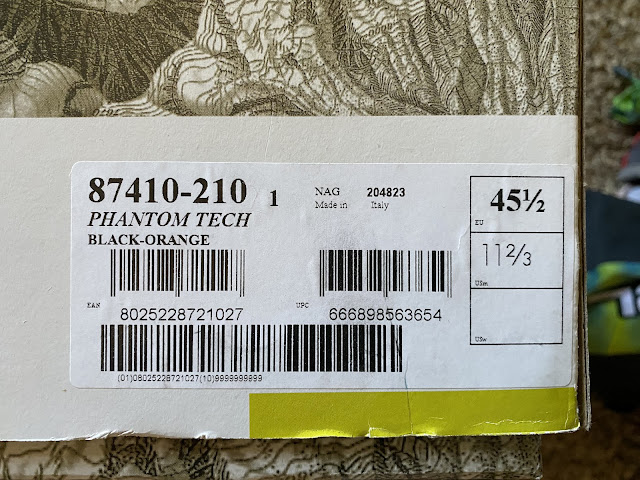
NIB, unworn Scarpa Phantom Tech, 45.5
$425, includes priority mail shipping.


 Posts
All Comments
Posts
All Comments

Recent damage to my feet has forced me to sell off all my mtn boots.
NIB, unworn Scarpa Phantom Tech, 45.5
$425, includes priority mail shipping.


Black Crow
Nevis Freebird, 173.4cm, 102mm, 19m, 3# 10.3oz / 3# 9.4oz
Corvis Freebird, 176.2cm, 107mm, 21m, 4# 2.4oz / 4# 2.80oz
La Sportiva
'23 Tempo, 179cm, 103mm, 18m, 3# 14oz / 4#
'25 Tempo, 179cm, 103mm, 18m, 3# 3oz / 3# 4oz

Movement
'23 Alps Tracks, 177cm, 106mm, 19m, 3# / 3# .02oz.
'25 Alps Tracks, 178cm, 106mm, 21.5m, 2# 14.5oz / 2# 14.oz
I bought both the older model and the newer model Alps Tracks late last season. And it was an internet comment that really got me wondering just how much different the new version might be from last year's version.
But frankly what I was really looking for was the widest ski I could find that was @ or under 3# per ski. The Dynafit Denali's had simply spoiled me @ 98mm under foot and 2# 12oz per ski at 176cm. The Denali will ski literally any snow condition I can ski. Even as It is not an easy one to replace no matter what anyone wants to say about the latest and greatest.
Gear reviews | Dynafit Denali | PowderGuide
The big indication they were different is the turn radius. The '23 version is @ 19m. The newer version is at 21.5m. Less rocker on the '23 106 and more rocker on the '25 106 than the original Denalis. And that is pretty indicated how each Alps Tracks would ski. The '23 holds an edge better, and is more stable everywhere. The '25 is more playful and even with a 21.5 radius still quick under foot. Both are very light weight and a pleasure on the ski track or on your back.
"Who prefers a more precise ski?" That would be me, thanks ;) And without a doubt '23 106 is a very precise ski. I was able to ski some of my best runs of the year (technically most difficult for snow and terrain) on the '23 version of the 106. I really like the ski. Being mounted online which is pretty far forward helps that ski IMO. No question the older ski, even in a 106 width, is scalpel in bad snow and on steep terrain. I can't say enough good things about the ski. Either version is way more solid than it should for the weight at speed. The newer version is surfier, and releases a lot easier. The older version, because it has an almost flat tail and little rocker reacts better at some speed. You need to be on top of that ski. If you are, the ski will pay dividends for sure. This year's model? It is mounted 2+ cm back from the previous ski. Which had me concerned when I was mounting. But, in for a penny in for a pound on Movement's skis. A bit more rocker was added to tip and tail on the '25 version. A hand flex test tells me the tail is a bit softer as well. Overall, I'd say the new ski is a little softer over all as well. Not a noddle but softer than the previous year. Frankly none of those changes were giving me high expectations over last year's Model. Turns out there really are times a ski company improves a ski, instead of just changing the top sheet. Almost but not quite dramatic in the 106's comparison. I've skied slush, powder, some nasty mank, both wet and dry in both. Loved the newest 106 everywhere I have skied it. May be a bit more than the earlier version. I simply love the newest version. Really a fun ski to skin with and even better to carry. I've skied some glare, spring ice and some hard freeze-thaw, in bounds, spring ice. None of that was any fun but the skis managed well enough. This is a very, very forgiving ski. Much more forgiving than the previous version of the 106. I like them both. But the new version just takes less effort and is simply more fun for me to ski. In the world of lwt 100+ touring ski, both are outstanding pieces of engineering. I was wondering if I would ever find a ski as light as, or lighter than, the Dynafit Denali-Dhaulagiri series? I have no doubt in my mind that I found, better skis than either, which is saying a lot for width, weight and versatility. And that is saying something in my book. I grew up on old school Rossi GS skis from the 80s. Boards you could rip around on at 35 or 40 mph with not too much effort. My Slopes phone app says the 106 is good for 35mph, no issues, and big smiles ;) Pretty much 40mph being my max on any ski on a typical day of lift skiing. I typically like making lots of turns these days. But really fun to have a ski that seems capable of doing both without having to tightly crimp your toes in either venue. This makes a really fun ski for me!

DPS
'25 Kaizen, 179, 105mm, 18m, 4# 2.7oz / 4# 2.3oz
"I want to retain my ski. Way, way less worried about unknowingly skiing in avi terrain."
DB, May -11-2014

Since I wrote that I have spent a lot more time watching grass grow and shoveling manure than skiing. And even less time skiing terrain that I actually worry about loosing a ski. But I still do fall down on occasion, even on easy terrain while simply skiing on piste. Or as we know it here in NA "at a ski area" as "on piste".
In that 11 year's time, I have seen some things and heard even more. One of the best and most astonishing to me was putting on my skis in the parking lot getting ready for an easy hour plus tour into a hut. I am seldom willing to spend the money for a guided trip, so this was a rare occasion for me. But I was looking forward to the skiing the terrain, spending time in the American version of a hut (a yurt in this case) if for no other reason than there are so few huts s here to choose from.
Anyway, back to the parking lot 2 years ago. A guide walked by and told me, rather bluntly, to remove my ski leashes, as "We don't allow them for safety reasons." My first thought was....."WTF? Really?" but I bit my tongue and complied. Stashing my leashes in my pack. Obviously, there will be no discussion with der leader.
The trip was uneventful and easily forgettable other than that conversation. The proposed "extreme ski week" turned into a basic skimo class for ice axe self-arrest and how to move on steep terrain with your newly acquired crampons and the guide's suggested 45cm ice axes.
What I did find amusing, when looking at what was an inspiring, and technical ski decent across the valley was the story of the 1st decent a few years earlier by the then owner of the guide school. Turns out he took an inconsequential fall on the lower section of the face and then the resulting 15 mile ski out, on one ski. Funny to me that no one thought that an opportunity to rethink "what was allowed".
Sometimes people learn slowly...very slowly. And have lots of time to reconsider their decisions. Sometimes you don't.
This Spring while skinning up to the col on the shoulder of the Grand Montet, I watched a ski go by us, doing Mach 1, into a crowd of skiers on piste below us. An expensive day out or could have been for any number of folks. The loss of a ski hopefully the least of it.
Then there is the current published thought, from a good many IMGA guides, that brakes are better everywhere. Better only because you are safer, with your skis and leashes, less likely to trap you in an avalanche. Mind you it is the same fellows that don't recommend an air bag because they aren't warranted in "normal skiing". But avalanches are normal skiing? Saying nothing at all of skiing in crevassed terrain and the likelihood of a fall into a crevasse might well mean a lost ski.
Always happy to have the conversation about avis while winter climbing or doing patrol work and tossing bombs. Seen lots of avis in both. I try to stay out of avi terrain while doing "normal skiing". Conversations about helmets, air bags, beacons, and leashes seem appropriate to me even today.
10 years ago, there weren't the amount of tech bindings being skied in resorts in Europe compared to the numbers now. An even fewer in most of North American currently. Tech bindings on full size alpine skis even more rare. And when you do see them, almost always with brakes.
In Europe on the other hand, I saw as many brakes on touring skis and I saw skis, with neither brakes, or leashes. The skiers using the always available option of locked toes. I've skied a lot on locked toes and race heels. I have always used leashes on that set up as well. Redundant no doubt but I like the added security of always retaining my skis, if I can do my part. Even while not liking I have to bend over and clip the leash to my boot. It seems so uncool and slow having to do that.


I can barely remember now, crying from the pain in my feet as a 3rd grader, and twenty years later the pain of having to walk off Mt Rainier in cold mid-winter condition in only my socks. My feet swollen and frost bit from a bad bivy on top of Liberty Cap and unable to wear my boots once my feet unthawed.
I like technical gear and those discussions. But let's start this conversation with some basics that have little to do with the gear you buy. This part is free, just needs to be installed on your hard drive, located between the ears, and is worth more than any pair of boots.

Been a while since I have made a serious blog post. But if you can make use of the search function here, in the content are some comments on staying dry to stay warm.
It took me a long time to figure out a lot of my cold feet issues are/were caused by wet feet. I now suspect my feet naturally perspire more than the next guy's.
VBL socks and antiperspirants can help there. I have used both to good effect. I have climbed a lot in some very cold conditions, (-40C and elevations up to 22,000ft ). I've only had minor frost bite once, that winter in Mt Rainier in 1976.
Bottom line on wet feet? If your socks get wet from sweat your feet will eventually get cold. You can protect the insulation in your socks with a VBL (but they tend to slide around some) or by using a good dose of rub-on antiperspirant. I like antiperspirant and a thin sock, relying in the boot for insulation.
More on the boots shortly.
You need to know the source of the problem before you can solve it, right? So, no wet feet!
That is a good start. A number of reasons I can now list as to why I froze one of my feet on Rainier. All, but one, were trivial mistakes by a rookie. The same mistake, most make, is the culprit almost every time.
Dehydration.
Get dehydrated and tired in cold weather and you are very likely to become a frost-bite victim. Simple as that. Both dehydration and physical exhaustion are pretty much a part of winter alpinism. Do your part. Stay hydrated, and go out physically fit.
Fitness?
No one wants to be a mouth breather. And not everyone is Colin Haley. If you can climb as fast as Colin, you might get up the Cassin, unharmed, in single boots. If you plan of belaying all the mixed pitches and stay a couple of nights out on the Cassin, best to take a good pair of double boots and enough fuel (which means bringing a stove) to stay hydrated.
Colin wasn't the only one on the mtn that year (2018) in singles.
"5) Better gear.
Compared to my previous attempts, my crampons, ice axes, helmet, umbilicals, and clothing were all lighter weight. Also, this time I carried single boots rather than double boots, and no stove."
Cassin Ridge Speed Solo – Skagit Alpinism (colinhaley.com)
Common sense once you figure it all out.
The black set of toes above? Not mine thankfully. And I wasn't on that particular climb. But it was one of the coldest nights I have spent in the mountains sitting in a tent below them. They had an open bivy. Temps lower than the climber and his gear were prepared for. But I'd guess it was the dehydration and wet feet (from hard climbing all day) that were the real culprits. It wasn't fitness or a gear issue IMO.
Look closely at any climbing frostbite injury and very likely something similar will jump out as the cause.
Cigarettes? Not an uncommon suggestion. Nicotine is indeed a vasodilator. Best to do some more reading on the subject if that is the answer you prefer. I'll stick with dry feet and a better water intake :)
"Vasodilators dilate arteries and/or veins. This results in increased blood flow and lowered blood pressure. Vasodilators are commonly used to treat high blood pressure (hypertension) and heart conditions."
"Hello friends with terrible toe circulation, have any of you tried a full double boot and found it to be significantly warmer than a lighter tech option?" BM
Not an uncommon question.
Still, I don't think it is the right question on how to solve "cold feet".
Good hydration, dry feet, and right up there, as the "most important" basis for warm feet, is boot fit. If the boot doesn't fit well you are simply screwed from the get-go.
Almost everyone will find one brand of boot a better fit than another brand of boot. The boot you may have your heart set on (and your pocketbook) may be the worst boot for your feet. A smart buyer will use the Internet and their credit card to order in every boot that you think will do the trick and rug test them all for fit. Simply return what you know won't work and sort the rest in the comfort of your own home. The results may surprise you.
Dry feet? Check.
Manage your fluid intake? Check
Perfect boot fit? Check
The perfect boot? Ya, not so much ;)
A few have used fruit boots on Polar Circus. No need really, as the climbing isn't all that difficult. I've used double boots there several times in cold weather and really light weight tech boots there in nice weather and Spring conditions. 8hr suffer fests in the cold or 4hr romps under blue skies. Pick your poison for the boot and the conditions.
But that is what alpine and ice climbing are all about, right?
A lot of difference between "perfect" conditions and a bad day out.
Photo is from a few winters back. A bunch of us were trapped on top of the Midi in a storm. Notice what the locals are wearing for boots. I was the only one waiting for the tram the next morning, in single boots. And very glad I didn't have to spend the night in the loo again in singles.


If I can stay warm, I will always choose a lighter boot. The cost of the wrong choice may be steep.
"You must ask yourself, is it $1000 total, or $100 per toe?" JJ

These days I own 4 different pairs of mtn boots. All sorted by weight and warmth. Overdone? Sure. But having warm and dry feet, and the least amount of weight/bulk on my feet makes the $ spent per toe worth it to me.
My "old" double boots (the Scarpa 6000 I wrote about below) are still working fine. But there are a few new ones I'd love to try. But up front, the boot needs to fit your foot and your use, not mine. Good luck!
FS New (unworn/unmolded/hang tags intact) Dynafit Blacklight boots, size 29, $600 shipped CON US. Venmo or Pay Pal if you pay the fees. Neat boot. Lighter and stiffer than a TLT6P Just not a good fit for my feet.


