Pageviews past week

The cold world of skimo & alpine climbing

The cold world of skimo & alpine climbing
Showing posts with label what works for me. Show all posts

Thursday, September 19, 2013

The Dynafit TLT6 ski boot, shake and rebake!

 
Lets see if I can sort through some of the early Internet misinformation and misrepresentation on the TLT6.  Admittedly some of it clearly my fault here @  C-T no matter how unintentional.

First up lets talk shells and add some definitive comparison numbers to the older TLT5.

Zamberlan 4000 Eiger Ice boot...

 
A few years ago at Winter OR I stumbled across a boot company called Zamberlan.  Honestly I can't remember if I had heard of them prior.  May be in Europe some time but I simply don't remember now.  Friend Jonathon Miller and fellow guides at the show really liked their Zamberlan boots and tried in vain to get me hooked up with Zamberlan that winter,
 

Thursday, June 13, 2013

CAMP Contest skimo Race Suit review..lycra again

The CAMP "Contest" Ski Mountaineering Race Suit..used not racing.

http://www.camp-usa.com/products/backcountry-ski/ski-mountaineering-suit-1594.asp

Yep, Lycra again!

If nothing else, reading Cold Thistle will give you an idea  that the envelope can be pushed on how modern high tech gear is supposed to be used and where you might find a place for some of it in your own clothing and hardware systems.  Much of it can be used far outside the original design parameters.

Point in case is skimo racing gear like this CAMP suit or some of the reviews coming up in the future of long distance running gear.

Let me clear up any false impression that I might  have unintentionally left here on CT in the past.  I am not a skimo racer or a bike racer.  I have done races in both venues.  But if you are thinking I  am competitive, I am not.  I push hard  and I race...but only against myself.   I am how ever, an alpinist.  Which  I consider in my own egotistical away, better than a mountaineer.  Obviously I write a alpine climbing blog.  So I think my opinions are worth sharing with the world ;)  Your mileage may, very well, vary :)

Which brings us back to Lycra and  eventually, if you have a little patience, to the CAMP skimo racing suit pictured above and other suits and clothing like it.

Ever felt like you needed to climb in just your base layers on a hot day on the glacier?


Fact is, Lycra is better looking and given the right fabric blend and specific pattern, not a bad option on hard rock or a hot glacier.

Clearly Lycra is not the best option in clothing for ever situation in the mountains.  In the recent past  I have used Lycra as a base layer, a light insulation layer and a wind shell depending on what has been required and the  current environment.  Some times all three on the same trip.

As I mentioned in the previous post on Lycra this last week had been one of the most comfortable ski trips I have done.  Temps ranged from around 25F as the sun came up to as  80F by mid afternoon. in bright sun out of the wind.     It was a wide range of temperatures.  Only going above 11K required the addition of a Patagonia Micro D pullover when I was stopped.  Impressive performance IMO.
If you needed more in the wind a Camp Flash pull over would do more, nicely enough.


Above is another versatile ski rig that is mostly Lycra. A Patagnia Piton Hoody used with a Dynafit Movement pant. One of my favorite sets of clothing for a number of outdoor pursuits.

Micro D is here:
http://coldthistle.blogspot.com/2013/04/patagonia-micro-d-14-zip-synchilla.html

Flash is here:
http://coldthistle.blogspot.com/2013/02/it-is-all-same.html

For base layers under this suit I used a tech short sleeved shirt and tech briefs.  Not much between you and the environment.  That I painfully realised the first time I took a spill on the pavement hard snow because I hadn't brought ski crampons.

Same basic  set up Brian used on his c2c speed run up the Gib Chute but in a Crazy Idea race suit.


It is worth paying attention to what is being worn and why.

Check out the usual suspects (the guys out doing it) on the web.   More here on skimo specific clothing:

http://slc-samurai.blogspot.com/2011/11/backcountry-ski-clothing-systems-what.html

http://www.getstrongergolonger.com/journal/2011/7/17/grand-teton-speed-project-update-weight-matters.html

Look closely at what they are using on their own back country missions.

So why am I about to start raving about a once piece race suit? 

After all, one piece suits are notorious for poor ventilation and hard to control your temperature in.  Too hot generally by design or too cold in only Lycra because the material doesn't offer enough insulation.  How do you ventilate and breath in a once piece suit?  Hard to head the call of nature in one as well.

I've used well designed one piece suits often in my climbing career to good effect.  All the way back to early Goretex versions in 1977.    But never a one piece in such an aerobic situation.

 
Never at a really high level of physical out put.  Enter Lycra one piece suits fitted correctly and with the additional insulation and breathable material required.  It all starts to make sense.

Stuff a bunch of food/skins/gear into a kangaroo style pocket system (as they have above or below) and you profile will look funky and fat no matter how skinny you are...or aren't.  Get over it.


 The one and only time (a local ski mo race)  I have ever had sweat running down my forehead and snow blowing hard enough to blind me while at the same time freezing on my outer layer all at the same time, I was in Lycra.  And I was comfortable.  As long as I didn't have to stop for long!

The Flat Bellied Stallion?

The jokes never end and  the questions don't stop.  Takes some confidence to wear Lycra at any age, in any style.  It generally isn't flattering to the human form.  Unless of course your human form is what the current society norm considers attractive.

Here are two classic views and the casual uneducated observation.


Big gut! This guy shouldn't be in Lycra.


Big gut! This guy shouldn't be climbing in Lycra either.
(same combo I ski in btw)

Truth is I have had a big gut in the past.  No reason to deny it.   But for the most part, chemo and radiation during cancer treatment eliminated it.  Damn near have abs in both these pictures an no spare tire there.  I had friends laugh at the pictures from this winter in the Dynafit Movement pant and the Patagonia Piton Hoody combo.  And now in the Camp Speed suit.  No gut hanging out there isn't.  Just extra gear, food and fabric no matter what the first impression is.  Not Gym Jones fit either.  If you spend your life worrying about what people think you'll likely miss most of a well lived life.

I take my time with pictures generally.  Simply to help me get my point across.  But I am at least as vain as the next guy (likely more) when it comes to how I look and am perceived by others.

Below is a picture looking down across my abs from above, while wearing the CAMP Contest suit.  The Cliff Bar Shot Block that is sticking out is just  the tip of the iceberg.  I have 10 Gu packets, 4 Shot Blocks, sun screen, lip balm and my freakin camera stored in the first layer of pockets inside my suit.  It may look a little funky but if you are trying to stay up on the calories and keep moving at the same time you have to work on a system to do so.  Some use gel flasks.  Right now I am using, and really like, the simplicity of the pocket system the Contest suit offers.  You will have a "spare tire" fully loaded, but with the end result of easy access to your fuel and other essentials while moving.

The suit is easy to use no matter what you might think of the aesthetics of such a garment.  

I know what I look like in and out of Lycra.  It isn't always a fashion show.  But it is always about how fast and how far can you go if you are pushing yourself and your gear.


Looking down at my boots.  I can stomach a "spare tire" for the easy access.


The "junk" in a a well designed skimo suit.  My Gels and Shot Blocks are in the "outside pouch"  Accessed through the zipper via either the top or bottom slider.  There is another layer of pockets big enough to take the smaller race skins behind this "pouch".  And finally a transceiver pocket behind all of them. Four pockets total inside the suit.

There is also a separate pee zipper below all the pouch pockets. 

On the outside there is a small zippered breast pocket and two huge, elastic closed chest pockets intended for short term skin storage.  I used them for used Gu wrappers, gloves and my camera on this trip.  The current colors may be not all that flattering for you physical  profile but this suit really works as advertised if not even better!

I set my own PB using this rig on Rainier recently.  You might not want to  be too critical on first impressions.

More interesting to me is that not only was I never passed on the uphill (which is extremely unusual) I actually passed a lot of folks both going up and coming down.   Much of that "speed"  was the difference in weight of my entire kit.  But it also had as much to do with how capable my clothing was on the extreme ends of both hot and cold. 

If it makes that big difference for me...you can only imagine the difference it might make  for you.  I write a blog but I am no fitness animal in the mtns.  Far from it.  When I can easily drop anyone else on the trail I am more than happy.  It seldom happens these days.  For skimo I have "bought" my fitness for the most part by using  cutting edge, lwt boots, skis and clothing..

I had one goal using this suit.  And that was to climb with the least amount of effort.   If I can turn Rainier into a half day's effort you likely can do even more with similar gear.  

No hood on this suit.  Which I can't really applaud for the application but like much better than with a hood.  Even though no question I would want and use a hood  if the conditions required it.  I am admittedly not a skimo "racer" although I like taking part in the local races.  For me the majority of the time a hood isn't required or needed.  So I am glad to see a suit without the hood.

The stand-up collar is my favorite.

The collar is a high stand up version with plenty of coverage on the neck.  My actual preference over a hood.  Easy enough to add a thicker head band, hat or helmet.  Short of really nasty weather my preference to dump excess heat is through my head and neck first.

Speaking of dumping heat.  Both the under arms, which features tiny holes in the fabric. 

under arm vents


And the back panel, via a mess panel are there to dump excess heat on the uphill and work exceptionally well imo.

The entire black back panel is open weave nylon mess.  Directly under your pack which really helps me control my body temperature on the uphill.   And easily protected with even a light wind shell or my favorite Patagonia Micro D pull over.

Funny how the good clothing works so easily in a "systems" approach over a broad spectrum of conditions and clothing choices.  The Micro D  or a simple base layer is one of the basics for me skiing, especially on the down side of the ski track.


As you can see from the length of this blog post there is a lot involved in the features of these race suits.  And for the asking price of $400 per suit there should be.  But I originally thought $1000 was a lot of money for a TLT boot and now I think the price is a steal for the weight and performance involved.  Same on a "race" suit.  Like the TLT P the suit is another piece of highly technical gear I will use  almost anywhere in the mountain now if a ski boot is involved and I want to eat right on the effort.


Finally.  One of the things that make or break a pair of pants for me BC and touring is the cuff.  Movement pant and the Dynafit buckle system is a serious PIA to me.   I like simple.  Simple because I want the boot easy to get at and easy to adjust.  But I also don't want snow in my boot.  All of which is a problem for a TLT user.  Or at least in my experience it is.  For races to date I've used simple tights.  Easier to hit the top buckle latch and not deal with Velcro/ cutting holes in one's pants and what to do with the buckles when open.  The Movement pant is decent.  But not fast to hit the hole in the pant leg and a true bitch to get on and off.  No my favorite thing to use when in a hurry.  So I have used several simple soft shells.  Notably the Arcteryx Gamma LT pant as well.


CAMP suit is simply brilliant on those lines.  The buckle slips in and out via a open and reinforced seam.  It is the very best method I have seen yet to utilise the TLT buckle system.  I was forced to put one small hole for the cuff  buckle latch to go through and lock the boot in down hill mode..  If I am not in a hurry, easy enough to use and latch/unlatch in the field.  Durable and a slick system to keep snow and crap out of your boots with the boots wide open in walk mode. 


Simple round hole I put in with a wood burner.  Lycra is reinforced at the point and a soldering iron seems an  obvious tool for the choice.


CAMP isn't the only one making race suits.  Or the least expensive.  I've not used any thing else for a similar purpose other than the two piece Dynafit system they made for the recreational racer in previous winters.  The Dynafit Movement pants and jackets are really good imo.  I use them both.

But the once piece suits are a big step up in performance.  There is a reason they call them "race" suits.  But the label doesn't mean they are only good on race day,


Dynafit Movement Pant and jacket


The CAMP Contest Race Suit

CONTEST SKI MOUNTAINEERING RACE SUIT
• Competitive Ski Mountaineering
• Constructed from durable, lightweight Lycra and mesh panels
• Double layers on the knees for warmth and durability
• Dedicated external pockets for fast access to skins and gels
• Internal pocket for avalanche transceiver
• Kevlar reinforced cuffs with reinforced elastic stirrups
• Dedicated slots for back boot buckles are compatible with all boot models
• Full chest zipper for temperature regulation and quick-zip for emergency evacuations
Holy smokes Batman! The new Contest ski mountaineering suit is optimized for competitive ski mountaineering like super suits are designed to combat villains and protect the victors. Lycra construction is lightweight and breathable and the mesh backing helps with temperature regulation even during the fastest competitions. Every detail has been tended to with dedicated skin pockets on the chest positioned at an angle that makes getting skins in and out fluid and natural, a dedicated external pocket for gels, an internal pocket for a transceiver, full-length chest zipper, stirrups, and back cuff slots designed to be compatible with all boot models. Suits like the Contest have become so perfectly optimized that many racers now wear their suits as a base layer even on casual back country days.
SPECS
ID: 1519
Sizes: S - M - L - XL
Weight (M): 480 g, oz

$399.95 USD


More here on the skimo race suits I do know a little about.

http://skitrab.com/en-no/c-22-clothing/49-dragon-track-suit-man.html

http://www.crazyidea.it/index.php/products/catalogo/undefined/undefined/race/page:4

http://www.dynafit.com/product/first-layer/dy-speed-up-race-suit-l

Bottom line?  If you really want to preform better in the mountains, this is speed you can buy.  People need to simply get over their aversion to Lycra based sportswear.  Lycra isn't a right, it is a privilege to wear.  But the privilege is not for the typical reasons most consider before sliding Lycra on or avoiding it in the store.  It is a privilege to be able to go fast, safely in the mountains.  Any gear that helps you do that is a very good gear imo.

I have to remind myself of that fact as well, every time I pull my Lycra out of the gear room.
The use might be skiing, or a run, a Tri or a bike ride.  Either way using Lycra is always worth the extra effort.


Saturday, April 16, 2011

A 2nd look at ice screws....

I had a chance to climb on some ice this winter that was unique.  Was to me anyway. 

I had thought I had seen hard black ice previous.  Uncomfortable but workable.  But some of the stuff we got on in Chamonix was damn near bullet proof.   And I actually know what real "bullet proof " is by USDOJ standards.  This was IIIA no problem.  Ceramic plate hard.   Going for a solid III or IV rating hard.   Hard, cold and dry.  Some times as much rock and sand, as ice.

I had thought over time I pretty much figured out how to get a decent belay on ice quickly.   Typically takes only a few minutes and I'm done.  Nothing fancy mind you.  Two screws, two tools to the hilt.  Clove the screws on a good day, clip a tool out of the loop may be and were are off to the races.  Nothing fancy.  I can do fancy just don't chose to generally.

Only once have I failed to get an anchor...that in the upper bowl on Slipstream.  Even in the old days when we already knew the screws we were using wouldn't work in some ice we'd just keep climbing in a similar situation.  Never have I spent an hour trying to get a belay on ice...until this winter.

Matt  (high middle of pic) above tied off screws and  well deserved rock pro....finally.

Likely obvious but alpine ice isn't waterfall ice.  I spent an hr we could ill afford trying to get two decent screws into the belay from where this picture is taken.  You might reasonably ask why not rock gear there?  And it would be a reasonable question.  We had just climbed 250m of hard, (like rocks are hard) north facing ice with a foot or so of fresh snow on it and my patience was wearing thin.   I actually climbed over to the rock thinking I'd be able to get something in where the picture is, easily. ( I seldom can't in a minute or less on rock)   It was prefect granite for chrimney's sake!   By the time I realised rock gear wasn't going to be easy I was determined to grovel, dig or full on excavate to get ice..any ice.

What ice that I could/should have gotten a screw into normally I was coming up dry.  I'd get a bite, a couple of 1/4 turns to a start.  Then the ice turned to the consistency of rice and the screw failed to bite as the tip, plugged up with ice.  Over and over again.  Clean the tip and try, clean the tip and try.  Nothing in the tube.

Six holes.....yes I counted.  And many failed ice screw placements later I gave up (i gave up!?) ...tied the two shitty screws off , covered them with snow, reset my tools, tied them off and said "climb".  Surely not not all that thrilled with the screws or the time wasted.  We should have just started climbing together so I would/could have found better ice.  Bad, really bad, judgement call on my part in several ways.
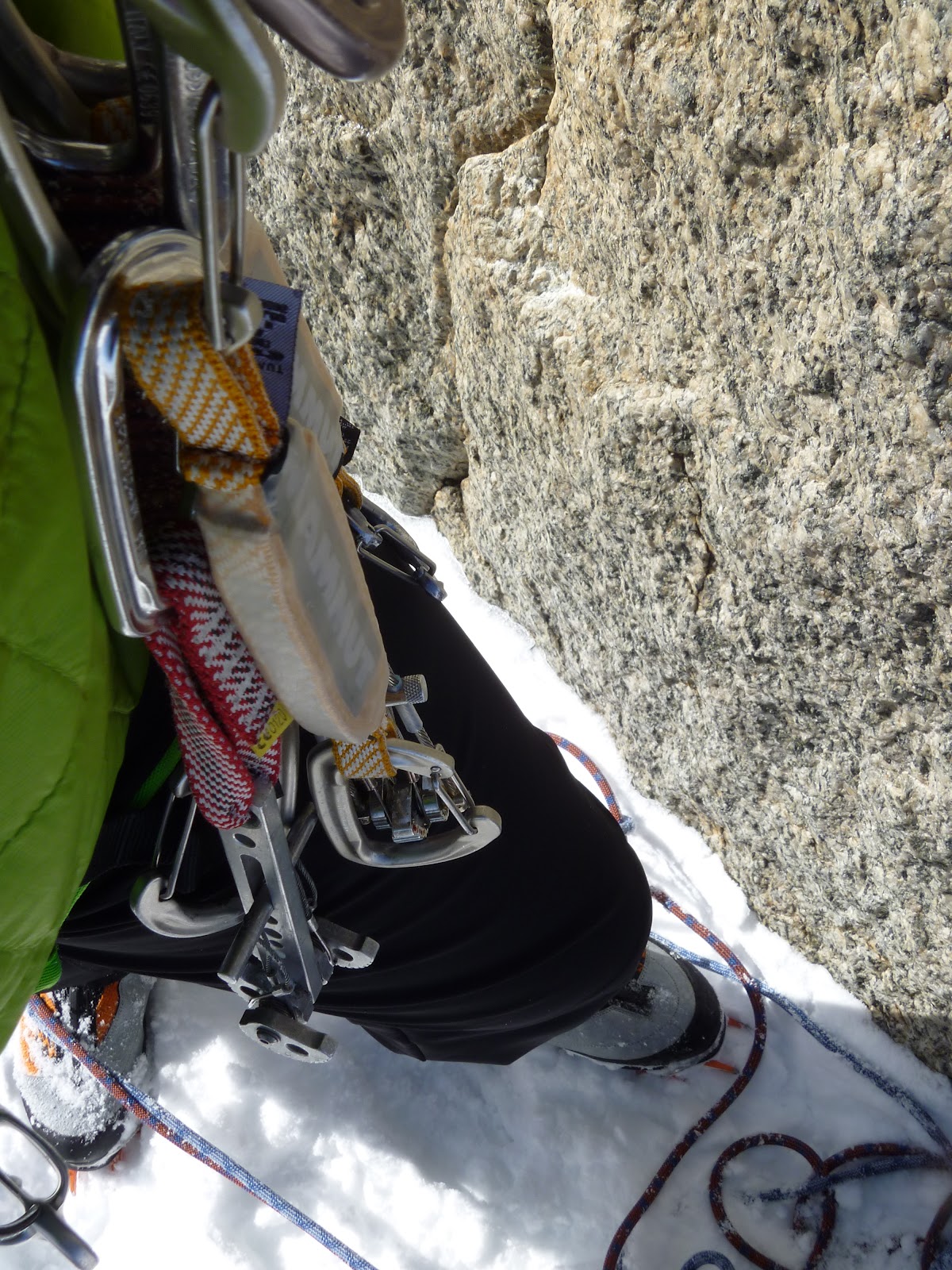
I had covered the anchors because I knew my partner was not going to be pleased.  With the gear or with me.   Hell! I wasn't pleased and at this point was feeling like a total failure.  WTF happened here?  A couple of things.

The ice was really old and hard.  It was shallow.  I dinged 3 screws trying, I know.   But and here it comes....the screws were all new (as in brand new) BD Express screws.  I had decided to make a real effort to use the BDs in the alpine on this trip.  Lighter by a few grams, rack easier and all.......
Even if the BD's are a bit harder to place, which has been my experience over time,  it is only alpine ice.  How hard can it be?  "It aint going to ever matter."

Ya, that was a dumb answer.  And this was a "easy" climb.  Just the fact that the ice wasn't being cooperative made it, well, not so easy.

A number of things stood out to me on this particular climb.  New snow on the approach and the easy angled ice, the cold temps and the ice quality.  It was hard to get takers for a trip  back to that set of gullies ;)

What I did fine when I made it back the next week was...similar snow conditions.  And the same ice conditions.  Likely a tiny bit warmer but that would be only a guess and if so not by much.

But I brought a majority of Grivel Helix screws this time.  Fool me twice and all.  Amazingly enough...every screw was sunk to the hilt first try.  Nothing tied off and no time wasted on bad anchors.

To be fair.   I knew where I was going, where there was good/better ice on route and where to avoid another dry hole.   But still......if I didn't think there was a difference...a big difference..I wouldn't be writing about it.    With a little help my partner was able to climb "the obvious line" that wasn't all that obvious first time around or for the locals that were following us that day.

I have a full rack of the newest BD and Grivel screws and no horse in the race..   YMMV but that is my 2 cents from this experience.


Looking down from that same belay....great snow ledge anyway :) 
Sadly, no, the beautiful and warm sunshine  never touched the belay.

Thursday, April 14, 2011

The Power Nap..a cautionary tale


A couple of years ago in early winter we walked into a local peak, climbed it and walked back out.  With the nap I took walking out I was just over 24 hrs c2c.  My partner a few hrs less.


Nothing exceptional for time.  A bit of the climbing was spectacular.  The walk?   It was long enough.  Longer than I wanted it to be.   Shorter than it can be.

But this story has nothing to do with climbing or walks.  It is all about the Power Nap.

I love a good nap when I am tired or better yet when I am tired and warm.  Preferably with the sun shining on me in a protected, comfortable and safe place.

The power nap I spoke about above has a few of the elements.  I was tired.  Protected?  Not so much I just laid down on my pack off to the side of the trail and let the cold wake me up.

Here is the rest of that story and the end result.

http://coldthistle.blogspot.com/2010/11/immersion-foot.html

Seems reasonable.  Wet and cold feet pounded in a few hrs of hard walking in, on and out.

So then I decided to take another power nap.  This time at 12K feet in the sun and it was AWESOME!  It felt amazingly great.  I was warm and cozy and comfortable out of the wind and soaking in the last bit of sunshine I knew would be the last I would see for awhile.   My feet weren't wet or cold this time.   Dry and warm as matter of fact.   The one thing that both naps did have in common was tightly laced single boots that I couldn't be bothered to unlace for a nap.  Dumb!  Really dumb in retrospect.


                                                     A great place for a power nap!


So??    The result of my second power nap?  Pretty much the same result as from my 1st power nap with wet and cold feet a couple of years previous...fooked up feet.


After both of these "power naps" I ended up walking for another hr or so each time after I woke up.  My feet felt a little weird but never thought they had been damaged.   More like they had fallen asleep a bit, not fully numb, but woke up with the additional milage.   Both times the resulting nerve damage came as a surprise a few days later.

Now before you pass me off as a nut case...,OK, may be that already has happened.  But in my defense I have spent a few nights out up high in the middle of the Canadian/Cascade winter and early spring in Alaska at much colder temps with little or no gear and not fooked up my feet.  The difference you ask?  Well I generally spent the majority of time on those trips bouncing around trying to keep warm.  I didn't lay down and take a power nap.  I was more worried about getting back to some place warm enough so I could take good nap and be sure to wake up again.

The lesson?  It might be obvious by now for any rational person ;-).   If you are prone to taking power naps, mid trip, take the time to unlace your boots early on.  You'll likely be happy you did.

Wednesday, April 13, 2011

Vertical or horizontal front point?


This winter's Ice climbing season started early. Nov. in the Ghost River area of Alberta in fact for me.

                                                                   The Ghost

 The super cold temps that would later invade Canada and Montana had yet to arrive.   Some where you generally have to pay the price for good early season climbing.  For me that was climbing on harder ice than I am generally use to for the majority of the season.  By Jan and -30C temps in Canada I was pretty much worn down and worn out with hard water ice.

In a typical winter I start climbing water ice in Canada after Christmas and continue through mid April.

This winter I had 4 trips north in before Christmas.

The 5th trip was to the Ice Fields Parkway at the first of the year.  Cold by any standard.  I took dbl boots and for once a pair of BD Cyborgs to easy the pain of pounding toes on hard ice.  It made a difference.

Generally I like climbing in horizontal front point crampons.  They offer marginally more support and resist shearing the front points in wet, soft ice.  I have found most of the cruxes in my own climbing to be sun rotted  vertical ice or just as likely what ice that is there sublimated or just out right melting off the wall.   Places that a set of single vertical front points just don't "cut" it for me.  I hate having my feet pop off on anything including steep or not so steep ice because of the specific tools I have decide to use.

Some huge advantages of a mono point on mixed but even there I will generally try to get away with a set of dual horizontal fronts unless I know it will be a mostly a rock climb with boots and tools required.  Not dry tooling per say but certainly "modern mixed".

I know for my size a set of dual horizontal fronts offer more support and that I am less likely to pop my feet.  Proven to my self over and over again.

But then there is hard ice....not the typical couple of days of hard freeze ice but weeks on end at -20 or less.  The stuff that breaks tools, crampons and dinner plates big enough to break helmets.  Cold...like an animal wanting to kill you.  Polar Circus was a good example in Jan.  Dbl boots and a set of vertical front pointed Cyborgs made it less effort, thankfully.

                                                   The Ice Field Parkway


Ha!  Funny now in retrospect as I have never been as cold as I was climbing in Chamonix this winter.  Shivering to the bone cold, on route.  Temps only -20C or so and with a good wind.  Likely most of it was me being less than fit and not acclimatised.  But no matter, I as cold. (reoccurring theme about that trip)

The cold I can deal with..even while bitching about it.  The ice was another matter all together.  The first bit of gully ice I found shattered on impact and was tough even to get enough purchase for a good hook let alone a solid stick.  That bit of ice was mid route on what is generally considered a "rock" route so I blew it off  to the 4 mm pick and my inabilities.  Boy was I mistaken.

The next bit of ice I encountered was at least half gravel and sand, frozen into the back of a corner.  Proper gully ice that.  Thankfully there were enough rocks sticking out of the ice that front points weren't an issue.  Getting a decent stick with my tools was however.  Nomics without pick weights or hammers this time.  My normal choice for Cascade or Rockies mixed and the seemingly hands down preference in the Alps I am bluntly told.  Nomics, Cascade picks and no weights.  Ya, well that choice didn't work so well for me.  And a set of sharp, vertical crampon points is likely the only thing that will consistently penetrate alpine winter ice, aka, Chamonix asphalt.  The ice may look great for climbing but the difference between Neve and old winter water ice is genuine and huge.

No more worrying about shearing a set of dual vertical front points or a mono for that matter through soft ice.  The ice was hard enough to support even my lard ass on a mono in every alpine gully I climbed and half the water falls I did this winter.

So while I am still a big fan of horizontal fronts I am also a huge fan of Monos when I can get away with it and even a bigger fan of dual verts.  And when it is cold...really cold.....I want VERTS.

                                                                       Chamonix

There you go...another change of mind on my part for gear...it can happen on occasion ;-)

The Love Letter

The truth about blogs?


Before I left for France in Feb. I got into a pissing match with one of the original supporters of this blog.  A supporter of blogs in general really, from what I know.

The dispute came from how blogs should be used.  Some how my friend wanted to see Internet support but not constructive criticism.  Let alone anything remotely resembling "investigative journalism" when the "facts" didn't add up.

I'm obviously not done with that topic or the investigative part of looking at gear with a critical eye and calling bs when i see it.

This week I became aware of what most already know I suspect.  Blogs are generally detail oriented!   The details you won't see in published print.   I obviously like climbing and would do more of it and write less if I lived in a place, like Chamonix for  example, where it is "easy" to climb every day.

Living just outside of Seattle, generally has the weather defining when I will climb and where. 

So back to the blog or blogs.  It doesn't really matter what Blog, most go into such detail that it can be over whelming or just plain boring even for me. 

I loosely follow a few blogs.  Generally on climbing or conditions but some on fitness and a few others on things I am interested in from time to time.

As a neighbor who works for REI pointed out.."I tried reading your blog a couple of times (she was interested in the trip to Chamonix) but it was too technical".

Duuuuuuuuuuuhhhhhhhhhhhh ;-)    Most blogs are too technical.  They get into details that no one in their right mind would really care about.   Except for the details we do care about.    Be it your lactic acid threshold or what kind of steel your crampon is made of, how to pull a part a '86, the case capacity of a .416 or the oil cooler requirements of a '95 3.6 conversion.  Did I loose you yet?

You get the idea I suspect.  :-)

No worries, more details, useful or  not, coming on climbing gear asap.

Everyone draws a line some where....


If you haven' read this and the research behind it you should.

http://coldthistle.blogspot.com/2010/05/why-weight-of-your-footwear-is.html

I draw a line at cold feet and heavy boots.  Admittedly that is going to be a balancing act generally.  

While I was in the Alps a friend who was on the way to Chamonix asked me, "should we bring doubles?"

At that point in my own trip I had been handed my ass time wise and by the cold on two separate climbs that by guide book and my "sitting at my desk standards" should have been easy...to the point of casual.  They weren't and I was cold.  Luckily for me I never had cold feet.  But then I didn't have to spend the night out either as clearly I would have if  I had been required to do so.  One climb was in dbl boots, Spantiks in fact.  The other was in Scarpa Ultras.


So of course I suggested they bring dbl. boots.  And of course they didn't.  It worked out fine as the weather warmed up in the couple of weeks it took for them to show up in the valley and get on something big.
When they did climb, they climbed fast which helps :)

Snell's had several dozen pairs of the Scarpa Guide in stock but only 3 pair of the Ultras available.  No Ultras in my size or I would have bought a second pair as they aren't available in NA and easily replaced.

I've already reviewed the Ultra.  This is a revisit to that topic.

http://coldthistle.blogspot.com/2010/09/scarpa-phantom-ultra.html

http://coldthistle.blogspot.com/2010/12/phantom-ultra-vs-trango-extreme-gtx.html   

http://coldthistle.blogspot.com/2010/11/scarpa-phantom-ultra-and-scarpa-phantom.html

Weights are of a one boot in a size 45.


La Sportiva Spantik 3#.05oz / 48.05oz/ 1362g
La Sportiva Baruntse 3#2.5oz / 1503g
La Sportiva Batura 1st gen. 2#7oz / 1106g
La Sportiva Batura 2nd gen 2#11/ 43oz/ 1219gm
La Sportiva Nepal Evo 2#10.5oz / 1205g
La Sportiva Trango Evo Extreme GTX 2#3oz (35oz) / 992g
Scarpa Phantom Ultra new 2010 model 2#3.5oz (35.5oz) / 1006g
Scarpa Phantom Guide new 2010 model 2#7.5oz / 1120g
Scarpa Phantom 6000 new 2010 model 2#10oz/1190g


I've been trying to high light the gear I used and really liked in Chamonix this winter on the blog and will continue to do so as time allows.  I took 3 pairs of "big boots" on this trip.  The Ultra the lightest of the three.  It fits my feet very well and most importantly it dries easily.  They dry faster than either my new Baturas or my Scarpa Guides. Part of that is the insulation and inner boot body and part of it is the OurDry liner I suspect.  Now both the Guide and the Ultra are using OutDry.  My early Guides are Goretex.  Not sure what is in the Batura. But the Batura is warmer than either Scarpa single boot.


I had intended to climb in only the BD Sabertooth crampons with these boots as they offer the best fit with the addition of Petzl bales.  But it bacame obvious pretty quickly that I had chosen the wrong crampon for the hard ice conditions we experienced early on.  (more on that choice of horizontal or vertical front points in a later blog)  Not a big deal normally but the Ultra (and its stable mate the 6000) are not the easiest boot to  fit a crampon to.  Here is why.  The sole profile on the toe of the Ultra boot.  By far the most narrow toes on a technical boot from  the Industry to date.
Ultra and a new Batura side by side here.


I find the Petzl crampons or at least crampons with Petzl front bails seen to fit the Ultra the best.  So I started using a pair of Dartwins in the rock hard ice gullies.  The fit isn't perfect but it works well enough and you aren't likely to loose a crampon as a buddy of mine did in Spantiks and Sabertooth crampons in the middle of a a tight mixed chimney.  Annoying that, at best.


No real point to this blog other than to say how much I like and used the Ultra this winter.   November through April it has been my go to boot.  It fits me well and climbs good enough.  Not the support of a Nepal Evo or Spantik but they are lighter than either by a fair bit and warm enough.  More support and warmer than the Trango Extreme.  And I consider all of the boots mentioned some  of the very best available for alpine ice climbing.


All the boots I mentioned are obviously excellent boots.  No surprise of  the boots I climb in and have pictured above that I would like one pair better than the rest.  They all climb well so it eventually comes down to fit.  The Ultras fit me the best..even better by a fair margin than the Scarpa Guides.

Down side of the Scarpas?  They aren't very durable to date.  Which is why I would have bought a second pair in Chamonix.    I like them enough and know they aren't going to last long.  The inners are coming apart on both pair of my boots, new Guides and Ultras.   And I have had friends collapse the toe box on the new Phantom Guides.  Scarpa NA wanted nothing to do with the obvious warranty issue.  Thankfully the UK importer took care of the problem with a complete refund.


Nov.
                                                                        

                                                                            Dec.
For Jan. it was Spantiks in Canada and during Feb in Chamonix as well.  March was a toss up between singles and dbls.
If nothing else writing a bog post like this reminds me I have gotten some good climbing in this winter season. Nothing spetacular by any count but it was fun ;-)

Tuesday, April 12, 2011

Blue Ice again?


I have been lucky enough to secure a steady flow of Blue Ice climbing gear to the NA market.

They offer some unique items now and more to come in the near future.

More here:
http://coldthistletools.blogspot.com/2011/04/blue-ice-gear.html

Thursday, April 7, 2011

Patagonia Nano Puff Pull Over?


This is a great piece of clothing  but up front I am not a big fan of Patagonia.  I think they are over priced, and the fit is generally terrible.  The fit has always been off...and nothing seems to have changed in 30 years.  Arcteryx is a good comparison...high priced but a great fit in almost every single piece of clothing they make.   The Atom Lt is one of my favorite pieces of cold weather clothing because of the fit.


Atom Lt in the Icefields in Nov.

I bought two of the Nano Puff Pullovers on sale this winter.  One for a buddy's BD present and one for myself.  If I had known just how good they were I might have given my buddy a decent bottle of wine instead of the Nano!

The best thing I can say about Patagonia is they have a stellar warranty and refund policy.  So no question what you buy will either live up to your satisfaction or you can get you money back or do an exchange.  I've done both in the past but generally stay away from Patagonia clothing because of fit. 

In the last year I have had two different pairs of Micro puff pants...neither size fit.  One of  the other pieces from Patagonia I used this winter was the Hooded Down Sweater.  Which I liked a lot except for the fact t was down.

I wouldn't be writing this one up if I didn't think the Nano Puff was truly a stellar piece of kit.

Like almost any light weight piece of clothing I use the Nano Puff as part of my layering system.  With the Nano it is generally used as a wind shell or over layer.  When it is warm enough I'll use it as an wind and insulation layer over a thin R1 hoody or collared R1 layer.  The R1s are another excellent piece of kit from Patagonia.   They also fit much better than the norm.


  Nano Puff Pull over used with a R1 pullover.

In cold weather I'll use the Nano Puff as a wind shell and additional insulation layer over an Arcteryx Atom Lt hoody.  Awesome combo that gives me 100g/m worth of insulation while still keeping the extra breathability of the Atom Lt side and under arm panels.  Easy combo to climb technical ground with.


-20C and windy @ 10K feet...a Atom Lt Hoody used with a Nano Puff as the wind shell layer.


There were only a couple of clothing items I wore almost every day in Chamonix late this winter and into spring.   We had temps of 0 and -25C between storms and brilliant sunshine.  The Nano Puff pullover was one of the few pieces of clothing I had with me that was versatile enough to use at both ends of the temperature extremes.


Sadly the Pull Over version doesn't fit me the same as the full zip or hooded full zip.   The Pull over is the only one that I think fits well enough to buy.   I'd own one of each  of the others if they did actually fit.  Even in my XL size  this pull over  jacket packs up super small and adds way more warmth than expected for the thickness of the insulation. I really like climbing in this rig.  It breaks the wind and adds enough insulation to make even a cold day in the sun super fun.  At the moment I own one...the bright green shown here.  But it won't be just one for long.   They don't take the abuse of rock or sharp objects well.   Next time I get the chance I'll find and buy another on sale.   This is a piece of clothing anyone can use and one worth throwing in the pack anytime you head above treeline.

Not many pieces of clothing I get really excited about.  The Nano Puff and the Atom Lt make an unbeatable combination for alpine climbing...and other fun, cold weather things as well!