Pageviews past week

The cold world of skimo & alpine climbing

The cold world of skimo & alpine climbing

Tuesday, November 28, 2023

Warm feet? Do I want a Double or Single boot?

 Or maybe better asked, "How to avoid this?!"


This is the Internet.  So, the following is basically a "rinse and repeat" of earlier info posted prior.

I'll get to the boot question in a minute.  But if you have never had cold feet, feel free to skip this one.  Cold feet have been a reality for me since my very first outdoor endeavors, literally starting in the 3rd Grade!   That was a long time ago and I have learned to manage cold feet for the most part, even after some serious chemo induced neuropathy, but warm feet are still an ongoing process, decades later.

I can barely remember now, crying from the pain in my feet as a 3rd grader, and twenty years later the pain of having to walk off Mt Rainier in cold mid-winter condition in only my socks.  My feet swollen and frost bit from a bad bivy on top of Liberty Cap and unable to wear my boots once my feet unthawed.

I like technical gear and those discussions.   But let's start this conversation with some basics that have little to do with the gear you buy.   This part is free, just needs to be installed on your hard drive, located between the ears, and is worth more than any pair of boots.


Been a while since I have made a serious blog post.  But if you can make use of the search function here, in the content are some comments on staying dry to stay warm. 

It took me a long time to figure out a lot of my cold feet issues are/were caused by wet feet.  I now suspect my feet naturally perspire more than the next guy's.

VBL socks and antiperspirants can help there.   I have used both to good effect.  I have climbed a lot in some very cold conditions, (-40C and elevations up to 22,000ft ).   I've only had minor frost bite once, that winter in Mt Rainier in 1976.   

Bottom line on wet feet?  If your socks get wet from sweat your feet will eventually get cold.  You can protect the insulation in your socks with a VBL (but they tend to slide around some) or by using a good dose of rub-on antiperspirant.    I like antiperspirant and a thin sock, relying in the boot for insulation.

More on the boots shortly.

You need to know the source of the problem before you can solve it, right?   So, no wet feet!

That is a good start.  A number of reasons I can now list as to why I froze one of my feet on Rainier.  All, but one, were trivial mistakes by a rookie.    The same mistake, most make, is the culprit almost every time.

Dehydration.

Get dehydrated and tired in cold weather and you are very likely to become a frost-bite victim.  Simple as that.  Both dehydration and physical exhaustion are pretty much a part of winter alpinism.  Do your part.  Stay hydrated, and go out physically fit.

Fitness?

No one wants to be a mouth breather.  And not everyone is Colin Haley.  If you can climb as fast as Colin, you might get up the Cassin, unharmed, in single boots.  If you plan of belaying all the mixed pitches and stay a couple of nights out on the Cassin, best to take a good pair of double boots and enough fuel (which means bringing a stove) to stay hydrated.  

Colin wasn't the only one on the mtn that year (2018) in singles.

"5) Better gear.
Compared to my previous attempts, my crampons, ice axes, helmet, umbilicals, and clothing were all lighter weight. Also, this time I carried single boots rather than double boots, and no stove."

Cassin Ridge Speed Solo – Skagit Alpinism (colinhaley.com)


Common sense once you figure it all out.

The black set of toes above?   Not mine thankfully.  And I wasn't on that particular climb.  But it was one of the coldest nights I have spent in the mountains sitting in a tent below them. They had an open bivy.  Temps lower than the climber and his gear were prepared for.  But I'd guess it was the dehydration and wet feet (from hard climbing all day) that were the real culprits.   It wasn't fitness or a gear issue IMO.   

Look closely at any climbing frostbite injury and very likely something similar will jump out as the cause.

Cigarettes?   Not an uncommon suggestion. Nicotine is indeed a vasodilator.  Best to do some more reading on the subject if that is the answer you prefer.   I'll stick with dry feet and a better water intake :)

"Vasodilators dilate arteries and/or veins. This results in increased blood flow and lowered blood pressure. Vasodilators are commonly used to treat high blood pressure (hypertension) and heart conditions."  


"Hello friends with terrible toe circulation, have any of you tried a full double boot and found it to be significantly warmer than a lighter tech option?" BM

Not an uncommon question.

Still, I don't think it is the right question on how to solve "cold feet".

Good hydration, dry feet, and right up there, as the "most important" basis for warm feet, is boot fit. If the boot doesn't fit well you are simply screwed from the get-go.

Almost everyone will find one brand of boot a better fit than another brand of boot. The boot you may have your heart set on (and your pocketbook) may be the worst boot for your feet. A smart buyer will use the Internet and their credit card to order in every boot that you think will do the trick and rug test them all for fit. Simply return what you know won't work and sort the rest in the comfort of your own home. The results may surprise you.

Dry feet? Check.

Manage your fluid intake? Check

Perfect boot fit? Check

The perfect boot? Ya, not so much ;)

A few have used fruit boots on Polar Circus. No need really, as the climbing isn't all that difficult. I've used double boots there several times in cold weather and really light weight tech boots there in nice weather and Spring conditions. 8hr suffer fests in the cold or 4hr romps under blue skies. Pick your poison for the boot and the conditions.

But that is what alpine and ice climbing are all about, right?

A lot of difference between "perfect" conditions and a bad day out.

Photo is from a few winters back. A bunch of us were trapped on top of the Midi in a storm. Notice what the locals are wearing for boots. I was the only one waiting for the tram the next morning, in single boots. And very glad I didn't have to spend the night in the loo again in singles.


Technical ground in double boots? Sure. But every ounce on your feet eventually adds up to pounds on your back.


If I can stay warm, I will always choose a lighter boot. The cost of the wrong choice may be steep.

"You must ask yourself, is it $1000 total, or $100 per toe?"  JJ


Last but not least.  How many pair of boots do you own?   For a long time I owned a pair of mtn boots and a pair of rock shoes.  It was all I could afford.  

These days I own 4 different pairs of mtn boots.  All sorted by weight and warmth.  Overdone?  Sure.  But having warm and dry feet, and the least amount of weight/bulk on my feet makes the $ spent per toe worth it to me.

My "old" double boots (the Scarpa 6000 I wrote about below) are still working fine. But there are a few new ones I'd love to try.   But up front, the boot needs to fit your foot and your use, not mine.  Good luck!


And finally, all viable, modern options, to extend your comfort level of your own boots.

Lenz socks

Thermrup insoles

chemical toe warmers


Saturday, November 25, 2023

FS Dynafit Blacklight boots size 29.

 FS New (unworn/unmolded/hang tags intact) Dynafit Blacklight boots, size 29, $600 shipped CON US. Venmo or Pay Pal if you pay the fees. Neat boot. Lighter and stiffer than a TLT6P Just not a good fit for my feet.


Saturday, November 11, 2023

Movement's, "Alp Tracks", series of ski, plus 1

A meter of new snow!   The 2021/22 Movement 106 in its element.  


15 years ago Dave Goode, in Provo Utah, was making carbon fiber skis that still have yet to be surpassed for weight.

Ten years ago Dynafit did a run of very light weight touring ski that covered 3 different widths from  78mm to 98mm underfoot.  For what they were, all of them still skis exceptionally well for their width and weight as a touring skis.  And IMO all are still exceptional skis by any standard.

Here are some numbers for comparison:

The Nanga Parbat 80mm

171 x 80mm    Nanga Parbat 1052g

The Cho Oyu 88mm

174 x 89mm    Cho Oyu         1180g

and the Denali 98mm

176 x 98 Denali 

1299/1259 = 1279g average

1294/1305 = 1300g average 

Ten years on now, the general touring skis have gotten wider and overall lighter for the most part.  But few have match let alone surpassed that run on the earlier Dynafit skis for the weight compared to the width under foot.


Movement's skis for 2022 and 2023?  Construction?

  • ULTRALIGHT CARBON
  • wood core, ultralight paulownia
  • DOUBLE PLATE TITANAL
  • BASE SPEED
  • RACE EDGE
Tour width skis available in the men's specific ski?  (Thy also have women's specific skis in similar
widths)

Weights listed are actual from my own skis.

This ski has a slightly different construction.  More on it coming shortly.

Race Pro 77.
77mm  838/828g per ki
833g average on my pair (161)


85mm
2022 version
968g (161)
This is a ski I took on a local 20 mile ridge traverse.  I'd done the traverse before on 65mm x 161cm race skis.  My day sucked because of that choice in skis.  Snow was really wet and the majority of the traverse is flat or slightly uphill until the last 1000 ft drop.  My race skins failed mid trip.  Life got old fast.  I ended up walking in knee deep, wet snow, for much of that trip.  The skkis were too skinny and the skins simply sucked.   This time around I used Movement's clip attach skis, which were great even after, literally, dozens of transitions.   It was an outstanding combination for that particular trip.  Nothing I  own was going to make it any better than the Movement 85.    That traverse is a lot better with no snow, on a mtn bike :)


90mm

1030g (162)  This is a ski I don't own.   It was a tossup between the 85 and the 90 underfoot.  The "on sale" price point made that decision for me.


95mm

1108g (161cm)  Short and stubby, intentionally.


98mm (2023/24) version

1273g/1275g per ski (178cm)

1274g average for my pair, which is outstanding.

This is the ski I bought to replace my aging 176cm, Dynafit Denali.    The Denali was listed as 131-98-116, 21.5m  and weighted in at a1290g.  The 98 is listed as 126-98-124.  20.5m radius and came in at  is 1270g.   So the two skis are very close.  A little less side cut, and hopefully, a little less hooky on the Movement in bad snow.   We'll have to see if they ski good enough to justify carrying the extra 1 pound in ski weight over some of my lighter 161cm ski for Spring and Summer corn.  I once thought so and skinned on a pair of Huascaran to Camp Muir.  Huascarans were a full 2.5# heavier than either of the two LWT skis.  For a run ski down from Muir to the bridge very fun, but a really dumb idea to carry an extra 2.5# on your feet..anywhere...if you can help it!  I expect the 98i to be just as much fun as the 2023 106mm version, just in a bit less ski in overall weight.   I'd guess it to be every but the ski the original Denali was and a good bit more playful and forgiving.  Which should equate to an outstanding b/c touring ski. More to come on that choice and why.


106mm (177cm) 2022 version 1340/1335g


2023/24 version 1296/1283g


When I went looking for a new ski in Jan. of 2023 it wasn't like I needed a new pair of skis.  The ski inventory in my shop is embarrassing in its selection.  But some of them are getting a little long in tooth if not by technology, then by use.  

At the start of the pandemic, I had sent a deposit for what I had hoped would be a fun 4 or 5 days of steep skiing.  It took a couple of years a change of ownership before that deposit was finally honored.  Turned out it was the biggest ski season in decades and the snowpack to match.  I've never left home with the avi danger so high in the back country.

But that trip or at least the promise of that trip sent me looking for a new ski with at least the weight and surface area the older Dynafit Denali.  

The Denali has been my go-to ski for a while now.  It had replaced my much-loved Cho Oyu that I have spent even more time on.   The Denali was a bit more forgiving, and I liked the added 10mm under foot, both of which bettered the Cho.

I have skis going from 65mm under foot, all the way to 138mm under foot.  Usually more than one and between them a number of great skis that overlap on width.  The Denali is 98 under foot.  It was replaced by the Dhaulagiri @ 95mm underfoot.   And eventually replaced again and again with a few tweaks by the Dynafit to arrive at the Blacklight 95, which is the current, touring oriented, 95mm from Dynafit.

I bought and skied on two different sized 95 Blacklights.  Although the BL 95 is close in weight,  IMO it is no Denali when it comes to how they ski.  A decent ski sure.  But nothing to write home about either.

So the search continued throughout the winter.

Skimo Co. in SLC generally has a great selection of back country skis and, more importantly to me, reliable data.

Movement Alp Tracks 106 - 2021/22 (skimo.co)

What they offer IMO are very reliable descriptions of how the skis actually perform.  I would prefer more in hand reviews that a J. Peterman catalog of fantasy writing.   The best I could hope for on reliable data was what the end users were commenting on in Skimo's Q&A section.  Even then I found some of the comments totally at odds to my own from actual use.

Which in turn got me to write about my experience with a number of Movement skis here.

The 106 was my first Movement ski.  So the conversation really starts here.

There was some back and for the between SKIMO comments and perspective buyer's comments on the two versions of the 106.  Which made me favor the "more traditional style 106 from 2022.  Flat tail, a little stiffer maybe and a less "fun" ski by what I would consider "modern" standards.   I think the "less fun" comment is spot on when compared to a dbl rockered, twin tip style, modern freestyle ski.  The Praxis GPO is a classic modern, and really fun ski.  DPS 112RP is different yet but another.   Both are also a good bit more under foot @ 112/116mm and weight well over 9# for a pair.  The Movement 106 comes in 3# lighter for a pair.

So not the best comparison.  The 2022 version is not the best for shape as a comparison either.

Don't get me wrong I really like the 2022, Movement 106 version.  But it has its place.  And it is not the 2023 version.   I skied the 2022 version in all sorts of snow.  And it would be a great all around ski for me as is in soft snow conditions.

But playful it is not.  You have to work the ski.

The 2023 version with pronounced twin tips and a slightly softer flex is flat out a better soft snow ski.  And at least in the two pair I ski, the 2023 version is a bit lighter.

Everyone very likely has one run that stands out from the 2022/2023 ski season.  I have a couple of them.  Both on the 106.  And earlier winter run made me think the 2022 version was one of the best skis I have ever skied on for size and weight.  Same run, in similar conditions, 2 months later convinced me the 2023 ski was without a doubt the best lwt "mid fat" ski I have been on.   I am stuck on that conviction even now.  The 2023 version is simply an easier and more forgiving ski in soft snow than the 2022 version.

That said, I'd still carry the 2022 version to ski off Rainier, early season.

Which such a quiver of sizes to choose from it is fun to pick and choose what width and length of ski you might want for your own adventures and the time of year.

There is no doubt that the Movement ski line up really are good skis.  Isay that  even when not focused on ski weight.  Every Movement ski I own skis exceptionally well.   But the reason I bought them is their weight.  It is the weights specs that first grabbed my attention with Movement.  The weight alone has continued to hold my attention on this width of ski.

I wrote this comment on the 106 first, but I'll try to give some perspective on the other with ski widths as well before I am done.


Saturday, May 20, 2023

Movement Skis?

Toys?   I still get excited by the best of them. If you do any skinning in the winter hopefully you already know about Movement Ski. I'm in the process of writing an in-depth review but thought it worth a heads up first. Movement is an innovative Swiss company producing outstanding skis. Their "Alps Tracks" series are along the lines of the original carbon fiber skis by Dave Goode from Ogden Utah some 16+ years ago. By the looks of it no one yet has really upped the game from Goode's skis for weight. (1080g in a 95mm 160cm ski) But others (Movement included) have taken the technology and improved how carbon fiber skis. And the Alp Tracks series of skis really do ski exceptionally well! From my perspective the Alps Tracks Series keeps getting better, after having skied on some of last year's 2021/22 models and then their newest version of the same ski in the 2022/2023 models.

All, old and new, have been outstanding skis.

Better yet, most of them can be found on sale this time of year for around 1/2 off retail. Long gone are the days of underperforming lwt ski. Some of the best days I have had on snow, were this winter, on Movement skis.
One ski's weight (average between a pair), no binding, on my postal scale,
77mm 161 833g
85mm 161 968g
95mm 162 1108g
98mm 178 1275g
106mm 178 1290g


Wednesday, April 12, 2023

45cm ice axes for self-arrest?


Everyone starts somewhere.   The start of a skimo adventure circa 1970 :)

I've been lucky to ski a good bit this winter.  Great fun with a record year for snow fall.  Hang out with enough skiers and gear always gets discussed.   Everyone has an opinion.   Worth paying attention to see if your goals match up with the suggestions you get.  I have a number of comments I'd like to make instigated by recent conversations, but I'll start with the topic of "ice axes".  There is more, but I'll start here.

10+ years ago Bruno wrote what I still think is a pretty good description of and use for a traditional axe.
I'll try to address that same reasoning to a traditional SkiMo outing today.  Some may want to label me a troglodyte.  That's OK.  


But let me cut to the chase up front.  Up to and including WI 4 ice climbing there nothing a 60cm traditional, steel headed ice axe can't climb easily, if you have the skills to climb ice.

There are many uses for an axe in mountaineering and ski mountaineering.  The first is likely the most obvious.  The axe gets used as a cane, holding onto the head and using the shaft for support.   It doesn't take much of an axe to get that done.  I've used a dead tree branch and I've used a old school, one piece, ski pole for the same effect many times over.


Man, the tool user.

There is a reason a "ice axe" is designed as they are.  First choice is the pick and then the adze to chop steps.  Seems like it would be the other way around but it isn't.  The pick is simply more efficient for cutting steps quickly.  Often times the pick is the preferred tool to chop steps in hard snow and maybe the adze to follow up and clean the step up.   Two strikes and you're done.   These days most will put on crampons rather than cut a step.  Too bad.  Cutting steps is a very useful skill in the mountains.  And often as not may be faster (and safer) than putting on crampons in an awkward position.   (More on the awkward position. As in, "you could die here easy enough!", below)

Die, you say?!  Did that get your attention?  The most obvious use for a mountaineering axe is self-arrest.  You know, the skill you practice until it is automatic, that skill that keeps you from stopping your fall before you hit the nearest flat spot, if there is one?

If you have done much self-arrest practice, a couple of things you'll note very quickly.  Not that easy to get stopped.  Stopping gets harder yet as the snow gets harder.  When you eventually hit water ice all bets are off.  Generally, the bigger the head/pick and the longer the shaft the easier it is to use the axe in self-arrest position and get stopped.   The added physical size of the axe gives you physical leverage and that really helps you get stopped in a fall.    The harder the snow, the harder (and slower) it is to get stopped no matter the axe designs.  But the only thing that really helps is having enough leverage on the axe to get the job done.

"For most, any axe under 55cm is simply a more difficult tool to sue as intended, getting stopped on hard snow."

A 45 cm axe of any sort might not be the best answer for the majority of skimo uses.  Sure, a 45 cm axe packs easier.   I'd rather have/carry the easiest tool to use as needed than the tool that is the easiest to carry.

Trying to stop a fall on steep, hard snow or iced, terrain or just as bad, steep soft snow will be rather educational with any 45cm axe if you are over 5'6" tall.  Really short axes are simply a very small tool (physically)  to work with.  

They are all tools.  Be sure to pick the right one for your objective.

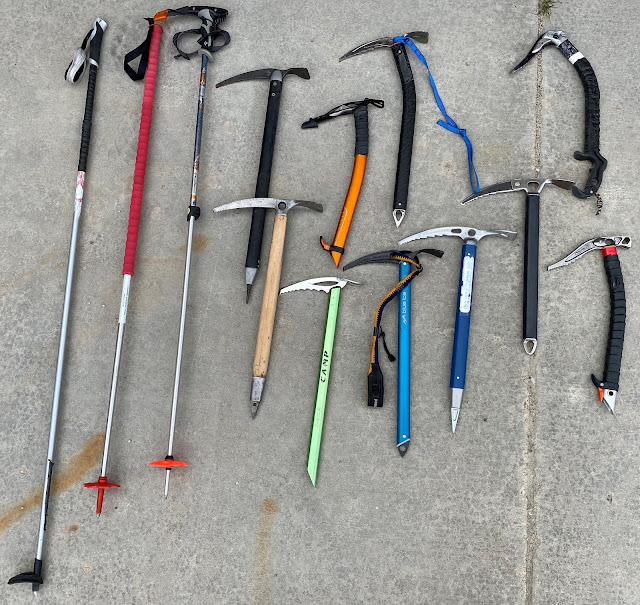
The axes range from 65cm to 45cm. 

For my own skiing I have used most of what is pictured here.  Long Nordic poles for skiing some distance, so I use my arms poling.   Non-adjustable poles with long grips to save energy on side hill skin tracks.   Grip straps to support your hand and lower the fatigue when using your arms poling.  And of course the obligatory. "Whippet".  A ski pole with a short ice axe like head, used to get stopped or support yourself on a steep hard snow surface.

Before I get more into specific "axes" here is an opinion on the self-arrest poles of any manufacture.  I own a pair.  Have for well over a decade.  I am skiing more technical lines now than I ever have.  Occasionally skiing places you'll be lucky to survive a fall.  I have never used my Whippets.  Very likely never will.  Why?  Because if I ski into terrain when I need to self-arrest I want a proper ice axe to get that done.    Let's be honest.  If you are reading this bog, you very likely have no need for a Whippet.  Common sense and a little caution goes a long way to keeping you safe in the mtns.  First rule of skimo is, never-ever fall.  If you think there is a chance of that best to be somewhere else. 

There are other opinions.  Colin Haley for one, likes and uses the Whippet.
Another recommendation from a guy who has skied plenty of steep lines.


 I've carried the green Camp Corsa axe above (weight is 209g) while skiing on the Haute Route a couple of times and on most of the Cascade Volcanos.   Great axe for the right conditions.   It makes a good walking stick and will self-arrest on soft snow easily enough.  The right conditions for a Corsa?  "Soft snow".  


I've taken two falls in crampons in my climbing career.  One in soft snow that even a tradition 60cm axe with a long pick wasn't slowing me down on.  I had enough time to think about that fact, roll over and switch to my adze, which was a much better tool at getting me stopped.  I was doing well, until I thought I had slowed down enough.   It wasn't slow enough.  I caught a crampon point and was immediately ejected into space.  The result was a long walk out and a couple of dozen stitches in my shins hours later.  Luckily I didn't break anything  which is what usually happens with a snagged crampon in a fall.

The 2nd time?  I popped a crampon off soloing on some easy water ice 3, right at 1000' tall.  The only thing that stopped me?  Catching my partner's pick with my axe's pick as I went by, as I continued to rapidly gain speed.  Thankfully, no harm no foul there.   I got off the water ice and found my crampon in the snow.  Strapped it back on and finished the climb.   If I hadn't, by chance, hooked my partner's pick?  Or had his axe placement failed when I "hit" it?  I very likely wouldn't have survived the 600 foot slide. 

Point being?  If you need an ice axe to get stopped, buy a proper ice axe that will easily penetrate the kind of snow conditions you expect on your trips and learn to use the axe  adroitly.  The easiest slide to stop is, one that never gets started. 

"Penetrate the snow conditions?"   A steel headed axe might be what you need.  But it isn't just the steel head version, or titanium or aluminum that you need.  You need a properly shape head to penetrate hard conditions.   No one axe will likely be the right tool for every tour or  every climb for that matter.  

For things like this?
Falling is not an option.


I can't tell you how many times I have heard of guys dropping into lines from the top and finding out in short order that was a bad idea.  Snow changes to ice or the surface has slide away or the snow conditions simply aren't skiable.  It happens.  It happens to everyone eventually.  Everyone.  Doug Coombs and Trevor Peterson come to mind.

Boot it from the bottom or ski it from the top?   I'm lazy but I never take it for granted from either end and now, after scaring myself silly, just once, I carry a proper technical ice tool and the additional bits of gear to sort things out if needed for that kind of "fun".

Remember I mentioned  previous?  It may be faster (and safer) than pulling skiis and putting on crampons in an awkward position."

When it is time to bail on a ski line by climbing out, better to have crampons on your feet, than skis.  Better to have actual tools in hand than a pair of whippets.  And an umbilical tied to your harness may well be in order?

Can you pull your skis off?  How about your snowboard?  Can you put crampons on your boots?  You've got your harness on already right?

I personally know of more than one pair of skis lost in this kind of transition and a single snow board.
Bad day all around there.  Trust me.

Expect and be prepared for the worst.  Think ahead and have the proper gear easily at hand.  Never be afraid to bail upward on a ski line.  The question will be is it safer to ski down or climb out.  One advantage to booting in.  The answer is usually more obvious up front.

I have just about every tool imaginable as a choice fro any climbing or ski mission.   And I have done a lot more, hard ice climbing than I ever will on difficult skimo lines.

I want an easy to place, steel pick, for hard water ice and a shaft that I can plunge into soft snow.
This is what I still use.  I like a hammer to set anchors, if required.  I see no advantage of an adze here.   

This tool is also no longer available from Petzl.  

A replacement I have been using more recently, the Petzl, Gully, axe or hammer.  Both tools shown have handles wrapped to be used as a dagger.  And a hand rest that is movable on the shaft.  The idea with the dagger position is to never allow a slide to get started.  Pick weights added to my Gully tools to ease penetration on water ice.


But make no mistake, I don't want to use either to self-arrest with!
They are both 45s and both way, way to difficult to self arrest with IMO.

Pick the right tool for the job!
Ignore the fashion trends or get determined to get really good self-arresting with short axe.  Most anyone will have a hard time self-arresting with a 45 anything.   Always better to have the right tool and the skills to use them than the other options.  The mountains have no sympathy.

Yvon Chouinard is 5'8" tall.  The photo is from him teaching an ice climbing class in the '70s.  The axe is a 60cm piolet.  There is a hint there.  Even if the axe won't fit inside your pack.

Lots of handier ways to carry an ice axe than inside your pack.


Another look from my friend Dave Searle who lives and works, year around, guiding in Chamonix.

DPS Phantom Glide....no more waxing!

 PHANTOM Glide At Home Application Instructions - YouTube


The back story for me?  Some time ago (years) I purchased and didn't use the original 2-part application of Phantom.   I was skiing a lot more this winter and some new skis to mount, so I finally added the older 2-part Phantom (one package) which allowed me to cover three pair of new skis.

The results were pretty impressive.  No more hot waxing my ski once a week.

This Spring there were more new skis in my shop.  And enough skiing that waxing was getting tiresome.  So, I bought the newest version of Phantom for the newest skis.  It is a much easier one-part application than the older stuff.   One of my big concerns was just how well my skins would stick to the surface for touring.  If you have ever had a glue failure on your skins, mid trip, you know the concern and how you can so easily have a really bad day.  But that was bad skin glue.  Not a bad base job.

Keeping the bases clean is a huge help to keep skins on as well as keeping the glue in good shape.

It took a couple of longer days skinning and in different conditions to make me comfortable with Phantom while using skins.  Once that was done the worry was gone.

But at $50 to $100 a packet, Phantom is not cheap.  The older 2-part application can be found on Ebay right now for $50.  I was able to easily coat 3 pair of 100+mm width x 180cm skis with that version.  The newer 2.0 version I get one pair of 100+ mm skis per package.  That is $95 per package and one pair of skis currently.  So, Phantom isn't cheap.

DPS says the Phantom coating will last the lifetime of the ski.  No reason to not believe that with the product now almost 10 years old.  But I can't verify that life cycle from my own use.

What I can tell you is I'll no longer be waxing my own skis.   I'm already planning on the skis I'll ditch at next Fall's swap.   Those would be the ski without Phantom that I am not willing to clean the wax from the old bases.   If I was still making a living on skis for half the year, Phantom would be a Godsend.  And worth every penny in my book.

I could "wax on" about how great the Phantom is on snow.  But I won't.  You wouldn't believe me if I did.  I wouldn't believe the experiences I have had with Phanton if I hadn't actually been on the skis with Phantom applied.  Midwinter blower to early Spring slush?   Phantom simply works.  It works better than any wax job I have ever used.  The one caveat so far is 45F+ air temps and lots of sun.  Phantom gets a little sucky there.  Wax might be better at the extreme of where you'll be in slush.   DPS says additional, traditional waxing won't hurt the Phantom.  And they claim the Phantom will make your hot wax adhere better and last longer.   Seems adding a warm weather wax (via a hot wax) as needed is a common technique to get the most out of the skis in really warm weather.  More when I get some better feedback off my own skis to offer up over the next couple of months.

And no more hot waxing messes to clean up in the shop.  If you can get a little sunshine, the new one-part application for the current Phantom is easy and quick.

This is simply a PSA.  This stuff was worth the initial buy in for me despite my original skepticism.  It just took a while to really appreciate the advantages Phantom offered to my own skiing.


Good luck!

Friday, July 29, 2022

1996 Blanchard Interview


 The story about this film series: In 1996 and 1997 Chic Scott recorded 84 interviews with leading mountaineers all across Canada, as research for his book, Pushing the Limits, The Story of Canadian Mountaineering. These interviews have been safely stored in the archives of the Whyte Museum of the Canadian Rockies for 25 years and have now been digitized.

Barry's  routes on the north face of North Twin, the east face of Mount Fay, and the Emperor Face of Mount Robson are amongst the hardest in Canada. In the Himalayas, his ascent of the North Face of Rakaposhi in 1984 with Kevin Doyle and Dave Cheesmond was one of the best climbs of the era. In 1988, with three companions, he almost succeeded in an alpine-style ascent of the Rupal Face of Nanga Parbat. These climbs were on the very leading edge of Himalayan climbing.


Wednesday, December 29, 2021

Showa 282-02 winter glove..late to the party?


Takes about 2 minutes to do a Google search for this glove.  One of the first web reviews you'll find is Colin Haley (yes that Colin Haley) endorsing them for climbing.  I should/could  just leave it at that.

Colin Haley’s Clothing System for Alpine Climbing in the Chaltén Massif - Patagonia

Of course, I won't.  Hard to cut this glove with a sharp, really sharp kitchen knife.   I tried.    Just the ticket for busting 8" of ice out of 100-gallon stock tanks while the wind is blowing, and the temps are in the teens F.    Even better when you need to pull all that ice out of those same tanks now with 50 gallows of water in them and 200# of block ice.    You get wet no matter what you do.  But no reason to have wet or cold hands now.   I have used expensive neoprene gloves in years past, and they work as well.  Just not the the dexterity, warmth or comfort of the Showa.  And the long cuff with an elastic draw cord fits over my Arcteryx jacket sleeves like they were made for each other.

I have yet to climb in them, but I know just from working around here this winter they'll be one of the best gloves I own for ice climbing.   Only thing I miss is a leather palm.   These things are way stickier than leather.    I own a LOT of high dollar gloves climbing gloves with similar warmth and durability.  None of them cost anywhere close to $20! 

These things are easily found, currently for under $25.00 a pair.  Usually under $20.! 

I have been buying them here:   I am typically a XL in any glove and the XL fits we well enough, but a XXL might be appropriate as well.  Worth a try on sizes as they are very stretchy.

Showa 282 Temres, Gloves (go2marine.com)


Friday, December 10, 2021

Thursday, December 2, 2021

Nirmal Purja? Project Possible?

Missing this one I have obviously been asleep at the wheel.  This is the most impressive bit of mountaineering I have ever imagined, let alone seen accomplished.


Tuesday, November 30, 2021

Looking back at Covid?

I had made this post on a FB page April of 2020 with little care and no clue where we would be today.   I found the post gain this morning and like the reminder. 
We aren't totally locked down in Idaho but practicing social distancing is lowering the curve and making a big difference in new numbers. First time out in a month and was able to get in a tortured 18 mile one way ridge line tour. Bad snow so it went a little longer than planned. Skiing is skiing even if you are just walking in knee deep isothermal chit snow that wouldn't support a ski.


I should add this considering the current situation via the virus and 1st Responders. By the time I realized I was going to be really late for my pickup and with no or little phone reception to call this one off I was feeling pretty stupid. It would be an easy run up the ridge line via the road I was following on a snow machine to pick me up if something had gone wrong. Not like post holing has ever caused a sprained knee or an easy slow motion fall hasn't caused a nasty spiral fracture. I am use to getting in over my head and getting out again...knock on wood....but I was feeling pretty chagrin at the thought of having to ask for help to get off an easy ski tour. I was having a hard time imagining what all would have been involved had my ride home decided to call 911 when I was 6 hours late. Some lessons learned and relearned again. Ya'll be careful out there!

Late?  Yes...hours late.


Sunday, November 28, 2021

Tifosi Sledge sunglass with CLARION RED FOTOTEC lens?

Common for me to go back and look at a product I really like. Less common of me to go back and buy something again that I really like and to my surprise have been using a lot.

 https://coldthistle.blogspot.com/2020/05/sledge-sunglesses-by-tifosi.html 


 We are having an outstanding Fall here. The riding has been exceptional. 

 My general review format is, "did I notice the gear". If I did notice the gear it is likely not such good gear for me. If I didn't notice the gear past, "was actually helping me enjoy the sport", then I am likely impressed. For a few decades Oakley has been my go to sunglass on the bike. 

 I don't like change much so I keep one good pair around to keep me and my eyes happy. The Tifosi Sledge was inexpensive by comparison to any Oakley and silly me, made a lot of judgements on the lens quality and technology just from the price.

 Until wearing the Sledge I just thought of Tifosi and a "cheap" sun glass brand by comparison to a other more well-known glasses. Admittedly really dumb on my part. 

 I really like the huge field of view in the Tifosi Sledge. Reminds of some of the old school Oakleys from the 80s that the Sledge profile (and others now) resemble. I liked it enough on the bike that I went looking for others just so I didn't have to look through the frame of the glass if I didn't want to or was incapable of lifting my head to look ahead on the bike. So much that I bought a couple of cheap pairs with similar frames off Amazon. 

 Silly move there. Lens were OK for the price...but nothing to write here about. My experience is lens are really, really good or they are crap. But the frames...they were no question, crap. Nose piece was killing me on just a 30 minute ride. Ditched them asap. 

 The Tifosi Sledge on the other hand was really comfortable. Even more comfortable than my favorite Oakleys I hold in reserve for the adventure rides. So comfortable I simply don't notice the fit, the frame, the lens, in any condition even after hours on the bike. My better half with a much smaller face seems to agree with me. Impressive to me that one glass can be used by both of us and we are happy with the results. Next up for me?    This glass and skimo soon enough. 

 SLEDGE-MATTE BLACK-CLARION RED FOTOTEC $79.95 

 May be something a little special if you have the need. We bought ours (wife and I) on sale. I really like them a lot. Enough so, to write about them a second time! The lens changes from a cat 1 to a cat 3 lens in a very short amount of time. The Tifosi Fototech is as least as good/fast on lens change as my favorite ski glasses by Julbo.   That is saying something!    Julbos like Oakley also easily cost dbl the retail of the Tifosis.

Wednesday, November 24, 2021

The list?

 I have seen this before but seems like a better list now that I live 600 miles closer.  But a wonderful story of life in the mountains as well.  Worth a look if you haven't seen it.


Tuesday, November 23, 2021

Inspiration?


I have no clue if I am anything like other people when it comes to inspiration and imagination.  I do know that as long as I can remember I have admired other athletes for their known skills and likely even more for what they could imagine.  

Early on in my climbing I had read somewhere that one of the great alpine climbers of the 1920 or '30s said, "where there is snow, I can go".  That to me was imagination, as silly as it sounds now.  That quote opened my eyes to what might be possible.  Then as now I do a lot more reading than actual climbing.

But it wasn't long after reading that I went looking for snow to climb.   The quote might well have been from Wilo Wasenbach.


If you have been around the climbing community long enough if becomes pretty obvious it can be a dangerous sport no matter the level you climb at.  The higher the level of your achievements puts you at a higher level of risk.  It doesn't take much research or experience to see that many of the "best" in every generation of alpine climbers don't generally live full lives.  

What I am really thankful for, isn't the technology advances that a good many climbers have brought to the sport but the level of imagination they bring to do things differently.  Making adventures and efforts once thought impossible, eventually common place.  Even if those sorts of efforts were only being done by a very capable few. 

The inspiration you get for free.  And often as not that will still spark my own imagination and give me a goal to aspire too.  It doesn't have to be a cutting-edge goal.  Just a goal.   For that I am grateful.