Pageviews past week

The cold world of skimo & alpine climbing

The cold world of skimo & alpine climbing
Showing posts sorted by relevance for query batura. Sort by date Show all posts

Monday, February 14, 2011

La Sportiva Batura

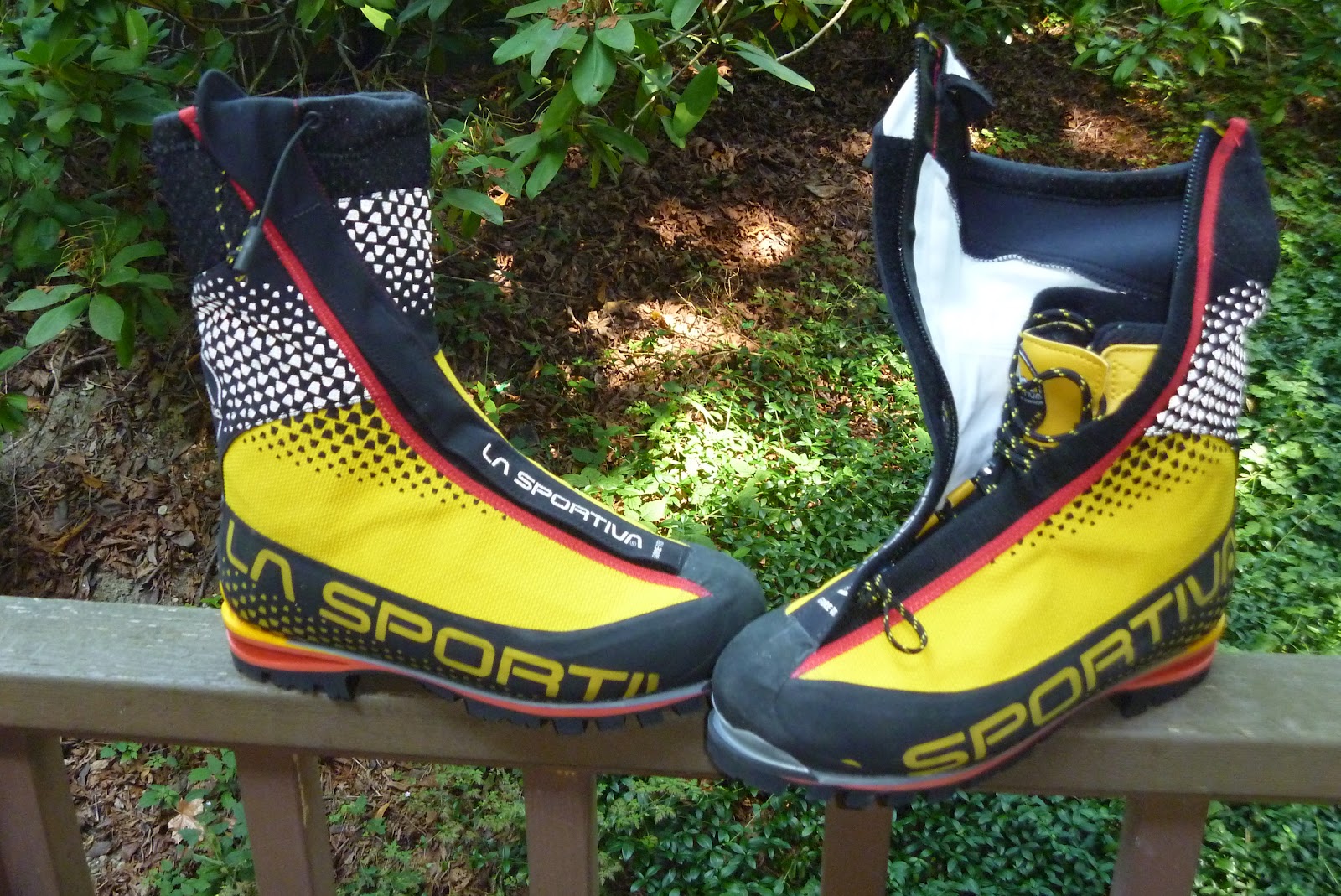
The NEW 2011 La Sportiva Batura!

It may look the same, but trust me, it aint!

Above:  Jack Roberts in the 1st generation Batura climbing Curtain Call in 2010.     

La Sportiva makes two of the most popular and highly technical  alpine single boots on the market, the Nepal Evo and the Trango Extreme ExLt GTX .  Both are truly benchmarks in current technical alpine/ice footwear.  I and many others get an exceptional fit and performance in either of these La Sportiva boots.   The Batura is a bit heavier and a good bit warmer than the Trango Extreme.  And now a bit heavier  and still a bit warmer than the Nepal Evo.   So the Batura is in heady company here.  It is easily slotted into the La Sportiva mountain boot line, between traditional single boots and heavier double boots.


La Sportiva Spantik 3#.05oz / 1362g
La La Sportiva Baruntse 3#2.5oz / 53oz 1502g
La Sportiva Batura 1st gen. 2#7oz / 39oz, 1105g
La Sportiva Batura 2nd gen 2#11/ 43oz 1219gm
La Sportiva Nepal Evo 2#10.5oz / 42.5oz/ 1205g
La Sportiva Trango Evo Extreme GTX 2#3oz (35oz) / 992g

More here on weights
http://coldthistle.blogspot.com/2010/04/weights.html


The Batura is state of the art technology in a stiff soled, flexible upper cuff and warm mountain boot.  What is not to like here?

Before I answer that question, a couple of comments before I get in to the gist of this Batura review.

I think the Batura style boots (boot with a built in insulated gaiter) have the most potential in cold weather alpine climbing of all the boot designs currently available.  The "best design" might well evolve into a super thin dbl boot or new technology (OutDry for example) might allow the single boot design to finally live up to the task of multiple days out with no worry of accumulated moisture.in the boot.  I don't know.  But I do think the boot manufactures are on the right track.  La Sportiva, Zamberlan, Scarpa and Kayand all have similar styled boots available now.  

The new 2011 Batura

At the moment my two favorites are the current version of the La Sportiva Batura and the Scarpa Ultra. And while close to being prefect for my needs, neither are perfect, as of yet.  So you are about to read a detailed and very specific commentary on my thoughts of the Batura.   It was and is a very good boot.  The potential is so  great I think it worth the effort in being very specific in my critic and comments.   My comments to follow might sound harsh out of context.  So think about the next sentence before you decide just how good or bad  the Batura is.

High praise?  The Cold Thistle blog's opening picture is a pair of  Batura on my feet for the 2nd ascent of Blue Moon, IV WI4 R M6 5.8    At the time the climb was a good challenge for me.  It was no accident I chose to climb in the the Batura on "Blue Moon".


I started climbing in the original La Sportiva Batura in 2007.   I used the same pair of boots off and on until I sold them last winter (2009/2010) while they were still in decent shape and lots of life left in them.  They had held up well and no issues on the zipper or boot for that matter.   But I have not been kind in my previous reviews of the Batura.  All the while having specifically chosen the Batura for some of my best winter climbs in the last couple of years.  Some quite cold, where a double boot would have been more appropriate,  And not even a hint of a cold injury in the Batura let alone cold feet.

I had hoped La Sportiva would have done it better for fit and comfort the first Batura go around.  The previous Trango Ice series of boots certainly gave La Sportiva the back ground and insight to get it right on the Batura.   I bet my $550 cash on La Sportiva getting it right the first time in fact.

I wouldn't have made the effort to get another pair of Baturas recently or do this review if  La Sportiva had not chosen to make a few significant changes to the 2011 Batura     Changes for the better, imo.  Having spent the last  6 months in the 3 Scarpa, Phantom series of boots,  the Ultra, the Guide and the 6000, I can make some easy comparisons.

Worth stopping here for a moment I think and discussing design in general.  Often times I look at several products from differing companies built for a singular purpose.  It might be boots or crampons or ice tools for example.  Three different categories of gear and all very specific and highly technical.  Making direct comparisons of similar items makes it is easy to see things that get missed.  Sometimes it is durability.  Some times it is fit.   Some times you just have to wonder why they stopped "there" instead of finishing the project.  Or may be they thought the project was finished.  It might be a pair of boots, a crampon design,  ice tool, or a pair of pants.

Classic example?  I looked at a British's climbing company's new lwt belay jacket the other day.  Amazing jacket.  Primaloft 1, Pertex shell, nice long arms, perfect cuffs and a generous helmet compatible hood.  One internal zippered pocket and two unlined outside pockets.  Unlined to be lighter and absorb less moisture.  Beautiful jacket that I'll never buy.  Why?   No zippers and no other way to close those two outside pockets.  What were they thinking?       

It happens a lot on anything you want to look at and compare in detail.  Even boots.

Back on task.  Here are the previous Batura reviews and comments:

http://coldthistle.blogspot.com/2010/04/la-sportivas-batura.html

The comparison post below is rated 2nd for all time hits on the Cold Thistle blog!  A comparison I don't believe is valid now with the newest model is now available.

Comparison here:

http://coldthistle.blogspot.com/2010/04/scarpa-phantom-guide-vs-la-sportiva.html

While still an issue just not as much, thankfully.  One way to address the soft ankle support issue.

http://coldthistle.blogspot.com/2011/01/added-support-for-la-sportivas-soft.html

If you are buying new boots now, make sure you don't get just  the new zipper and the old boot internally!
Which is exactly what the boots shown in the picture below are, a new zipper and the old boot.  There is a BIG difference between that boot and what I am now reviewing.


The main reasons I think the Batura is worth another look?
The new zipper is nice, incredibly so compared to the previous yellow YKK toothed version.  This one looks to be a small, continuous coil, YKK that has taped seams on the inside and a decent seal on the outside.  But it is only water resistant.  Water proof maybe in perfect laboratory conditions where nothing flexs the zipper. No where close to being water proof once you move the zipper around a bit..  Great over size slider and pull strap though.  At least the zipper moves up and down very easily.  That should no longer be a zipper failure point.  The Scarpa TZip is pushing the definition and seems fairly "water prof".  The TZip has been what everyone seems to have measured reliability by to date..  I've never felt a zipper "ooze quality".  This new zipper on the Batura does.  It remains to be seen just how reliable it really is.  The small coils worry me.   But I would expect a distinct improvement on durability and water resistance over the original YKK.  Why La Sportiva didn't just buy the T Zip for this project still baffles me.  But that isn't the reason, the zipper is trivial in my mind.  I didn't have any issue with the first one but almost everyone else certainly seemed to.

I think the change making the Batura worthy of another look and detailed review is the major redesign of the lace system, heel pocket and a totally new boot tongue.  All three of which greatly improve the over all fit.  Heel lift is totally eliminated now even with my funky feet and super skinny ankle volume.  I had to come back and add this part because I hadn't yet stuck my hand inside the boot and felt around.  These boots have the biggest, specifically built heel pocket I have ever seen in a mtn boot.  And I have seen a lot of mtn boots!   The pronounced heel pocket is comfortable on my foot so far.   No track record on the heel pocket  but gotta say it sure impresses me.  The fit, because of the new heel pocket, is incredible.  The tongue is noticeably thicker, better articulated at the ankle and much more comfortable.  The old wear pattern on the sides of the  previous boot's tongue is also reinforced now.

La Sportiva says the Batura is built on the Nepal last.  It may be true but you couldn't prove it by me.  I find th Batura much tighter in the heel now and much bigger in the toe box than the Nepal Evo.  I found the original Batura had a bigger toe box as well.   The bigger toe box makes for a warmer boot I think.  I certainly have room to roll my toes and wiggle them around to keep them warm or warm them if chilled.
More room in the toe box is a big advantage over the Nepal Evo I think.   It feels like the Batura was designed specifically for cold weather climbing......with the appropriate attention to detail and build quality.

The more I wear and use this boot the more impressed I become.  I am not easily swayed because of my experience with the first generation of Batura.

.  


The fit is really important to me.  This version of the Batura really delivers there.  The Batura has also gained a bit of ankle support on the forward flex by adding the extra and well spaced eyelets.  Which were really needed imo.

The advantages the Batura has over the Scarpa Phantom Guides/Ultra are worth listing;
Not all are obvious to first inspection let alone 1st use.  It took 6 months to come to these conclusions. 

Batura advantages:
Much better crampon fit (and it is a biggy as almost anything snaps on perfectly)
Better and slightly taller gaiter
More comfortable top gaiter closure
slightly better Achilles ergonomics on the cuff design 
Much stiffer mid sole
Laces that stay tight first try
A stronger and reinforced toe box
Better boot/ankle protection from crampons
Slightly larger external volume should mean a warmer boot

But the Batura is at least 3oz (7.5oz on the Ultra) per boot heavier than the Guide.
And it is built like a truck. It can afford to be "better".

Above:  Check out the new positions of  the five cuff  "eyelet" on the ankle and upper cuff compared to the previous version pictured on the right below.  Basically 4 eyelets where there were only 2. before.  And they are all better positioned and more comfortable on my skinny ankles and shin.


The previous picture is the newest Batura.  In the picture above compare how the lock lace has been moved down, another lace eyelet added above it.  The metal speed lace on the original Batura have been replaced with a lower profile and less intrusive fabric "eyelets".  The actual lock lace eyelet is lower profile and way less likely to bite my (your?) ankle in use.  As the previous one did occasionally on my foot.

You might wonder why, if I like the Scarpa Ultra and the Scarpa Guide so much, why would I bother playing the Batura again.  Easy answer.  The first being, crampon fit.  Yes you can get a crampon to fit the Guide but it takes some effort.  The Ultra and 6000 take more than a little effort and some serious desire with a bit of trickery thrown in to get a perfect fit.   The Batura has a more rigid sole that the Scarpa Phantom boots....any of the Phantom boots.   Another major advantage on steep ice.  From my experience with both brands of boots I also prefer the gaiter on the Batura.   That is not an opinion easy to come by.    The Batura gaiter seems to breath better in really cold conditions and is easier on the back of your calf and Achilles tendon once tightened.  The Batura cuff  is ergonomically better cut for Achilles tendon relief.  Seemingly trivial but I also find the Batura gaiter easier to tuck my pants into instead of using a pant leg over them as a gaiter.  Not so trivial if you want a smaller profile on yo r lower leg.   And lastly the reinforced toe box on the past Batura seems much more durable and reliable than the Scarpa toe box.  The Scarpa Guide toe box is rapidly gaining a  reputation for collapsing on water ice from the pounding they take.
 
Tucking your pants into the Phantom line almost guarantees wet feet as the tight elastic gaiter stops evaporation from the boots cuffs.  For me the condensation and freezing only gets worse in really cold weather.


By the numbers you can see the Batura is 99g or  3.5 oz heavier per boot than the Scarpa Guide.  More than a fair trade for a slightly stiffer boot sole, toe box and a softer cuff if they fit your feet.  3.5 oz heavier than the Scarpa Guide or 7oz heavier per pair.  As I mentioned the volume is slightly larger than the Guide.  And the boot is a bit heavier (115g or 4.2oz)  than the 1st generation design.  I would expect the Batura to be a slightly warmer boot than the Scarpa Guide simply by volume alone.
 
What I am looking at is over all weight and thickness of the mid sole on the La Sportivas as a comparison..  "MIDSOLE: 8-9mm "

By the numbers?
 
TRANGO EXTREME GORETEX

WEIGHT: 35oz- 992g - Gore-Tex® Insulated Comfort Footwear INSOLE: 9mm insulating Ibi-Thermo MIDSOLE: 6-7mm HP3 SOLE: Vibram® Lavaredo (Sticky Supertrek Rubber)

NEPAL

WEIGHT: 42oz 1205g - leather with high-abrasion resistant fabric/ Vibram® rubber rands LINING: Gore-Tex® Insulated Comfort Footwear INSOLE: Insulating Ibi-Thermo 9mm MIDSOLE: 8-9mm TPU/ PU inserts/ SBR Aircushionion resistant fabric/ Vibram® rubber rands LINING: Gore-Tex® Insulated Comfort Footwear INSOLE: Insulating Ibi-Thermo 9mm MIDSOLE: 8-9mm TPU/ PU inserts/ SBR Aircushion SOLE: Vibram® with Impact Brake System

BATURA EVO

WEIGHT: 39oz 1106g - Elastic Corduraynamic™ with water repellant membrane UPPER: High tenacity nylon/ Insulated anti-dragging felt/ Insulated PE/ Insulating aluminum layer LINING: Polyamide Thermic layer/ Mesh INSOLE: Insulating Ibi-Thermo 9mm MIDSOLE: 8-9mm TPU/ PU Inserts/ SBR Aircushion SOLE: 8-9mm TPU/ PU Inserts/ SBR Aircushion


The real numbers on weight?

La Sportiva Batura original version 2#7oz / 39oz, 1105g
La Sportiva Batura 2nd gen 2#11/ 43oz 1219gm
La Sportiva Nepal Evo 2#10.5oz / 42.5oz/ 1205g
La Sportiva Trango Evo Extreme GTX 2#3oz (35oz) / 992g

SCARPA Phantom ULTRA new 2010 model 2#3.5oz (35.5oz) 1006g
SCARPA Phantom GUIDE new 2010 model 2#7.5oz (39.5oz) 1120g

The Batura is going on 5 years old this winter.  That is a long time to leave any technical boot in today's market place unchanged.  Obviously La Sportiva has sold thousands of them world wide.  That isn't luck.  The Batura is a  good boot...just not yet a great boot.  It is a good step closer though imo.   But I'm glad La Sportiva is still invested in the idea and continues to improve upon it.  The technology and basic design have huge potential.

Here is some of what I have learned in those 5 years on the Batura.   The old zipper wasn't very reliable and certainly wasn't water proof.  Both of those issues the new water resistant YKK zipper should have solved.   The original Batura had a reputation of  "eating your feet".  Foot cramps were a common complaint.   I suspect that was because of the fairly rigid sole, not enough rocker (although La Sportiva did try on the rocker) and the really soft ankles.  The soft ankle will let us walk a long ways in some pretty stiff soled boots.   I suspect the soft ankle is making your foot do things it normally would not be doing.  My theory anyway.   Lots of ankle flex and a virtually rigid sole makes a great mixed boot.  But if La Sportiva would only add a little additional ankle support, you would have have a great alpine boot as well with little loss on hard mixed.  

The Batura excels in this kind of mixed terrain.
photo courtesy of Daniel Harro

If the mixed is going to be very difficult (as in modern mixed and bolts)  most will have a fruit boot or a lighter pair of mtn boots like the Trango Extreme on anyway. 

Durability is always an issue with fabric boots.  La Sportiva 's Batura answer for crampon durability, lots of heavy rubber reinforcement on the fabric at the instep of the boots.


For what ever reason, four of us stopped using the Batura after the onset of some serious foot issues last fall.  Which happened to co inside with the NA release of the new Scarpa Guides, thankfully.  Used Batura were turning up in numbers on Ebay.  The foot issues were not something any of us had ever experienced before.  Neuromas and bone spurs were common with this boot on my and other Batura owner's feet.   I have not had the same issue with the Scarpas.  My foot issues have almost totally disappeared while climbing in the Scarpa Ultras.  May be it is just the better insole that Scarpa provides but I would hate to think it was something that simple.  Insoles are easy to replace.

I am not a biomechanical kinesiologist.  But my guess is the extra flexibility of the mid sole and the added ankle support of the Scarpa Guide and Ultra is what saves your feet. Again only my guess here but something is defiantly happening with these only slightly different combos of stiffness, sole rocker and support between the Scarpa boots and the La Sportiva boots.    The flex in the Scarpa sole allows your foot to more in a more natural way when walking.  I suspect the extra support in the ankle limits the stress on the foot as well.   Down side to that is I would rather climb on a rigid sole for ice and  alpine.  I don't  have huge concerns on how well a climbing boot "walks".     With any 45/46 size boot all have a little flex.  Some just less than others.

The new Batura has substantially more rocker in the sole than the original version.  I noticed it immediately in the few few steps I took once in the boots.

While my photos with the yard stick shows 1 1/8" for rocker on the Batura and  1 1/ 4"on the Scarpa Ultra,  the soles are enough different that the extra 1/4" of rocker and how I measured it is questionable.  But even then that is only 1/16" per foot.    The Batura actually feels like it has more rocker than the Ultra.  All the while the Batura is stiffer in the sole by a good bit and about the same now compared to the Scarpa Guides for ankle support. 

Batura shows 1 1/8" rocker.

Ultra shows 1 1/4" rocker.


Scarpa Ultra, super thin (and light weight) lugs on the left, the Batura with full depth lugs on the right.
Scarpa Ultra's uber sticky and low profile Vibram® MULAZ sole on the left.   On the right the Batura's  IBS is a sole born from the collaboration between La Sportiva and Vibram. The sole presents a new treading system, the IBS or Impact Brake System which was designed by La Sportiva and developed by Vibram to reduce impact on hard terrain.   I am thinking, a lwt weight and super sticky rubber may have been a better answer :)


The old plastic Kolfach Ultras double boots were totally rigid boots with a good amount of rocker built into  the sole and some reasonable ankle support front to back.   I spent some time in my old Koflachs recently just as a comparison.  I have walked may miles in those boots and never had foot issues.  Shin bang...sure.  But my feet were generally happy.  The Kolflachs climbed rock and ice well enough.   And we all like "happy feet".

The next couple of months of climbing should give me an idea if any of the internal changes have made the Batura a more comfortable boot on my feet.   But I already know they are a much better boot for me than the previous generation.   Have to say I am pretty stoked at the end result.   The test will be my opinion 90 days from now.  I'll report back my findings here..   But so cool to have multiple pairs of perfectly fitting crampons again!

More details of the Batura and a Scarpa Ultras as a comparison.   What you don't get from the pictures is the obvious better build quality of the La Sportiva.   Which to be honest, surprised me.


 The toe's sole profile is the reason crampons fit the Batura so much better than the Ultra.

Tuesday, January 22, 2013

Scarpa Phantom Ultra vs La Sportiva Batura, Jan 2013 2012


The April 26, 2010 previous review of the same boots is by far the most well read post on Cold Thistle.  More than twice the number of reads there than any other blog post I have made to date.  You can review it here:

http://coldthistle.blogspot.com/2010/04/scarpa-phantom-guide-vs-la-sportiva.html


There are a number of updates on the Batura 2.0 here at the blog.  One is listed here:

http://coldthistle.blogspot.com/2012/04/la-sportiva-batura-20.html


In this review I want to update that info for what is currently available for these boots, although not easily in the case of the Ultra.

The boots for this side by side review were a long time coming for me.  And important enough for my own knowledge that I paid for both at retail...although both were on sale at a decent discount.

Here is a list of weights for one boot, size 45 on my digital postal scale

La Sportiva Batura  TWO -0-  GTX                2# 2oz / 970g

Scarpa Phantom Ultra new 2010 model          2# 4oz / 1020g

La Sportiva Batura 1st gen.                             2# 7oz / 1106g

Mammut Nordwand TL                                  2 # 7 oz / 1105g

*Scarpa Omega, with factory Intuition liner   2# 7.5 oz / 1120g

Scarpa Phantom Guide new 2010 model       2# 7.5oz / 1120g

*Scarpa Phantom 6000 with Baruntse liner   2# 8oz / 1134g

La Sportiva Batura 2nd gen.                          2# 9oz / 1170g

I was excited about the 2.0  and wanted so desperately to make the first comparisons in my actual 45 size.

...One boot in a size 45...and a smaller more appropriate comparison

La Sportiva Batura 2.0 GTX              2# 2oz / 970g

Scarpa Phantom Ultra                        2# 4oz / 1020g

Scarpa Phantom Guide                      2# 7.5oz / 1120g

*Phantom 6000  w/ Baruntse liner    2# 8oz / 1134g

Before I go farther into the boots and a comparison I'd like to offer some observations.   In the last 10 years I have climbed in just about every pair of technical ice boots made and easily available in North America and some that aren't.  Generally of that selection, some times a couple of pairs and in differing sizes (1/2 and full size differences) of each boot.  What I have gained from that experience  and my on going efforts is that most boots don't fit me very well.  Not that I have a strange foot.   I don't think I do by the feed back I get on the bog.  If I do so do a lot of others.   US 11.5 or a 12, or  Euro 45 generally fits me almost perfectly for length.   I like a lot of heel hold down and have a fairly narrow heel.  That use to be a problem but seems everyone has solved heel hold down for the most part.  Cutting off the circulation in your foot when laced securely may be not yet though!

So I don't generally get the best fitting boots.  And I'd bet most others don't either!  I made a similar statement here a few years ago about crampons.  "Most crampons don't fit very well."  And at first people scoffed at the idea.  Now poorly fitting crampons and taking the extra effort to fit them correctly is generally common knowledge  and a  given in our community.

So what is a correctly fitted mtn boot?  This one is easy.  A boot that fits will be comfortable out of the box.  Not a few weeks in when your feet and ankles have adjusted to the boot with minor complaints.

Here is an example of what I mean.  For several season I climbed in the 1st gen Batura.  Good boots that allowed me to do some hard climbing more easily.  But they had always been hell on my feet.  The longer the walk the worse it was.  But they climbed well because of the rigid sole.  And they walked easily with the soft ankles.  The first year the Phantom Guide came out I bought one of the first pair available.  I did two back to back week long trips straight away with them.  Great boots.  But I was  surprised at the soft shank and mid sole they offered for ice climbing.  I like a rigid sole (or did then)
on my technical ice boots.  The new Batura was almost rigid.  The Guide was almost flexible.  But the Guide was a good bit more comfortable for me.  I'll get into why in a minute..bare with me.  Guide was just as warm and climbed steep ice every bit as well... and imo just a tiny bit better than the early Baturas.

At least my feet were more comfortable and warm in the Guide.

On another Canadian climbing trip I picked up a pair of Phantom Ultras from a buddy that brought them in from the UK for me.  As I handed over the cash I was having terrible buyer's remorse.  The Phantom was "good enough".  I doubted the Ultra would be worth the effort let alone the extra cash.

The Ultra and the Guide are a very similar boot in the places that is counts.  But also very different.  More than the 3.5oz  difference in weight per boot would ever indicate.

But I lost all reservation on that purchase when after a day of climbing I was siting on the stairs of the guest house, I slipped my foot into the Ultra.  There was no question the Ultra fit my foot much, much better.   Didn't even need to lace it up to know that.  Once laced the initial impression was only highlighted.  A comfortable fit!  If someone had told me there would have been that big of difference between two so similar Phantom Series boots I would have said, " BS".

But trust me...there really was a noticeable difference in fit between the two like Scarpa boot models.

My point here is there are may boots available in the market place the will meet your personal climbing requirements.  It is worth making the extra effort to find one that really does fit you.  Not just a boot you can use and eventually get used to as they eat your feet and ankles alive.

OK then,  with that done lets take a look at the Batura and Ultra again.

The now "old" Ultra and the "NEW" Batura.

The Batura is now the lightest ice boot on the market until the Scarpa Rebel Ultra shows up here in NA.  No question the Batura 2.0 is going to be warmer than the Rebel.  But it isn't going to be a lot warmer than the Guide or Ultra.   If the two layers of Goretex they used on the Batura 2.0 will keep the boots drier, then they may yet be warmer in comparison.  But the real issue is how are is either boot to dry once wet.  Answer to that is it is really tough.  Like take them home and wait till next week tough.

Of the three, Guide, Batura and Ultra,  the Ultra has been the one to stay dry the longest and dry the quickest once wet.

Bonus on the stiffer mid sole and less flex of the new honeycomb carbon fiber mid sole on the Batura.
Harder to walk in but easier to climb ice with I think.  But I really like a rigid sole for ice.   My shoe size makes that even more a preference.  The smaller/shorter the boot sole the more rigid a sole will be.  The longer the sole the softer the boot will be everything else being equal.  The one thing I want in an ice boot............is a rigid sole.

The Ultra is just stiff enough to climb hard ice in, imo.  Adding a rigid crampon helps its climbing performance.  But the softer mid sole also makes them much easier to walk in.

Fit?  Fit is so personal.  I get a great  fit in the Phantom Ultra.  And because it is only lightly insulated it breathes better on my feet than the Guide or the previous Batura.  I haven't used the new Batura 2.0 enough yet to tell you how well the 2 layers of Goretex will work.   But it is Goretex and once dirty it obviously isn't going to work as well.

The new Batura 2.0 has a sewn in and gusseted tongue.  It is an improvement imo and more comfortable with less bulk.  I am less thrilled with the lacing system.  It is neither simple or pretty.
Although eventually I got a decent fit by skipping the lock lace feature.


Scarpa?  Simple, succinct design work.  And a perfect fit on my skinny ankles.


I like how the Phantom Series of boots laces better than any generation of the Batura.  I finally figured out the only way I could use the new Batura 2.0 was to skip the ankle lock lace all together.  Now they work pretty well for me.  YMMV.  As I said fit is such a personal issue.  You have some good options on fit between La Sportiva which seem to run narrow for most  and Scarpa which seem to run a little wider for most.  Although I don't always agree with that "public knowledge".

Phantom Ultra on the left and the Batura 2.0 on the right.

Gaiter?  Back in the '70s we were cutting up Super gaiters and adding zippers and Velcro closures.  That system never failed in years of hard use.  La Sportiva got a clue and ditched the exposed zipper idea after  lots of failures.  Scarpa's zipper has a better reputation but I have no doubt, from experience,  that the Velcro and zipper combo is a much better way to solve that problem.


Weight?  I am now well under 1000g per boot and a rigid sole for my own ice climbing with the Batura 2.0 .

No more needs to be said does it?

Still, fit really is everything.  Find the boot that fits you!  I want the Ultras fit and added ankle support sewn on to the Batura's rigid carbon honey comb sole and new spiffy gaiter attached then sealed up with Velcro.  Or may be the 2.0 will mold a bit to my feet yet:)


Friday, April 20, 2012

The La Sportiva Batura 2.0


To my amazement the most often read blog entry on Cold Thistle is the Phantom Guide/Batura boot comparison.  The page reads on that one post more than double the next most popular blog.   The comparison was first posted in April of 2010.  Almost two full years later and the same blog entry still gets the highest number of reads month after month.

http://coldthistle.blogspot.com/2010/04/scarpa-phantom-guide-vs-la-sportiva.html


First generation Batura on M6

While I have always had great hopes for the "super gaiter" style single boots I had no idea just how popular they obviously have become.   I still think the technology could be bettered with a light weight and low profile double boot.   The boot manufactures and the buying public seem to disagree with my theory.

Ok, so call me cynical.

I wasn't impressed with the Batura 2.0's name.  I mean how different could the "2.0" be from the previous 2 or 3 variations or generations of the Batura?  Or for that matter from the Phantom Guide or one of my favorites the Phantom Ultra?

I understand keeping the name " Batura" attached to this model.  The "2.0" was kinda a joke to me on first impression.  How different could the boot really be?  In this case a lot different.  It isn't the same boot really, or even a variation of the old Batura, if you look closely.  If you are like me, I first coughed and muttered BS under my breath when I first heard the rumors of "a much better boot".  But I have changed my opinion on that, it is in fact a much better boot..

That was easy to figure out once the newest 2.0 showed up on FED EX.

Just pulling the boots from the box was a wake up call.

For any one who has climbed in a double boot...any double boot and also climbed in a super light Fruit boot you have to wonder why the two technologies haven't merged over the last decade with better effect.

My idea of a  mountain boot these days is the weight and technical ability of a fruit boot like the incredible Boreal Ice Mutant.  More realistically a Scarpa Ultra with some additional warmth and lighter yet in weight?  The support on ice and warmth of a Spantik or Baruntse would be a bonus.  And the over all profile of the Trango series.    The Scarpa 6000 comes pretty close to that idea but lacks the support on endurance ice in comparison to the La Sportiva models.  And its volume is getting up there in comparison to the Ultra for instance.  After all it generally takes more volume in a boot to offer more warmth, right?

But  if I make that call on the Phantom 6000 then the Batura comes up lacking on endurance ice as well.  A real fruit boot on similar terrain?  Pity the fool!   But a really light weight boot given the right support is such a pleasure to move in on most terrain.

Like the choices made in steel for ice tools, every decision you make in design and materials limits the over all use of any product.  So you first define the product.

Obviously the Batura is no fruit boot but neither is it a double boot.

La Sportiva NA president, Jonathon Lantz calls is a true "1.5 boot".  Half way between the best single boot and the best double boot for warmth.

The Batura has just been defined for warmth.

For difficult technical cold weather ice, mixed and alpine climbing we all know you need a few things incorporated in the design.  Low profile and small volume over all.  Think fruit boot here to be take every advantage of the terrain.  The flip side for technical ground is an awkward and big in volume, ski boot.  Which I assume we all want to avoid.  Make the sole rigid but no so rigid you can't walk in them.  Make that midsole durable so the boots never change in flex.   It is a climbing boot so you want a flexible ankle with enough support for endurance ice when required but enough flexibility for hard technical ground with and without crampons.

It is quite a wish list when you write it all down.

If this were easy we wouldn't have dozens of pairs of boots from many different manufactures trying to attain the same goal with varying levels of success.

The Batura has been successful as a "1.5".  Nothing new here as the basic design has gotten better every year since 2007 from my personal perspective.  There is so much potential yet in this boot style.   The same basic technology can be easily traced back to the early 1970s and Peter Carmen's Super Gator.  And it has worked well in the field ever since.   I am thrilled La Sportiva and now Gore has continue to evolve this style of boot.

So what exactly is different from the Batura Evo?
To continue the evolution of the Batura,  a second Gore-Tex membrane was added .  Now both the outer gaiter and in the inner boot have a Gore-tex layer for more complete protection.

The plastic zipper has also been scrapped in favour of a simple zipper with a Velcro hook and loop closure on the gaiter.  I only which they had added another inch or two to the gaiter.

Otherwise, construction appears to be the same as last year’s model, and the boot continues to be built on a Nepal last (i.e. if Nepal EVOs fit you, these should have the same fit).  The 2.0s feel seriously light. I mean three-season alpine boot light!

Actual weight on my scale?

1130g one 43 Batura Evo 2011
890g one 43 Batura 2.0 2012

Best thing I can do is make a side by side comparison,  Batura Evo to Batura 2.0.

Height of gaiter - same

materials used - lighter in weight for the 2.0


dbl layer Goretex - new to the 2.0

lower profile boot/toe - new to the 2.0

Left to right, new 2.0, last year's Evo and a Ultra


Below, carbon mid sole - new to the 2.0 on the right....earlier Evo version on the left.  Thinner for better feel but also warmer.


Above, the additional sole rocker and carbon fiber midsole of the 2.0 is shown on the right.
On the left is the previous generation Batura EVO.


foot closer to the rock/ice - by design in the 2.0

zipper and Velcro closer on gaiter - new to the 2.0

rocker
lace lock
ankle padding and stiffness
tongue bellows
fit and lacing
lighter in weight


Below, 30mm toe rocker on the Ultra,  38mm toe rocker Batura 2.  Making the Batura 2 easier to walk in.  Much like the rocker profile on the Spanik.


Note the differences in sole thickness with La Sportiva on the left and Scarpa on the right, where you attach the front crampon bail.  The Batura sole profile is a much easier fit to any current crampons

The first thing I noticed is the boot's weight. That you notice right out of the box. In a size 43 the 2.0 is a full 240g lighter per boot than the previous Batura Evo.

240 grams = 8.5 ounces per boot

That is a savings of 17oz per pair in a size 43 over the current boot.. You'll save more weight as the boots get bigger.   Lack of the boot's tongue and the new carbon fiber mid sole will show there.

Interesting that they new Baturas are so light. A good bit of the weight savings was done by using a super thin, honey comb, carbon fiber mid sole. Carbon is being used in the Olympus Mons, the Spantik and the Mega ice, oh and the Stratos AT boot. My take is the Batura has been bumped into a totally difference class of boot by La Sportva simply because of the manufacturing techniques and costs associated with the new Batura 2.0 design and manufacturing effort.
The new mid sole is now lighter, warmer because of the added air spaces in the honey comb and more consistent in flex.  Jonathon Lantz says, "this mid sole is slightly softer in flex but will never get softer,  as the previous 9mm Ibi-Thermo mid sole material did in use".    You couldn't tell that by my samples. The sole is rigid on these!

The thickness of the insulation has changed. For the moment at least Mr. Lantz wasn't offering anything very specific on the insulation. "Lighter and warmer" was the definition :)

No surprise I like a rigid soled boots and a stiff cuff. Generally I like my boots more rigid than most fabric ankle boots are capable of. Good news here. You have to look close to feel it but the actual boot that supports your foot is now made of a slightly stiffer Cordura fabric. Point is the added stiffness in the ankle was intentional and a good addition imo. Make no mistake though, it isn't a fabric version of the Nepal Evo by any means. And I would still be hard pressed to say the 2.0 is any stiffer than a pair of Trango Extreme Evos. Plenty of support but not so much as it limits your technical climbing ability. The Batura 2.0 still incorporates, "The 3D Flex™ ankle hinge allows side to side movement for better footwork while still providing longitudinal lockout when front pointing."

It doesn't appear the stiffer Cordura material will change the fit. But the super streamlined new bellows tongue design, new insulation material and two layers of Goretx will. That is complete coverage by one 3 layer Gortex on the exterior gaiter and another complete sock liner of 2 layer Goretx on the inside. of the boot.

"To stay warm you must stay dry."

If you have followed the previous blog posts on winter clothing you already know staying dry is the key to staying warm in a cold climate. One of the distractions for me in the older Baturas is they held moisture. You had to be very careful on how you manages the sweat from your feet and if out over night how you kept you boot dry internally long term. I have used both Seal Skinz socks and Mitchums antiperspirant to lower the moisture coming from my feet in an effort to keep the insulation in the Baturas working at its best.

Boot soles?  Lighter weight?  One word, traction.
The Vibram Mulaz sole climbs better on technical rock.  But the LaSportiva / Vibram claim the Impact Brake System sole is better for long approaches and big days in the mountains.

I'd rather see an additional drop in weight and the Vibram Mulaz sole used on the new 2.0.

Each boot takes 34 days to put together, most of that glue-drying time, and they continue to be handmade in Italy which makes me feel a bit better about the suggested $650 price tag.

We seldom get a view behind the curtain when it comes to research and development from any European manufacture. (Or the U.S. for that matter)   But in this case I did get a glimpse of the testing that La Sportiva and surprisingly Gore in Italy did on the newest Batura.

Last year to develop the new technology for the 2.0 version, Gore Italy and La Sportiva did some innovative  testing that I have never heard of being done for a mountain boot prototype.  Over several weeks in the Slovenian Alps, Gore scientists and La Sportiva boot makers collected the data from heat and moisture sensors and the personal feedback from 40 pairs of tester's boots and the testers themselves.  That data was down loaded twice a day for weeks.  I am impressed!

So when you ask yourself why La Sportiva uses a Gore product in their boots it should be obvious. Both Gore and La Sportiva  have developed a mutual trust and both are willing to go to the extra effort to  push the technologies available for our benefit.

These are comments from others already using the Batura 2.0:

"the new version with GoreTex Gaiter and GoreTex boot"

"They give a snug fit while letting the toes enough spare place to move which I really like for avoiding
cold feet and kicking hard ice."

"Although if wet, for example if you sweat in them too much while
an approach in warm temperatures they are still hard to dry."

"In general I think the made a good trade of concerning the insulation.
The are thin enough, so that you can wear them in the alps in the summer
time without excessively sweating in them, further more they are warm
enough for ice climbing on cold winter days. But I have to admit that it
can get a bit chilly in them on really cold belay days.

I've had cold feet in them while ice climbing on a day with -17°C."

"The Baturas have indeed changed a lot, the ankle is a lot more forgiving than the old version and I think I could live with them I that respect. The last however has changed unless I’m mistaken. They used to feel like a (slightly) roomier Nepal Evo. Now they feel like a Trango. I get a slight toe crush as I do with my Trango Evo which is not good for a warm boot. The heel has also gone the way of the Trangos, I now get considerable lift which I never got before.  I would also add that we're stiffer
than pretty much any other fabric boot I've seen."


■A six layer fully synthetic boot specifically designed for winter mountaineering.
■Board lasted construction.
■Upper:
- Exceptionally resilient nylon.
- Insulated anti-dragging felt.
- Insulated polyethylene (PE).
- Insulating aluminum layer.
■Gaiter:
- Elastic Cordura® provides waterproof protection, while allowing ventilation for a comfortable environment.
- Schoeller® - Dynamic™ with water repellent membrane.
- Vibram® rubber rand.
- Elastic nylon with impermeable insulating layer.
- Asymmetrical, waterproof zipper for easy, on the go access.
■Lining:
- Polyamide Thermic layer for extra warmth.
- Durable mesh layer extends wear and ensures moisture is transferred away from the skin.
■Insole:
Insulating Ibi-Thermo 9mm.
■Midsole:
- 8-9mm TPU.
- PU Inserts.
- SBR Aircushion.
■Outsole:
- 8-9mm TPU.
- PU Inserts.


Previous Evo version with a plastic mid sole and simple gaiter zipper


The newest Batura 2.0 with carbon fiber mid sole and a Velcro closed zipper on the gaiter.


new Batura 2.0 and the new Salewa Pro Gaiter both in a Euro size 42

Monday, April 26, 2010

Scarpa Phantom Guide vs the La Sportiva Batura

New:  2/15/2011...here is an update on the newest 2011 Batura worth looking at, as the Batura has some significant changes for the better.

http://coldthistle.blogspot.com/2011/02/new-2011-la-sportiva-batura_14.html


As always a caveat. My foot isn't your foot. Some will find the Batura a much better boot for them than the Guide. And some will find the Guide a better fit and boot for them than the Batura. I really like and believe in the potential of a "super gator" style boot for cold weather climbing. I don't think of either of these boots as being perfect. Despite both companies best effort to date either boot is too heavy for their warmth imo.

The La Sportiva Batura in my size 45 weights in at 2lb 7oz per boot. The Scarpa Phantom Guide in a size 45 weighs in at 2lb 7.5oz. Both should be closer to the 2lb they advertise.

As a comparison in size 45 both the La Sportiva Trango Exteme Evo GTX and the Nepal Evo GTX offer similar warmth while admittedly differing levels of protection. The Trango weight in at 2# 3oz, the all leather Nepal Evo at 2# 10oz.


I have intentionally updated the previous La Sportiva Batura review to put it on the same page as this review and the comparison of the Batura along side the newest Scarpa Phantom Guide.

In many ways these two boots are very old school. Basically light weight single boots with a short, Peter Carmen style "super gator" permanently attached as noted in the Batura review. It was a system that allowed us to use a lighter weight boot that climbed better technically and still have enough warmth to use the system in Alaska during the spring if you didn't go too high and winter in Canada if it didn't get too cold.

Lots of "ifs" in that statement but it worked without cold injuries, generally. Still there are places cold enough that a single boot just is not enough and enough cases of frostbite from those using Super Gators and good single boots on cold, difficult routes many quickly realised double boots were a better answer. Lucky for us Koflach came out with the Ultras about that time and then dominated the market for cold weather technical climbing for the next 20 years.

The flip side to that is both the Phantom guide and the Batura are chock full of high tech materials and technology.

But let me address a couple of things first that should be mentioned about fabric boots (both the Scarpa and La Sportive here are "fabric" boots) that are important.

"Mountain Guide and Scarpa consultant, Brian Hall emphasises that the Phantoms won't last as long as traditional leather and plastic mountaineering boots, but the sort of climber who uses them is after maximum performance regardless of cost..."

Nice of Mr. Hall and Scarpa to so easily admit that fact. La Sportiva on the other hand doesn't bother to mention it at all. No matter just how true it REALLY is. The majority of time I have spent in boots over the last 10 years has been in fabric boots. The exceptions have been the newest Nepal Evo and the older, blue Scarpa Frenzy. Both fully rigid soled, leather boots and both build stout for technical climbing and to last.

It would take me multiple years to wear either leather boot out and you would go through several resoles before you did.

Admittedly I have a hard foot to fit and am rough on boots because I have skinny feet in a size 12 US and weight in at 200# on a good day. Add a pack and gear to that and easy to be pushing 225# plus while climbing when all geared up.

There are times I prefer some extra ankle and forward support to ease the calf strain of the leverage on a big foot and my climbing weight. I've not found a technical, all fabric boot that will do that yet, short of the very best dbl boots, like the Phantom 6000, the Baruntse or Spantik.

And the kind of support and warmth a double boot offers isn't always needed let alone desired.

In Chamonix the previous versions of the Scarpa Phantom 6000 and the Phantom Light had the enviable reputation of being extremely durable compared to the Batura (which broke zippers and had wear issues on the fabric) or the Spantik (which broke laces and eyelets.


The La Sportiva all fabric Trango series of boots have lots of complaints on sole wear and fabric durability. All complaints I originally chose to ignore. While I love the original sticky soles of the Trango Evo series, the durability and support of the Trango is dismal even after just a little use. I basically wore a pair of Trango Extreme Evo GTX boots out in 3 months of ice climbing on just the weekends! That is CRAZY and expensive!

So while I am willing to put up with a reputation that matches "the sort of climber who uses them is after maximum performance regardless of cost" I am not willing to buy a new pair of boots every 6 to 9 months no matter how high the performance.

If you want a boot to last from today's choices, buy a leather boot. The Nepal Evo and the Scarpa Mt. Blanc are exceptional, lwt, technical leather boots. If you don't want to buy new boots every year I'd strongly suggest buying leather.

I feel the Super Gator/single boot idea is worthy of support. Most of my hard climbing has been done in one form or another of that combination up to and including the Batura the last couple of winters.

The original Scarpa Phantom Light, Scarpa's previous model to the Phantom Guide.

So let me get into the Batura / Guide comparison so you can see what I think are the real differences are.

The Batura has lots of things going for it and some faults as well to fit me correctly. And I really do wish the Batura did fit me correctly.

Batura's faults for my foot and fit:

Loose ankle cuff that doesn't tighten on my skinny ankles.
Not enough padding or width in the boot tongue for comfort or support
Hard to lace lower
Not enough lacing on the upper cuff and what is there is poorly placed and designed
Poor seal on the gaiter
Not enough support side to side and forward on the cuff
Terrible, super soft ankle flex, with almost zero support
Hard to keep dry inside and hard to dry out

An additional lower boot eyelet at the ankle and a third set of upper cuff lace hooks make the Phantom Guide different from the Batura. With the addition of a more substantial and well padded tongue all combine to offer more support in the ankle with no loss in flexibility.

The excellent sewn on gaiters of both boots are virtually the same height when snugged as they generally would be in use.

The lower lace system on the Phantom Guide also offers a lace "pull" that greatly increases the ability to tighten and just as importantly, untighten, the lower boot in use.

The Phantom Guide allows me to make my crampons one click smaller for size but mandate the use of a asymmetrical center bar for a proper fit.

The advantages of either boot?


Short integral gaiter.
More water resistance and warmth that a typical leather/fabric boot because of the full coverage gaiter
Flexible cuffs that allow for easy walking and good flexibility to rock or mix climb
Rigid soles for full clip-on crampons
Warm enough for all but the coldest temps


In my size 45 the insole is slightly longer on the Phantom Guide while the over all volume is slightly less on the outside than the Batura. The Phantom Guide is a more trim, lower volume boot and closer fitting boot than the Batura on my foot which makes rock and hard mixed easier.
The issues the Phantom guide solves for my foot.

ankle cuff will tighten on my skinny ankles.
Good padding and width in the boot tongue for comfort or support
easily lacing lower
upper and lower boot have enough eyelets for a proper fit
Good seal on the gaiter
Good support and progressive flex on the ankle
Goretex and Primaloft 1 should help keep the boot dry and help dry the boot once wet

One of the down sides to the Batura is the insulation inside the boot gets wet in use from sweat. And more importantly the Batura then becomes extremely hard to dry out in the field. The P-Guide on the other hand has a removable Primaloft 1 inner sole and the boot is also insulated with Primaloft 1. From my other experiences with Primaloft I know it dries faster with body heat than any other insulation I have used. Primaloft 1's insulation value and warmth is way out of proportion to the thickness used. Add to that a Goretex liner in the Scarpa P-Guide. Both Primaloft and Goretex should offer distinct advantages of the Scarpa over the La Sportiva in staying dry both from your body's moisture and the outside elements.


I've yet to had the opportunity to use this boot in very cold weather but I would expect the P-Guide to be a warmer boot than the Batura. Not a lot warmer mind you, but warmer and certainly easier to dry out in the field.


Easier to get in and out of the P-Guide and the laces lock my heels in much better. In general the S-Guide just fits me better over all. There isn't a lot more support in the ankle on the S-Guide than the Batura but what is there is noticeable and more comfortable for me. Certainly a lot less heel lift on the S-Guide no matter how you chose to tie the boot compared to the Batura.

I am still trying to wrap my head around how comfortable it is to walk in both these boots. Much of alpine climbing is spent on the approach. So walking is important. Although I will generally give up that comfort for the support of a heavier boot. This winter I used a La Sportiva Trango Evo Extreme on a number of long approaches and water fall climbs including no approach but some good ice on a quick ascent of Polar Circus.


Because of the ridiculiously easy ease of access I use ascents of Polar Circus a a testing ground for a lot of gear. Never thought I would enjoy a really light weight set of boots on a climb of that length. But there is enough walking to take advantage of a boot like the Trango, Batura or Phantom Guide. The longest stretch of front pointing is easy terrain on the approach pitches. You never climb more than 100m of steep ice in one session before getting a ledge or snow again up higher.


So for climbs like that or road side cragging on things like Curtain Call, Nemesis or even Slipstream I think any of these soft and lwt fabric boots are great. Just pray you don't have to spend a cold, unplanned night out in them. Because without some serious preventive measures most will have wet feet at the end of a long day in these boots. The full gaiter covering these boots keeps them drier and warmer for longer days walking and climbing but I'll repeat myself, they are not a replacement for a dbl boot. If they were only more durable they might well be good as summer alpine ice boots. Hopefully I'll be able to give a follow up on how the Phantom Guide holds up in those conditions.


Thankfully both Scarpa and now La Sportiva are using the T-ZIP for better water resistance on the gaiter and better durability. Scarpa has long used the T-ZIP on their previous generations of Phantom boots and have an enviable reputation.