I have a long history of using Eddie Bauer gear. Longer than I can remeber actually as one the first down bags was I used was Eddie Bauer that I borrowed from my Mother on early over night trips to the back yard!
So the brand name was a household word growing up in Washington and Idaho for me.
In 1977 there were better down garments available in Europe. Moncler and Egge were two that were easily available in the US at the time. I took my Monclear Teray jacket to Nepal the spring of '77. It was so obviously a better climbing jacket than the Eddie Bauer Karakorum we were supplied with.
The Terray, after a open bivy, high on Mt. Deborah, Alaska, May of'76
Eddie Bauer sponsored and supported John Roskelley and I in the spring of 1977 for a two man attempt on Makalu's West Pillar. (the first two man 8KM permit given in Nepal) John got ill on the walk in thankfully, as the project even today would be serious challenge for the best two man team. Although it does perk one's imagination doesn't it!
My friends John, Chris Kopcynski, Jim States and Kim Momb went back to Makalu in 1980 and after a concerted effort with fixed camps were able to put John, alone, on the summit.
JR (back), Kop (center), Kim(right) and myself on top of Takkakaw '82.
Lots of down in the picture, none of it from Eddie Bauer
So while we all knew about Eddie Bauer and they did supply a lot of expedition support back in the day by the time I was doing much all the EB gear was well dated.
In fact past the down sweaters I really wasn't interested in much of what Eddie Bauer was selling, until recently.
Funny story really. Someone started complaining on an Internet forun (imagine that!) about the newest First Ascent Peak XV jacket. And how they had washed it in a machine and the baffles had ripped apart. (imagine that!) Even though the jacket had been given to him, shall we say "very well used" after an Everest trip and more. Eddie Bauer's retail store honored the lifetime warrenty and gave him instore credit or a new jacket. His choice.
I was impressed by the warrenty. So next time I was in town I made a point of stopping by the local Eddie Bauer store. And didn't expect much. What I found shocked me. The Peak VX was the best heavy weight, technical, down jacket I had ever seen. With a price point no one could match. I ended up buying 2 that season...one as a spare as I figured the price would never be equaled for what I was buying.
A couple of years later and my mind hasn't changed. The original Peak XV is still the best, heavy weight, technical down jacket I have seen or used. The second version isn't bad either. Lucky for us both versions are available. The Peak XV is a good start. Eddie Bauer now has all sorts of different clothing pieces that are exceptional values. Mind you not all of the First Ascent gear is...but some are simply amazing, no matter the price point compared to value and design. As I get the time I'll write up the gear from Eddie Bauer that has truly become "go to" climbing and skiing garments for me and my extended family.
If I were to go back to Makalu tomorrow this is the jacket I would take. But it is not a jacket most will have a use for. It is simply too warm.
But it would work just fine in fall/winter on the north side of Rainer as well. Ptarmigan in Oct. '75.
More here on my thoughts about some of the most popular belay jackets:
The German-Austrian expedition in the best kit of the day on NangaParbat, 1934.
One of the things I have recently realised is there is a big difference between a belay jacket and a bivy jacket designed specifically for climbing. It has only been with in the last couple of seasons that I have actually seen jackets that I consider real belay jackets. The difference to me is a belay jacket is something light enough that you can really climb hard technical ground in after freezing your ass off on a cold belay and NOT get way over heated and "fried" by the end of the pitch.
I still own a bivy jacket. The kind of jacket you would use with a half bag to bivy in ( or bivy in just the jacket) or on Denali for extra warmth with a light bag. But something you'd only climb in on the type of days you really shouldn't be out at all. Windy and cold summit days on Denali or Rainier in winter type of days. I have never used a jacket of that weight any where else.
A belay jacket you'll put on earlier and take off later and then realise you can use it to dry things out as you climb and still not over heat. Your own heat management will be more efficient because of it, if the design and materials are up to the task.
Using my terms, once you start climbing in a true belay jacket, the "bivy" jacket won't see much use. I wouldn't take a jacket that heavy to Denali now. And for many things you might start thinking 1/2 pound of well designed stretchy synthetic insulation might well be be really useful to climb in during some really cold weather...say alpine stuff in Canada's winter.
Kinda a heavy weight hoody (using the benchmark Patagonia R1 Hoody as a reference) with wind protection....more like a belay sweater? To coin a new label.
But really just a climbing specific, sweater. By definition a very breathable and windproof garment with enough warmth to avoid adding a belay jacket for climbing generally.
I've not seen a garment to match that description till just recently. Although Ueli Steck mentioned a similar garment that he used when soloing the McIntyre/Colton last winter. While a great piece for climbing, Mountain Hardwear's original answer was the "Compressor Hoody". But the commercial version wasn't as light weight as what I was looking for. The Compressor Hoody makes a good outer layer and a great belay jacket, just a little too warm to climb in all the time.
The more I climb the more I go back to clothing ideas that have been used for the last 75 years or more. The "climbing sweater" is one of them. If you are trying to get to the bare essentials for weight and warmth hard to beat a thin base layer, a insulated layer, wind shell and finally your last bit of insulation, the belay jacket, when it is required.
I generally us a R1 hoody or a lwt Merino wool sweater as a base layer but if it is cold enough I'll had a light weight layer of wool or synthetic under that.
The insulated layer for warmth can be the original soft shell, a simple wool sweater. Or it might be a boiled wool Dachstein sweater as pictured in the 1934 picture above.
More likely today it will be some sort of pile in the thickness, wind resistance and breath ability you require, a wind shell combo with pile or a lightly insulated soft shell. I've use a similar systems myself until recently.
In the last few years I have almost totally stopped using pile insulation and soft shells in the mtns as an insulation layer.
I am back to using light weight wools sweaters or instead of a heavy wool sweater or pile I have switched to either a down or a synthetic layer that I would consider "sweater" weight. By the looks of what is available today it seems I am not the only one.
Arcteryx Atom Lt used in cold (-20/-25C) climbing conditions.
As a comparison here is what the weights are of several pieces of clothing I use all the time for winter climbing. Could be a day ice cragging in Bozeman or a full on winter day in the Icefields's at 10K feet or higher.
Belay sweater, insulated shell or just a sweater, your call and your label.
Patagonia Nano Puff sweater 1/2 zip large 11.5oz •60 gm/m² prima loft 1 insulation
Patagonia Nano Puff Hooded sweater large 13.5oz •60 gm/m² prima loft 1 insulation
Arcteryx Atom LT Hoody large 14.3 oz •60 gm/m² Coreloft™ insulation
Arcteryx Atom Hoody LT XL 15.6 oz •60 gm/m² Coreloft™ insulation
Patagonia Down Sweater Hoody XL 15.6 800 fill
Patagonia Down Sweater XL 14.6 800 fill
EB 1st Ascent Downlight Sweater XL 14.4 800 down fill
EB 1st Ascent Downlight Hoodie 1/2 zip XL 15.4 800 down fill
light weight insulated jackets as a comparison
Mtn Hardware Compressor Hoody 19.8oz (Primaloft)
Arcteryx Atom hoody SV 19.0oz
Patagonia micro puff Hoody 22 oz (Primaloft)
Arcteryx Gamma MX Hoody XL 24oz (Polartec Power Shield soft shell)
I've been using an Arcteryx Atom LT Sweater now for a couple of seasons. It is 10oz lighter than a soft shell MX Hoody and more water resistant from my experience. Big plus is it also breathes better. This winter simply because of the comfort and warmth of down clothing I have started using the Eddie Bauer Downlight series of sweaters and the Patagonia Hooded Down Sweater. The use of down insulated clothing while ice and alpine climbing as base layers is clearly questionable. And generally they are not very durable.
Some quick photos to see the sweaters used in combos. Below: Here in -20C temps, no wind, with a Atom LT and a Compressor Hoody used at a belay stance.
Below:Atom LT again in -20 temps and windy conditions. Atom Lt over a R1 Hoody and a Arcteryx Squamish pullover. Just enough insulation if I kept moving.
Below: Same set up again but climbing slowly and cold shaded belays. Perfect combo with the hood down for the temps which were around -10C.
Below: R1 Hoody here with a Polartec Power Shield Arcteryx Gamma MX Hoody, temps again a balmy -10/-15C with the hoods going up and down as I climbed. No question the Gamma MX is the most durable of the "sweaters" under discussion. It also weights in at 10oz more.
Below: This a combo for really cold weather (-15/-20C) I used for climbing a couple of years ago. On top of a R1 hoody again is a med weight hooded pile pull over jacket, and a Patagonia "Puff" pullover over that. What I am using now is as warm but again half the weight. By the time I retired my Puff it was mostly held together by duct tape. Warm, but not all that durable.
I would never recommend any of these sweaters in a down version for serious climbing. Although I have to say I am using mine there on more and more occasions knowing full well just how worthless they are when wet from the environment or just as likely from perspiration while working hard. Poking holes in a synthetic sweater is bad enough. Even worse with down gear. It will happen if you are using them for ice or alpine. Plan ahead.
A synthetic belay jacket can dry a down sweater out pretty quickly with body heat alone but it still a huge hassle. Best to know what will work or won't for your own use/project before getting into these too deep..
Besides Patagonia and Eddie Bauer, Mtn Hardware, Rab and Arcteryx are making similar products made with down or synthetic insulation.
If nothing else the "sweater" in any insulation material is another option you'll want to be fully aware of in your winter clothing system.
The following are comparison pictures and comments of the current sweaters I am using. Most of it relates to the down versions with a few comments and pictures for the Arcteryz Atom LT.
Above: Blue jacket in this picture is the Patagonia Down Hoody, the gold Jacket a Eddie Bauer Downlight Sweater. Cuffs are virtually the same.
Above: Again Pata and EB..pocket comparisons. Same/same.
Above: First major difference. Both down versions are simple sewn through baffles. The Patagonia version (red) has a full front lining that adds some warmth and wind proofness. The EB front lining (tan) only covers the lower torso behind the pockets.
Above: Another small difference is the Patagonia version has a draw string at the waist. EB version elastic only.
Above: Sewing quality is same/same form what I can see.
Above: Patagonia's hooded version in blue.
Above: Eddie Bauer's sweater collar in gold.
Above: Eddie Bauer's Hooded version in a dark blue.
Above: Arcteryx's Atom LT hood in lt blue with a red zipper pull.
Above: Atom LT's (in blue) •Polartec® Power Stretch® with Hardface® Technology in the
stretch side panel vents in the side of the jacket. High tech climbing gear here imo. I really like it for my own use. It is a bit of technology that can be down right nippy in a cold wind though. The Atom SV is a very similar jacket but warmer and heavier with 100g fill (instead of 60g) without the very breathable stretch side panels. But it is very breathable in the under arm area with less insulation there. More of a full blown jacket than sweater though. It is a bit warmer than the Atom LT but doesn't breath as well because of it. Look for a update and comparison on the Atom SV and Atom LT in the near future.
Above: Cuffs, L to R, from the EB, Pata, Arcteryx. Again the Atom LT does it a bit better imo.
Above: For those that wonder...between Patagonia and Eddie Bauer..800 fill down. It is the good stuff. Virtually the same weight jackets but the Eddie Bauer jackets show a lot more loft when measured side by side...almost twice the loft. Which at best is still only 2 inches! Patagonia Nano much less. EB has 25% more down fill in any size sweater. 3oz for Patagonia to 4oz in the Eddie Bauer in a medium size men's.
Above: The baffles size on the Patagonia garment are also smaller, so more sewn through seams and over all less insulation because of it. Patagonia really needs that full front lining to be in the same category for warmth as the Eddie Bauer versions.
Finally, while I like the pull overs and they are very warm for their weight it limits their use a bit. For example I use any insulation over my light weight sleeping bags when required. I generally try not to sleep in every piece of clothing I own because it gets to confining. A full zip sweater can add some insulation over the top of my bag. While a pull over sweater can be used in the same manner it is much less likely to stay in place.
All of these patterns are very simple and easy to reconfigure. If anyone at Eddie Bauer is listening...I'd like a full zip hoodie asap !
Retail on the Patagonia Down Hoodie is $250
Retail on the Patagonia Down Sweater is $200.
Retail on the Eddie Bauer Downlight Hoody is $189
Retail on the Eddie Bauer Downlight Sweater is $169
Sale prices? Patagonia is difficult to find on sale.
Eddie Bauer is almost easy to buy at a factory story discount.
Mr. Rab Carrington himself, at a crag in Osp, Slovenia. photo couresty of Veronika
The "RAB" stands for Rab Carrington. For guys like me of a similar generation Rab Carrington was one of the hard Brits running around the Alps and later the greater ranges knocking off the plums.
"In the 70’s, you weren’t a rock climber, you were a mountaineer. In winter you ice climbed, in spring you tried to get rid of the winter fat, in the summer you went to the Alps, then you did a bit in the autumn before it closed in for the winter - the drinking season.
In 73/74 we started going to the Alps in winter. We went out, a team of Brits, not knowing much, doing our own thing. We were aiming for a speedy style, but the first route took Al and me two days, and we later found out that Patrick Vallençant had skied down it in about 15 seconds.
The whole team of us shared an apartment. That was a wild time, totally drunken and debauched. We didn’t get our deposit back at the end of the season, that’s for sure.
I learned how to make sleeping bags by accident. Al Rouse and I had a completely abortive trip to Patagonia in 1973, when we travelled overland from the USA. We got to Buenos Aires to pick up our climbing gear - which was being shipped out from Liverpool - only to find the gear hadn’t even left the port thanks to a dock strike. We partied instead, but I also ended up working for Hector Vieytes, a friend of mine, for six months in Argentina, and that’s were I learnt the basics.
I fell out with Al Rouse in Kangtega. We were very successful, Al and I, and had gone on lots of great trips together over the years. We’d just done Jannu in 1978, were going to Kangtega in 1979, then on to meet Doug Scott and go to Nuptse, then Makalu the year after, then we’d a chance at Everest. But we’d grown apart, we had a different emphasis. He was more into publicity and success à la Bonington, I was less in to that - we separated.
I started my business when Liz, my daughter came along in 1981. It was the only thing I knew how to do. I worked on a building site in the day and in the evenings I sat upstairs in the attic and sewed sleeping bags."
The reason I mention Rab's history is I am convinced a basis in hard alpinism is the design genius behind a lot of innovative and quality gear. Problem is there are a lot of pretenders out there with neither design genius or building quality gear. And the climbing public seldom knows the difference. Give enough shit away and sponsor the right people with a slick multimillion dollar catalog campaign and all is "right" with the world. Right of course till the "shit" fails by design or by lack of quality.
I am a huge fan of down as insulation. Sadly I don't generally climb where is it dry enough to use it a lot these days.
Alaska sure. In the Alps? Not so much for what I have been doing recently. May be this spring that will change. My buddy Jon Griffith thinks down is the sheet for climbing jackets. Here in the Cascades..you are a dead duck. In Canada...on the ice fields, or the big faces? Sometimes. Around town? Sure.
As slick as the Norrona is it is a bit heavy for some things as is the XV when you start adding them to your pack.
I have a bunch of down sweaters, the previous Eddie Bauer pullover Hoody being one of the best and most used. But is is a pullover which limits the garment's use I find. And most of the time if I want down I want more than a sweater weight garment.
Enter the Rab "Infinity:". It has a little more loft than a sweater, packs smaller and was obviously designed by a team that knows about "fast, light and warm". The down is 850 fill.
◦Stitch-through baffle construction
◦210g /7oz of down fill. (L) of 850 fill power superior quality European white goose down
◦Lycra edged fixed down filled hood
◦2 hand warmer pockets with YKK zips
◦1-way YKK front zip and mini internal insulated zip baffle with chin guard
◦Elasticated cuffs
◦Double exit hem drawcord
◦Short cut
I got my XL a month or so ago. It weighs 17.5 oz on my scale...close enough to the advertised over all weight of 16oz/460g for a large. I spent a day in a light rain with it and the material was still shedding water when I finally added a shell. I like the cut and the amount of insulation you get for the weight involved. Like many really good pieces of kit, it is a simple product with a very complicated design.
And imo this one is done right.
Of all my down gear, the Infinity is a piece that finally fits in where I thought a good piece of kit was needed. It is a small niche market for climbers but the RAB Infinity is one well worth looking at. if you have similar needs.
The Eddie Bauer Sweater pictured above at -30C. The RAB "Infinity" bumped it in my line up because of the better design and materials used for cold alpine climbing by RAB.
Credit where it is due? Eddie Bauer has a price point that is difficult to ignore for high quality down garments. The original Down Hoody is an excellent bit of kit.
RAB Infinity Jacket is $280 retail. The Eddie Bauer Hooded Down Sweater is $200. The $80 difference? While both are sewn through, The RAB is a "jacket" and the EB a "sweater" in my opinion both with appropriate levels of insulation.
I spend a lot of time looking at and testing gear obviously. How much time I spend doing testing verses actually just using the gear is dependant on how much I like it. If I like the gear I do a quick review and then use it and forget about it. My perfect piece of gear is one I never notice while it is being used.
If I get confused on gear, and I do, I am amazed that other consumers actually get what they what from all the gear that is available.
Here is a classic example from Greg at Gear30, another blogger @
A comment Greg left here on the blog which opened my eyes a bit on RAB gear,
"Rab Jannu would be more in the Peak XV, Trollveggen range (30-35oz overall weight, baffled, etc). Neutrino Endurance is sewn-through, Neutrino Plus is baffled, two different jackets. Neutrino Endurance is about the same weight (22oz) as Lyngen, 29" back length (almost same as Lyngen), almost identical jackets.
All I meant by different applications was that I would take the Neutrino or Lyngen on a colder, longer trip than the infinity because there's more coverage. I'd take infinity when less weight and smaller pack is the priority."
I get confused as I said. So do others. It is too easy and none of us agree all the time. For down jackets I have here a Eddie Bauer Peak XV and BC Micro Therm, a Narrona Trollveggan and Lyngen, Rab Neutrino Plus Jacket and Infinity. BC Micro Therm is in the next review.
weight insulation construction
XL at the shoulder box wall/sewn through
Eddie Bauer Peak XV 1091g/ 38.5 5" box
Narrona Trollveggan 1063g/ 37.5 3" box
Rab Neutrino Plus 794g/ 28 5" box
Arcteryx Duelly 794g/28 2.5" non laminated syn
Narrona Lyngen 737g/ 26 3" sewn + layer
Mont Bell PermaFrost 694g/24.5 4.5" box
Rab Neutrino Endurance 650g/ 22.9 3" sewn
Mtn H Nilas 652g/ 23 3.5" box/sewn thru arms
EB BC Micro Therm 590g/ 21 2.5" sewn + layer
Mont Bell Mirage 420g/ 14.7 3.5" box
Rab Infinity 402g/ 14 3" sewn
There is a sweet spot between design, use and weight. Hard to define what will work best for you. But for my own use generally the warmth to weight ration will cut through all the fog. What works best for me has little to do with the quality of these jackets. All are high quality, state of the art, down jackets. Any one of them will keep you warm on most occasions. Each has a forte' and specific use worth searching for if you want to spend your money wisely. Without having all these jackets at hand in front of me there is no way I could have made a educated decision on what was best for my own use. And I continued to be surprised almost every time I start making these kinds of comparisons.
Between the fully baffled Eddie Bauer Peak XV and the sew through Rab Infinity there is a lot of leeway, weight and warmth.
I had expected the Lyngen Trollveggan to be one of the ultimate down garments. The Lyngen certainly is.
"Bjørn-Eivind Årtun soloing high on the Cassin in 2010, wearing a Norrona Trollveggen. Colin Haley photo.
The Trollveggen had a distinct lack of loft compared to other jackets of similar weight. It was disappointing. As was the over all weight. I actually left this one to air out for a week and ran it through the drier a bit to make sure I wasn't missing something on the down's loft. I wasn't.
The Eddie Bauer Peak XV, Narrona Lyngen, Rab Infinity I've all reviewed in depth previous. Some more than once. A quick search here will dig those up.
On the Trollveggen I won't belabor the point. I don't do written reviews of gear I don't recommend. Sadly I'll leave it at that and the numbers posted above.
In my last comparison the Narrona Lyngen came out ahead of the Rab Infinity. But it was close. Easy to have a preference for either depending on your priorities. In this comparison the Trollveggen wasn't even in the same ball game as the excellent RAB Neutrino Plus. The Peak XV is. But if forced to choose I'd take the Neutrino Plus over the Peak XV. The loft and warmth are similar...the weigh isn't.
The RAB will save you 10.5 oz. And that is enough to notice in a big down jacket. And I like the RAB's fit better for technical climbing
I'll admit it. In just a week this is now my favorite down jacket. I've spent a good bit of the week's time in this jacket. And like it more every day. A number of reasons for that so please bare with me while I explain. Because I feel like I am cheating on my previous favorite the Narrona Lyngen. Make no mistake the Lyngen is still also a very nice down jacket.
Two pictures above are the Neutrino with and w/o helmet
These two are of the Lyngen with and w/o helmet
But it is hard to argue 5" of loft. 2 more full inches of loft than the Lyngen. And most importantly the Neutrino Plus is not sewn through but fully baffled. The hood is better on the Lyngen and the addition of the Primaloft in all the right places is a minor plus. There are few, if any, better climbing hoods, than the Lyngen if you want to use a helmet. The extra loft @ a full 5" is noticable when you are using the RAB as part of your sleeping system
You might sleep with the hood up but with big down jackets you don't always need or want a helmet. What you'll always want when you pull one of these out of your pack is warmth. One observation I had written previous is that true cold weather down climbing jackets were historically fully baffled. That hasn't changed. But true down "technical climbing" jackets are hard to fine in my experience these days. Not all, but some of the best are listed in this blog post.
the Lyngen's hood actually being used at a belay
There are some exceptional sewn through down jackets mentioned here but given a choice I'd really rather have a fully baffled jacket. Simple reason...they will always be warmer.
When a fully baffled jacket weighs in at the sewn through jacket's numbers or close we have a winner.
XL Narrona Lyngen 737g or 26 oz
XL Rab Neutrino Plus 794g or 28oz
The Neutrino Plus also has a 30" back measurement in a XL. 2" more than the Noronna all around. It's hood doesn't fit a helmet as well but it does fit a helmet well enough. But it also has a stand up collar that includes the hood with a velcro "latch". The "latch" allows one to climb in the jacket with the hood buried and free of snow when it is not up.
Add articulated sleeves/elbows to that list and the Velcro and elastic wrist closures which work extremely well. All in all you have a very sophisticated jacket from RAB here. One that oozes warmth and comfort. When wearing the Neutrino Plus all that is actually noticable. I kid you not it surprises me just rotating jackets the obvious differences.
I love hoods for their added warmth and the little weight involved. But I almost never climb in one. Generally it is a hood up in belay mode and hood down, "I'm climbing!". On big, cold routes where I might be climbing in a down jacket for a length of time on moderate ground I'd simply tuck the hood and latch the Velcro tab on the Neutrino Plus when the weather was dismal. Easy enough to do and the jacket will stay drier for when you really need that hood.
the "latched hood" option which I like very much
the result is a huge stand up collar that offers a lot of protection and little chance of catching snow
The front and side zippers are all water resistant YKK. Not the easiest zippers to manipulate but certainly more weather proof than some available.
The "hard warmer" pockets are interesting in that they have no internal insulation. Smart design really as the pockets put your hand or gear directly against a single layer of nylon on the inside of the jacket, close to your body's heat. All that makes the jacket more trim and less bulky around the harness/waist area. And easier to dry out if required. I like the design effort.
The shell is made of the very water-resistant Pertex Endurance fabric. The fabric is almost waterproof. Pertex Endurance is a reasonably breathable fabric, breathing nearly as well as popular waterproof-breathable fabrics with laminates, membranes, or microporous coatings.
RAB sez:
30D triple rip stop Pertex® Endurance
275g (L) of 800 fill power superior quality European goose down
Box wall construction
Long torso for better core-body insulation
Helmet compatible fixed hood, with wired peak and velcro tab adjustment
2 hand warmer pockets with YKK water resistant zips
1 internal mesh pocket, 1 internal zip pocket
2-way, water resistant YKK front zip and internal insulated zip baffle
Articulated elbows
Laminated velcro cuff tabs, and hem drawcord
Supplied with stuff sac
This video below is worth watching and likely better than my write up but doesn't really tell you just how good the Rab Neutrino Plus really is. I like it enough to even keep the only XL I could get a hold of which was in the dark blue "Marin" color.
Easy to find on sale currently and worth hunting down imo.
More on another RAB jacket the Neutrino Endurance, from my buddy in Chamonix, Dave Searle, as he gets back to it after a broken knee earlier this winter.
Neutrino Endurance is sew through and about the same weight as Lyngen and the 29" back length (almost same as Lyngen) makes for a very similar jacket in many ways. But the Lyngen is much higher tech in construction and the pattern cut. You'll also want to dbl click the picture above for full effect :)
With a baffling array of different down belay jackets on the market it can be difficult to know what to go for. You could spend hours deliberating between pack size, weight, length, features, fill power, down quality or even colour……or you could buy a Rab Neutrino Endurance and get on with the important stuff.
The most popular down jacket in the world is the North Face Nuptse Jacket. A classic piece of kit
adored but the masses for its clean lines and high fashion appeal. This jacket is however as about as useful to a technical ice or mixed climber as a walking axe on a M6 and has no place in this article or even on this site.
The second most popular down jacket (I am talking on British shores) is the Rab Neutrino Endurance. This is bought and used by everyone who knows that a North Face Nupste is better suited to the Pub Crawl than the Cold Haul. Simple, clean, effective. Nothing much has changed on the Neutrino Endurance since its debut nearly a decade ago which is a very good example of……
"if it ain’t broke, don’t fix it.”
If I had it my way I would change one thing about it. I would add a lightweight mesh pocket on the inside for gloves and gas canisters. That’s it.
I’ve had mine for a few months now and it’s had a pretty boring life so far. My circumstances have dictated more Pub crawling than cold hauling but despite this my Neutrino Endurance still got out and about with me dog walking and the such. I’ve worn it in the traditional UK weather of “light rain, light wind, sort of cold….. but not really” I was impressed with its ability to stand up to a light shower which bodes well for Ice Climbing on the slightly warmer, “drippy” days.
The first week I was back in Chamonix after two months in the UK I was greeted with -20C temps. At
these sort of temperatures my mind and body start to shut down and I was more than grateful for my Rab NE on those long waits for the bus in Cham or the 500m dash to the next drinking establishment. Without it I probably would have died of exposure on numerous occasions but thankfully 225g of 800Eu fill down staved off any such tragedy. If it was any colder I would have needed something
more but for most of the temperatures that are encountered out here I think this jacket is pretty spot on for warmth. I like the cuffs, they work brilliantly for sealing in the warmth and I like the design of the hood too which is slightly on the small side for going over a helmet, but only slightly. "
There is a trend here..might pay to take note of it :)
weight for a Large is: 625g (22oz)
RAB sez:
◦30 Denier large ripstop Pertex® Endurance, soft Pertex® Quantum inner
◦225g (L) of 800 fill power superior quality European goose down
◦Stitch-through baffle construction
◦Fixed down filled hood with wired peak
◦2 hand warmer pockets with YKK water resistant zips
◦1 internal security pocket
◦2-way water resistant YKK front zip and internal down-filled zip baffle
◦Adjustable velcro cuffs and hem drawcord
◦Supplied with stuff sac
◦Medium cut
I never used down for insulation until this year. I had survived for years with my €35 Quecha belay jacket so why did I need to spend my beer money on a down jacket? You and I both know the pro's and con's of down over synthetic and it was when I realised that if it was wet in the mountains I'd rather be something else that I realised I should probably start using down. This year I bought my first piece of down clothing, a Rab Microlight Jacket which I have been really happy with and recently I was given a First Ascent/Eddie Bauer Downlight Vest to review for Cold Thistle.
My first impressions were....who or what is First Ascent/Eddie Bauer. Maybe I'm particularly ignorant but I had honestly never seen or heard of this brand before in the UK or even in Chamonix where they have it all. I realised I wasn't that ignorant when all of my mates kept asking where I had got it from. I was really surprised that no one had heard of it as it looked really well made with good materials and features. Why haven't we seen it before? I dunno, I'm just a climbing youth living out the back of my van but if I had to have a go at answering that question it would be that they have a lot of competition over here especially from Rab. So it would seem only fair to write this review with a comparison to Rab's rival product, the Microlight Vest, to get a better understanding of why I genuinely think that Downlight (the First Ascent one) is the better down vest.
Apart from having very similar names and looks this vests actually have very subtle differences in there design and features. First off the Downlight has a higher fill power than the Rab Microlight (800 over 750) which means it will have better loft under outer layers which could give it the edge in warmth although you would proabbly really struggle to notice. I think that the Pertex on the Rab vest is probably better at keeping the wind out but it is heavier than the material the First Ascent has used which is in my opinion more breathable. The Downlight has zips on the hand warmer pockets with a fleece liner which I prefer to the the non-zipped, pertex lined pockets of the Microlight because they do fill with snow if its windy and you can't put anything in them when your climbing, however I have heard this is something Rab is going to change soon. I would have preferred to have seen the pockets on the Downlight slightly higher so you could still use them if its tucked into your harness but I can see why they have put them so low and lazy for a more relaxed feel when your just dossing about town or at the crag. I like that First Ascent offer regular and long fit's for this vest which I have never seen before and given the option I would have gone for the longer cut.
I did have a few issues with feathers coming out to start with but that seems to have stopped now and I think it was probably just the slightly sharper feathers working they're way out rather than an issue with the fabric or stitching.
I am a big fan of my Downlight Vest now. At first I didn't know where it was going to fit into my clothing system but now it comes with me everywhere, mostly as a back up layer, but I have also used this to climb in too which worked really well, keeping my body warm without restricting my arms. It seems to be putting up with some reasonable abuse with little sign of wear which is also impressive for such a light garment.
Even though the Microlight and Downlight are pretty similar I prefer the cut of the baffles around the shoulders which give a less restrictive feel. However Rab have managed to squeeze a chest pocket into the Microlight which I would like to see on the Downlight as its a useful place for me to keep my camera and spare headtorch batteries. If I was stood in the shop with both these vests in my hand I think I would go for the Downlight primarily because of the cut around the arms and the pocket design. With this choice would come with the added benefit of being a bit different to the rest of the Brits you see shuffling about Cham-Town in there Rab kit. I hope I don't get excommunicated from the British climbing fraternity for such a conclusion but screw 'em I'm happy.
I had seen Mont Bell garments around for a few years. I liked many of the designs but until recently the sizing was off for me. I dropped weight and Mont Bell made an effort to re size. Now Mont Bell fits true to size for the North American market.
My first real exposure was actually "forced" upon me. I had agreed to do a synthetic jacket review for CC.com. They had wanted me to include two Mont Bell jackets. Fair enough and glad we did include them. I learned something from it.
The Mont Bell synthetic versions really impressed me. I see a lot of gear, as in, a LOT of gear. And I used the Mont Bell Synthetics last spring and through the summer. I kept one (Thermawrap Pro) and continue to use it now in winter. It is a great mid weight by any comparison. And like all the Mont Bell garments I have seen recently an exceptional pattern and fit for me personally.
It was well over 3 years ago now that the idea of a "gear test" and the resulting, Cold Thistle blog, came from my search for a very warm, down "climbing" jacket.
"I shall not today attempt further to define the kinds of material I understand to be embraced within that shorthand description ; and perhaps I could never succeed in intelligibly doing so. But I know it when I see it, [Emphasis added.]
—Justice Potter Stewart,
I've been around long enough to "know it when I see it" when it comes to a down jacket appropriate for climbing.
I've since looked at a lot of jackets. Some I tossed aside unworthy, early on and didn't add to this list. Many (5 and counting) of these jackets have been changed a lot since I did my first reviews. So make sure you know what you are looking at. The most recent update (data is from the earlier reviews though) below of the jackets I have thought met that criteria of "climbing jacket":
L or XL
weight insulation @ the shoulder box wall or sewn through
xEddie Bauer Peak
XV 1091g/ 38.5 5" box
xNarrona
Trollveggan 1063g/
37.5 3" box
xRab Neutrino Plus
794g/ 28 5" box
xArcteryx
Duelly 794g/28 2.5" non
laminated syn
xNarrona Lyngen 737g/ 26 3"
sewn + layer
Mont
Bell Permafrost 694g/24.5 4.5" box
xRab Neutrino Endurance 650g/22.9 3"
sewn
xMtn H Nilas 652g/ 23
3.5" box/sewn thru arms
xEB BC Micro Therm 590g/
21 2.5" sewn + layer
Mont Bell
Mirage 420g/ 14.7 3.5" box
xRab Infinity 402g/ 14
3" sewn
There is a sweet spot
between design, use and weight. Hard to define what will work best for you.
But for my own use generally the warmth to weight ration will cut through all
the fog. What works best for me has little to do with the quality of these
jackets. All are high quality, state of the art, down jackets. Any one of
them will keep you warm on most occasions. Each has a forte' and specific use
worth searching for if you want to spend your money wisely. Without having all
these jackets at hand in front of me there is no way I could have made a
educated decision on what was best for my own use. And I continue to be
surprised almost every time I start making these kinds of comparisons.
Between the fully baffled Eddie Bauer Peak XV and the light weight, sew through Rab
Infinity there is a lot of leeway, weight and warmth.
If you are looking the ultimate example of warmth and light weight construction in a down jacket is boxed wall construction. There has never been any doubt about that. The best down jackets made 40 years ago were box baffled construction and the best now are as well. It isn't a cheap way to make a jacket. It is however the best way to use down as insulation.
On the list above only these are full box baffled construction.
Eddie Bauer Peak XV* #
Narrona Trollveggan (the new one might make 4+")
Rab Neutrino Plus * #
Mont Bell Permafrost* #
Mont Bell Mirage (just under 4", more details in another review)
And of those only three jackets* break the legitimate 4" of loft at the shoulder #. These are all really warm jackets but going past 4" of loft is the exception here not the rule. Of those three the Permafrost is the lightest and the least amount of loft..@ 4.5" of 800 fill down. There is 9oz of the 800 down in a medium.
The Mont Bell's are the only large size jackets in these comparisons. The weights aren't going to be far off for comparisons if you wondered. But a large Mont Bell now fits me like a XL RAB (MB lg is a bit bigger) or XL Mountain Hardware Nilas (MB Lg is a bit smaller). "Like" but the Mount Bell jackets actually fit better with my intended layering system than either RAB or Mtn H.
Unzip the hood from the Permafrost and you drop 100g or 3.5oz.
4.5" of loft and now the Permafrost is 594g, or 21oz. Your decision on what is required of an insulated hood. But the huge stand up collar and detachable hood gives you some options that don't often see in these jackets. And something I don't generally like in my own jackets. This one may be a rare exception. I still have to wonder though what the weight would have been if they had ditched the stand up collar for a attached hood. The detachable hood will easily take a climbing helmet with room to spare inside. The zipper, baffle and detailing on the hood attachment is exceptionable.
The more I play with this jacket the more the Permafrost impresses me for warmth, detailing and value. It fills a niche market no one else even playing in yet. Something I am just beginning to realise Mont Bell does a lot.
The Permafrost's excellent stand up collar and detachable hood
The RAB Neutrino Plus also has a stand up collar that includes the hood
with a Velcro "latch". The "latch" allows one to climb in the jacket with the
hood buried and free of snow when it is not up.
The Neutrino Plus also has a 30" back measurement in a XL. The Permafrost is 29". A little weight savings there.
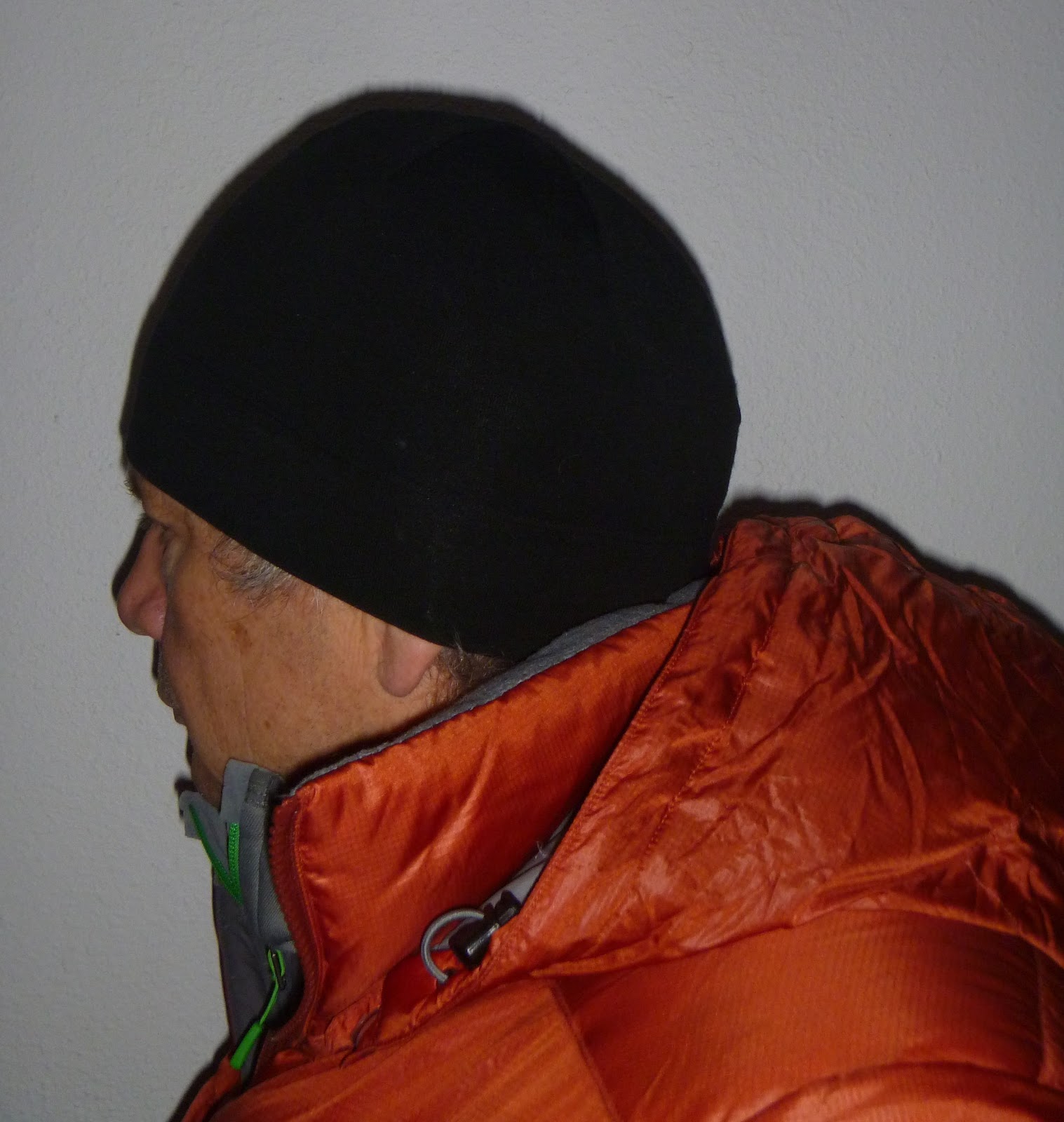
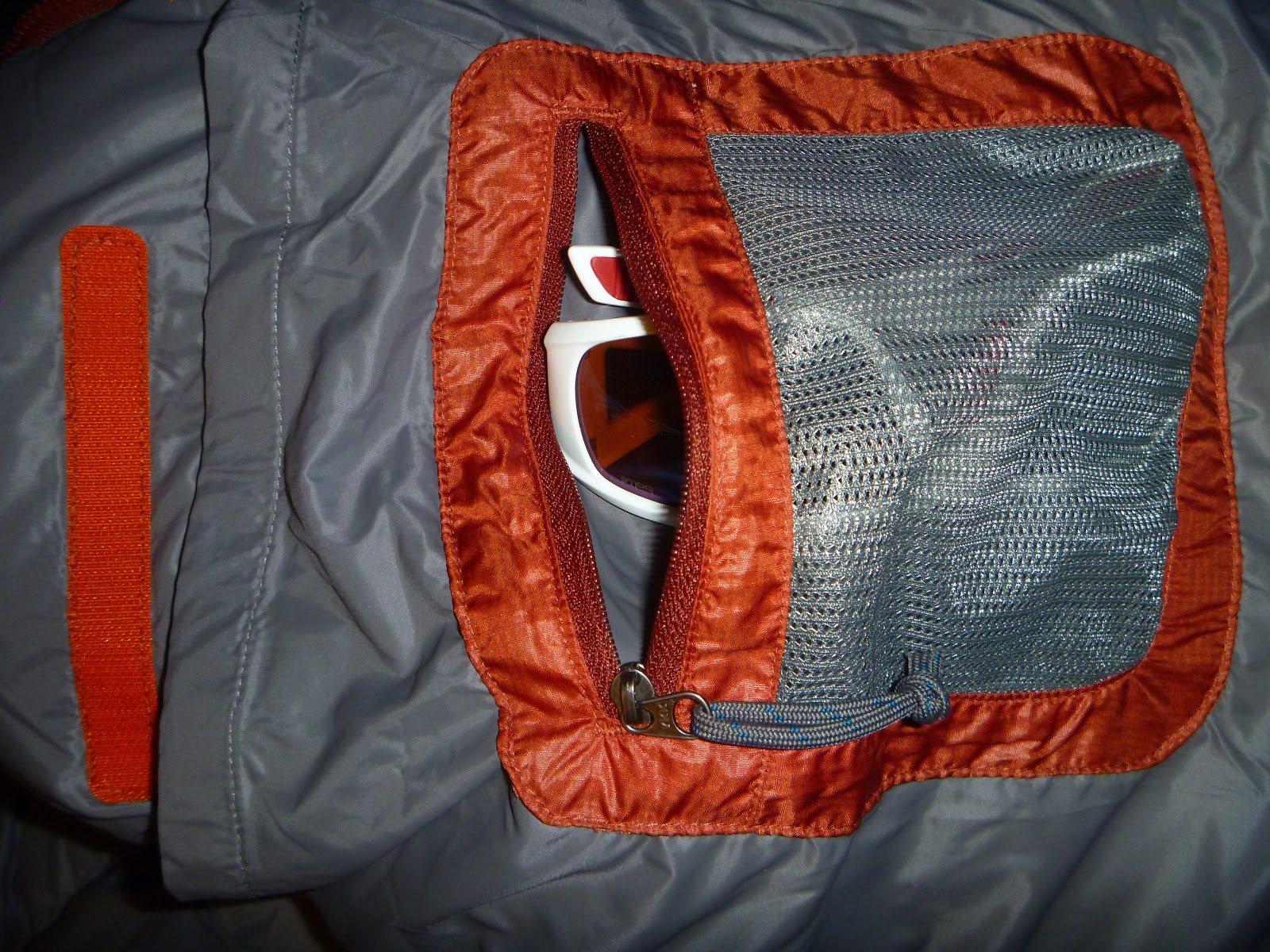
The best pocket combo I have seen in a jacket of this style. Big gloves or 2 liters per side, easy, plus a sun glass pocket. Hand warmer pockets with a micro fleece as well on the outside.
Fair size sun glass pocket and the detailing of a Velcro closure on the big pockets.
The Permafrost has Velcro and elastic wrist closures which work
extremely well.
The neck and collar are both lined with a super fast drying, soft micro fleece material.
The entire shell has a DWR coating and is made of Gore's Windstopper fabric. Winstopper laminated fabrics have proven to "offer total wind proofness and maximum breathability".

 Posts
Posts


.jpg)